



For years, extended enterprise learning has been built around content. More courses. More videos. More certifications. If partners completed onboarding and customers passed the final quiz, the program was considered successful.
But in today’s competitive environment, completion is not the same as capability.
Channel partners must demonstrate product mastery before they can sell with credibility. Customers need to apply what they’ve learned to achieve measurable results. Franchisees must execute brand standards consistently across locations. In every case, what matters is not how much content someone consumed—it’s what they can actually do.
This is why skills-based learning is becoming the defining strategy for partner and customer education programs. Outcomes now matter more than content. Source: Talented Learning; Source: CYPHER Learning
The limits of content-centric training
Traditional external training models measure exposure:
- Course completions.
- Assessment scores.
- Certificates issued.
These metrics tell you whether someone finished training. They do not tell you whether someone can perform.
For external audiences, that gap creates risk. A partner may complete onboarding yet struggle to position your product. A customer may pass a quiz but fail to implement best practices. A reseller may hold certification but still escalate preventable support issues.
When external training impacts revenue, retention, and brand perception, surface-level metrics are not enough. Organizations need evidence of skill mastery, not just course participation.
Why skills-based learning changes the equation
Skills-based learning begins with a simple but powerful shift: define the skills required for success, then design training to build and measure them. Instead of organizing programs around content modules alone, organizations map every element of learning to specific skills. Each module, section, and assessment contributes to measurable competency development. Source: Skillable; Source: CYPHER Learning
A modern skills-based external training strategy includes:
- Clearly defined skills tied to real-world performance outcomes.
- Structured mapping of content and assessments to those skills.
- Mastery thresholds that define what “proficient” actually means.
This approach ensures that partner onboarding, customer academies, and certification programs are aligned with tangible business impact.
For example, rather than simply delivering a “Product Fundamentals” course, a company might define required skills such as solution positioning, implementation configuration, compliance execution, or troubleshooting. Training is then designed—and evaluated—around those capabilities.
Content becomes a vehicle. Skills become the destination.
Skills mapping as the foundation of partner and customer enablement
Effective skills-based learning starts with deliberate skills mapping.
Skills mapping connects:
- Courses to competencies.
- Modules to specific skill outcomes.
- Assessment questions to measurable proficiency.
This creates structural alignment between what is taught and what must be mastered.
For partner programs, skills mapping ensures that sales partners develop positioning expertise, technical partners build configuration competence, and service partners meet delivery standards. For customer academies, it ensures users can execute workflows, adopt advanced features, and comply with required processes. Source: CYPHER Learning
When skills serve as structural anchors, training flows logically from foundational to advanced mastery. It also eliminates redundancy, closes content gaps, and reveals areas where additional development is needed.
Most importantly, it allows organizations to answer a critical question: are our external audiences truly ready to perform?
Mastery tracking makes outcomes measurable
Mapping skills is only the beginning. The real power of skills-based learning emerges when organizations track mastery at the individual level.
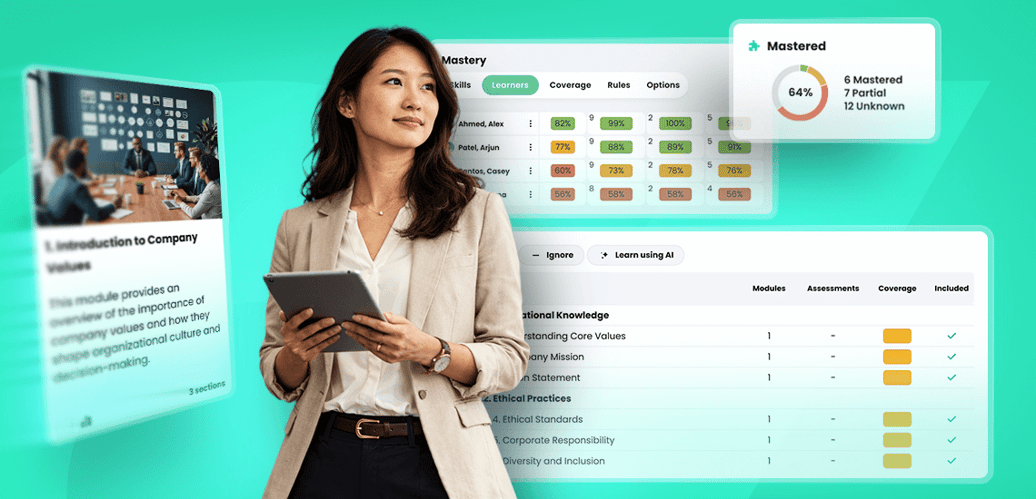
Mastery tracking moves beyond aggregate completion reports. It evaluates proficiency across each defined skill and displays progress in real time.
Instead of simply seeing that 500 partners completed a certification, organizations can see:
- Which specific skills each partner has mastered.
- Where proficiency falls below required thresholds.
- How mastery evolves over time.
This level of visibility transforms partner and customer training from a static event into an ongoing performance system.
For example, if a customer consistently scores lower on configuration-related skills, targeted remediation can be triggered. If a partner demonstrates advanced mastery across all competencies, they may qualify for higher-tier certifications or incentives. Source: The Learning OS
Mastery tracking shifts training from passive consumption to active capability development.
Competency dashboards bring clarity and accountability
Competency dashboards translate complex learning data into actionable insight. For administrators and partner program leaders, dashboards provide:
- Visual grids of learners versus required skills.
- Color-coded indicators of mastery levels.
- Drill-down views into assessments and performance evidence.
This visibility is essential in extended enterprise environments where accountability matters.
Channel leaders can identify underperforming regions. Customer success teams can spot adoption risks before churn occurs. Franchise operations can verify brand-standard compliance. Executives can connect training investment to measurable capability.
Instead of asking whether training was delivered, leadership can evaluate whether the right skills are being built across the ecosystem. Competency dashboards turn learning into a strategic lever rather than a reporting exercise. Source: CYPHER Learning
From certification to capability
Many organizations treat certification as the final milestone. In a skills-based model, certification becomes evidence of validated competence.
Rather than issuing credentials based solely on course completion, certifications are awarded when defined mastery thresholds are met across required skills. This ensures that credentials reflect real-world readiness.
This shift strengthens partner credibility, increases customer trust, and protects brand reputation. It also enhances motivation. Learners understand that advancement is tied to demonstrated ability, not just attendance.
When credentials are grounded in measurable skills, they become meaningful.
The strategic advantage of skills-based external training
Organizations that adopt skills-based learning for partners and customers gain three distinct advantages:
- Greater performance consistency across distributed audiences.
- Earlier identification of capability gaps and risk areas.
- Clear alignment between training investment and business outcomes.
In competitive markets, this advantage compounds over time. Well-enabled partners sell more effectively. Skilled customers adopt more deeply and renew at higher rates. Certified franchisees operate more consistently. Content alone cannot deliver these outcomes. Structured, measurable skill development can.
Why the future of external learning is outcomes-driven
Extended enterprise training is no longer a support function. It is a revenue enabler, a brand safeguard, and a customer success accelerator.
To fulfill that role, it must move beyond content delivery and embrace measurable capability.
Skills mapping ensures training aligns with real-world expectations. Mastery tracking verifies proficiency. Competency dashboards provide visibility and governance. Together, they create a system where learning drives performance. Source: CYPHER Learning
In this model, content remains important — but it is no longer the goal. Outcomes are.
Ready to move from content to capability?
If you’re building partner academies, customer education programs, or franchise training initiatives, it’s time to focus on measurable outcomes.
CYPHER Learning enables skills-based external training at scale with AI-powered skills mapping, real-time mastery tracking, and visual competency dashboards built directly into the platform. Align every course to real-world competencies, automate mastery validation, and gain full visibility into partner and customer readiness.
Discover how CYPHER Learning can help you turn external training into measurable performance.
References
- Source: Talented Learning - https://talentedlearning.com/how-customer-and-partner-education-fuels-business-growth/
- Source: CYPHER Learning - https://www.cypherlearning.com/solutions/customer-training
- Source: Skillable - https://www.skillable.com/resources/hands-on-learning/creating-effective-customer-education-and-partner-enablement-through-hands-on-learning/
- Source: CYPHER Learning - https://www.cypherlearning.com/blog/business/enterprise-wide-training-a-strategic-approach-to-workforce-development
- Source: CYPHER Learning - https://www.cypherlearning.com/tour/skills-development
- Source: The Learning OS - https://www.thelearningos.com/enterprise-knowledge/using-a-competency-and-skill-lms-to-assess-and-track-employee-growth
- Source: CYPHER Learning - https://www.cypherlearning.com/blog/business/which-lms-offers-a-customizable-learner-dashboard-and-progress-tracking
- Source: CYPHER Learning - https://www.cypherlearning.com/tour/competency-based-learning


