




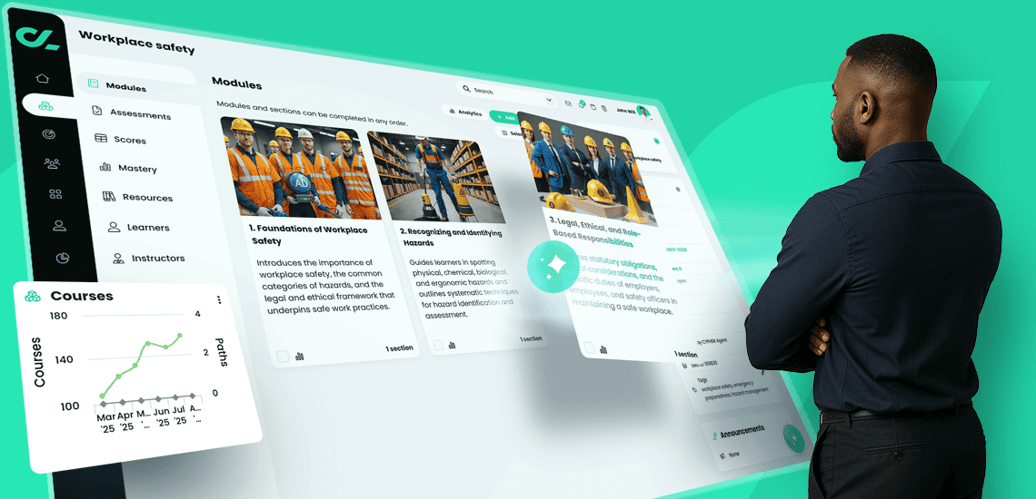
AI-driven course design transforms how educators and organizations develop and deliver learning experiences. It significantly reduces the time required for course creation while improving learner engagement and outcomes (CYPHER Learning, Enterprise-Wide Training, 2025).
How AI saves time in course design
Time is a major investment in course development, including planning, creating materials, and assessing learners. AI-powered platforms automate routine tasks, enabling faster production and personalized content adaptation.
- Automated course creation: Generative AI creates course outlines, lesson materials, and quizzes from simple prompts, cutting hours of manual work (eLearning Industry, AI Learning Platform, 2025).
- Rapid content updates: AI swiftly converts existing documents, such as policies and manuals, into interactive modules, accelerating course rollout (eLearning Industry, AI Learning Platform, 2025).
- Assessment efficiency: AI generates questions, grading rubrics, and personalized feedback, reducing grading time and enabling instructors to focus on mentorship (FeedbackFruits, AI Opportunities, 2025).
In business operations, AI-driven automation of routine tasks—such as data processing, customer support, and report generation—enables teams to redirect their efforts toward strategic initiatives, thereby enhancing productivity and fostering innovation (Makinsey, Superangency in the workplace, 2025).
Boosting engagement through AI-powered learning
Beyond time savings, AI enhances learner engagement through personalization and interactive course design.
- Personalized learning paths: AI maps content to address individual skill gaps and goals, tailoring courses for relevance and adaptability (CYPHER Learning, Enterprise-Wide Training, 2025).
- Interactive modular design: Breaking content into focused modules with interactive elements increases completion rates, often reaching 70-85%, outperforming traditional lecture formats (FeedbackFruits, Modular Learning, 2025).
- Gamification and social interaction: Platforms like CYPHER Learning utilize achievements and leaderboards to create competition and community, boosting motivation and retention (CYPHER Learning, Enterprise-Wide Training, 2025).
AI-driven active learning includes automated prompts and social annotation tools, which foster deeper discussions and reflections far quicker than traditional methods (FeedbackFruits, AI and Active Learning, 2025).
Real-time feedback and analytics
Instant feedback and analytics keep learners on track. AI tools provide immediate progress analysis, highlight weaknesses, and suggest resources tailored to learner needs.
- These insights help learners adjust their pace and focus.
- Instructors gain actionable data to refine course content and interventions (eLearning Industry, AI Learning Platform, 2025).
- The CYPHER platform’s reporting dashboard tracks engagement, progress, and satisfaction at individual and team levels, supporting continuous improvement (CYPHER Learning, What Is an LMS, 2025).
Seamless integrations and enterprise efficiency
Modern AI-driven platforms centralize course management and integrate with business tools. CYPHER Learning connects with Microsoft Teams, Zoom, and Google Drive, embedding training into daily workflows (CYPHER Learning Blog, 13 Best LMS Corporate Training Options, 2025).
This integration reduces logistical complexity, lowers costs compared to in-person training, supports remote learners, and cultivates a culture of continuous skill development (CYPHER Learning, What Is an LMS, 2025).
Best practices for maximizing AI-driven course success
To fully leverage AI in course design, organizations should:
- Align content with learner skill gaps and business objectives.
- Use microlearning and modular content structures to maintain engagement.
- Secure leadership support to encourage program adoption.
- Continuously refine programs based on data-driven insights (CYPHER Learning, Enterprise-Wide Training, 2025).
Applying these strategies with platforms like CYPHER Learning enables organizations to create efficient, engaging, and evolving learning experiences that empower both employees and educators.
References
- (CYPHER Learning, Enterprise-wide training: A strategic approach to workforce development, 2025) - https://www.cypherlearning.com/blog/business/enterprise-wide-training-a-strategic-approach-to-workforce-development
- (CYPHER Learning, What is an LMS? Learning Management Systems (explained), 2025) - https://www.cypherlearning.com/what-is-an-lms
- (CYPHER Learning Blog, 13 best LMS corporate training options to boost efficiency and engagement, 2025) - https://www.cypherlearning.com/blog/business/13-best-lms-corporate-training-options-to-boost-efficiency-and-engagement
- (FeedbackFruits, Modular learning engagement future-ready skills, 2025) - https://feedbackfruits.com/blog/modular-learning-engagement-future-ready-skills
- (FeedbackFruits, Opportunities and challenges of AI in higher education, 2025) - https://feedbackfruits.com/blog/opportunities-and-challenges-of-ai-in-higher-education
- (eLearning Industry, How An AI Learning Platform Drives Training Success, 2025) - https://elearningindustry.com/how-an-ai-learning-platform-drives-training-success
- (FeedbackFruits, AI and active learning, 2025) - https://feedbackfruits.com/blog/ai-and-active-learning
- (Makinsey, Superangency in the workplace, 2025) - https://www.mckinsey.com/capabilities/mckinsey-digital/our-insights/superagency-in-the-workplace-empowering-people-to-unlock-ais-full-potential-at-work?utm_source=chatgpt.com


