




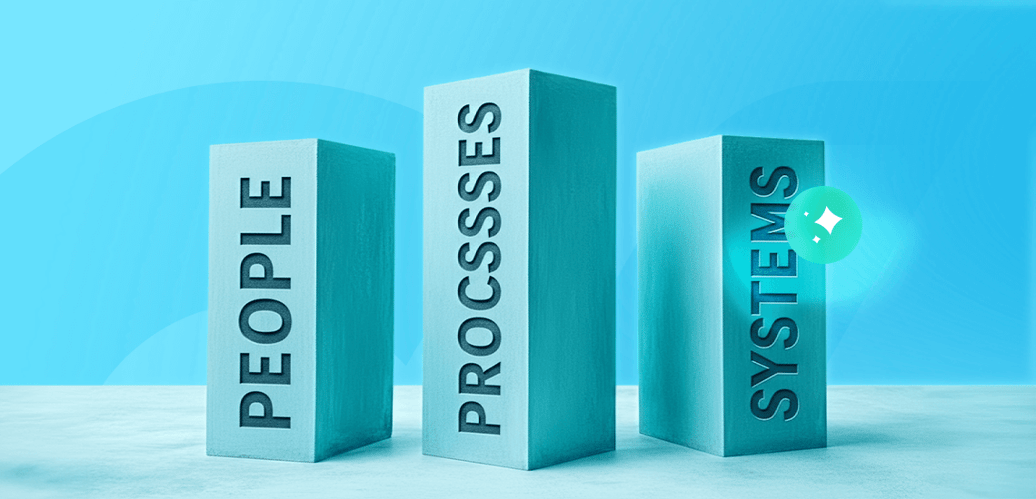
Moving beyond initial experiments, the long-term success of Artificial Intelligence(AI) in Learning & Development (L&D) rests on a solid, three-pronged strategy: People, Processes, and Systems. By aligning these three pillars, L&D can transform AI from a collection of projects into a true driver of business value.
Pillar 1: Refining your processes
Process refinement is essential for clear decision-making and impact, especially since up to half of all AI tools fail to deliver the desired outcomes. This pillar requires establishing clear guardrails and strategic alignment:
- Set L&D governance: Create an AI governance model specific to L&D, defining who is accountable and how decisions are made.
- Establish key topics for governance: Focus on Principles (Fairness, Transparency, Privacy), Oversight (cross-functional committee review, auditing), and Alignment (strategic fit with organizational priorities and defined KPIs).
- Strategic Planning: Assess risks, list use cases (ranking them by usefulness and value), and unify a long-term strategy that aligns with your goals and business-focused KPIs.
Pillar 2: Preparing your people
People and their readiness for change are the biggest drivers of success, particularly since 54% of people remain wary of AI. Building trust and competence is paramount:
- Educate your team: Demystify AI by clarifying what it can and can't do. Provide training on the different kinds of AI and discuss which uses genuinely add value versus those that are just "flash."
- Set policies: Identify safeguards and align your organization’s policies for acceptable use of AI with your specific L&D goals.
- Manage change: Roll out new AI features with transparent, proactive communications. Articulate the clear benefit of new features to both users and the larger organization.
Pillar 3: Choosing the right technologies
The explosion of AI in HR tech has made decision-making complex. When choosing a solution, L&D leaders must evaluate both value and risk, moving beyond surface-level capabilities:
- Integration: Ask how seamless the experience is, whether data leaves the system, and if the AI is a native part of the product's DNA or simply layered over the top. The level of integration drives how much the solution can truly accomplish.
- Capabilities: Demand a demonstration of real intelligence that goes beyond basic text generation. Ask what pieces are automated, what control users have for review, and how confident you can be in the outcomes.
- Vision: Assess the vendor's long-term vision. Does it align with your goals? Are they anticipating future changes in the market, and are they building the technology to keep pace?
Tying it all together: AI with impact
The final step is to ensure AI initiatives are not just busywork but are aligned with clear business drivers. This alignment guarantees that L&D is supporting core organizational goals:
- Productivity: Use AI to improve onboarding or process enablement.
- Retention & agility: Create new, necessary courses quickly and provide tools for career growth to keep top talent.
- Upskilling/reskilling: Keep skills lists current and offer learning that aligns to them.
AI is a tool that can transform learning goals (e.g., Improved onboarding, more responsive course delivery, skills-aligned learning) into reality through solutions like automated course creation, personalized learning agents, and skills mapping to course content. By establishing a robust strategy around the three pillars, L&D can effectively leverage AI to address business concerns and drive significant learning impact.


