




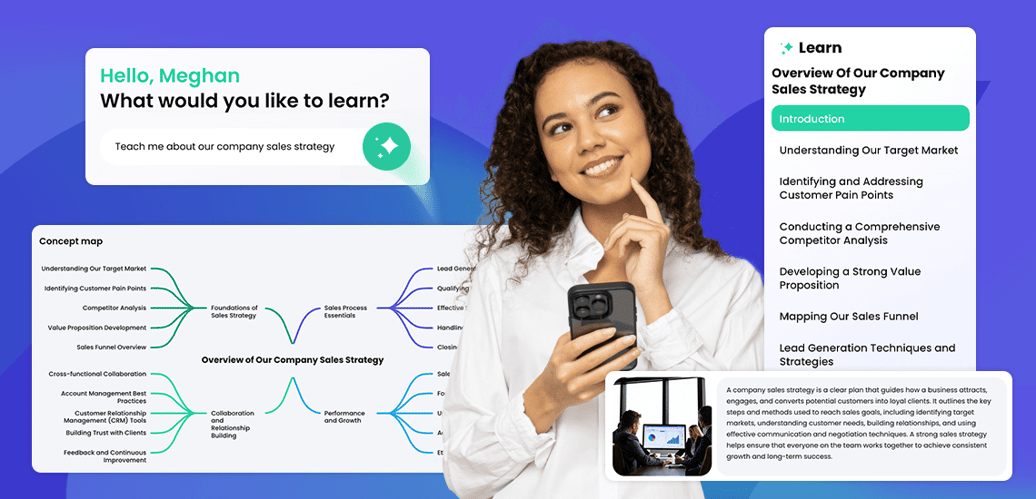
In 2025, Learning Management Systems (LMS) are evolving rapidly due to advances in Artificial Intelligence (AI) and autonomous learning agents. AI-powered LMS platforms, such as CYPHER Learning, transform traditional education into dynamic, personalized, and interactive experiences. This shift marks a transition from static content delivery to learner-focused ecosystems that adapt and respond to individual needs (CYPHER Learning, 2025).
CYPHER Learning: a pioneer in AI-powered LMS platforms
CYPHER Learning leads the market by integrating a multi-faceted AI agent that enhances the LMS experience through automation, personalization, and gamification. Its AI assistant, CYPHER Agent, exemplifies how LMS platforms can become intelligent partners in training for everyone and every role. Key features include:
- Automated content creation: Instructors rapidly generate courses and assessments through an AI tool, either all at once, or step-by-step. The AI tailors materials based on subject complexity and learner profiles, accelerating course development and reducing bottlenecks.
- Multilingual course generation: CYPHER Learning supports course creation in over 50 languages, enabling consistent training for international teams while minimizing localization expenses.
- Personalization and skill gap analysis: The platform detects knowledge gaps among learners and dynamically adjusts learning pathways. Instructors receive actionable insights from the analytics dashboard to optimize learning outcomes.
- Gamification features: AI-driven quizzes and interactive activities provide real-time feedback and incentives that boost learner engagement and retention.
Together, these capabilities reposition LMS platforms as interactive, AI-driven learning hubs rather than simple content repositories (SaM Solutions, 2025).
Why traditional LMS are becoming obsolete
Conventional Learning Management Systems are increasingly inadequate due to their rigid structure, lack of personalization, and inability to fully integrate AI. In contrast, AI-powered LMS platforms offer:
- Continuous assessment: Real-time monitoring and adjustment of learning activities enhance personalization.
- Automated administrative tasks: Instructors are relieved from routine tasks, focusing instead on mentoring and facilitation.
- Seamless integration: AI agents integrate with multiple digital tools, breaking down silos associated with legacy LMS platforms and inserting AI touchpoints throughout the learning process.
This evolution fosters learning experiences aligned with daily workflows and supports microlearning delivered on demand.
AI-first learning ecosystems and innovations
Leading LMS providers like CYPHER Learning and Docebo are championing AI-first learning ecosystems, featuring:
- Generative AI for content and assessments: Instructors co-create customized materials that align with learner needs and organizational goals.
- Virtual coaching and simulation agents: AI enables practice in safe, simulated environments replicating real-world scenarios.
- AI-managed learning marketplaces: Agents streamline logistics, automate workflows, and manage course lifecycles at scale.
These innovations reflect a trend toward digital learning environments that mirror the flexibility and responsiveness of modern workplaces (CYPHER Learning, 2025).
Core features of AI-driven LMS platforms: comparative overview
|
Feature |
CYPHER Learning |
Docebo |
Others |
|
Learning automation |
AI-powered course generation and personalized learning |
Automated workflows and content recommendations |
Basic automation in content scheduling |
|
Skill-based recommendations |
Real-time skill gap analysis with adaptive pathways |
Personalized learning paths based on performance |
Manual progress tracking |
|
Content in 50+ languages with AI translation |
Multilingual support with AI enhancements |
Limited language options |
|
|
Gamified adaptive microlearning |
AI-powered quizzes with dynamic feedback and rewards |
Interactive modules with AI coaching |
Static quizzes and modules |
This comparison highlights the comprehensive AI capabilities embedded in modern LMS platforms that facilitate scalable, engaging, and inclusive learning.
The expanding role of AI agents in enterprises
By 2025, AI agents serve as autonomous collaborators across various industries:
- Financial sector: AI agents conduct market analysis, assess risks, and support decision-making processes traditionally managed by human experts.
- Complex workflow collaboration: Systems using agents coordinate logistics and resource management, complementing human labor.
- Enterprise investment trends: Spending on agentic technologies is forecasted to increase over 32% annually, moving fragmented tools toward integrated AI networks.
In Learning and Development, platforms like CYPHER Learning automate course creation, monitoring and task management with minimal human oversight, improving operational efficiency (CYPHER Learning, 2025a).
AI-driven disruption in HR and organizational structures
AI-powered automation is revolutionizing Human Resources by:
- Automating recruitment, onboarding, training, coaching, and performance management through specialized AI agents.
- Shifting HR professionals from transactional work to strategic roles centered on organizational development.
- Reducing dependence on large HR and L&D teams by automating compliance training and skills development.
This transition enhances efficiency, agility, and the strategic impact of HR functions (Bersin, 2025).
Technical advances fueling AI-driven learning
Recent AI breakthroughs underpinning these trends include:
- Large Language Models (LLMs): Models like GPT-5 and Google Gemini 2.5 provide expertise in complex domains such as law and medicine, enabling context-aware educational support.
- AI simulation capabilities: Agents simulate detailed interactive scenarios, offering learners real-time feedback and tailored assessments.
These technological improvements, integral to CYPHER Agent, make traditional LMS features increasingly obsolete.
Opportunities and challenges ahead
AI-driven LMS platforms offer significant advantages:
- Personalized learning: Adaptive progression and real-time support cater to individual learner needs.
- Global scalability: Automated content creation and multilingual capabilities enable broad reach.
- Organizational agility: Data insights facilitate strategic decision-making in learning programs.
However, challenges include ethical data handling, mitigating AI bias, and ensuring human oversight during critical learning interventions. Despite these concerns, LMS platforms lacking AI agents like CYPHER Agent may fall behind as the digital learning landscape advances (SaM Solutions, 2025).
Frequently asked questions
Q: What makes AI agents crucial in modern LMS platforms?
A: AI agents provide real-time personalization, automate routine tasks, and integrate with existing systems, creating adaptive learning environments that improve engagement and outcomes (LinkedIn, 2025).
Q: How does AI personalize learning experiences?
A: By continuously analyzing learner performance and skill gaps, AI dynamically adjusts content difficulty and learning paths, offering targeted support and recommendations (SaM Solutions, 2025).
Q: What challenges does AI introduce in digital education?
A: AI raises concerns about ethical data usage, potential biases in algorithms, and the need for maintaining human oversight to ensure learning quality and fairness (Bersin, 2025).
Sources and references
- (SaM Solutions, 2025) - https://sam-solutions.com/blog/ai-powered-learning-experience-platforms/
- (Bersin, 2025) - https://joshbersin.com/2025/04/is-the-hr-profession-as-we-know-it-doomed-in-a-strange-way-yes/
- (CYPHER Learning, 2025) - https://www.cypherlearning.com/ai-360/cypher-agent-for-learners
- (CYPHER Learning, 2025a) - https://www.cypherlearning.com/blog/business/lms-features-comparison-why-cypher-learning-sets-the-standard
- (LinkedIn, 2025) - https://www.linkedin.com/posts/cypher-learning_cypheragent-aiinlearning-productsneakpeek-activity-7369795223473930242-lBe9


