




The hidden fragility of extended enterprise learning
Many organizations believe they have an extended enterprise learning strategy because they’ve enabled external users in their LMS. Customers can log in. Partners can enroll. Franchisees can complete courses.
But as programs grow, cracks appear. Administrators struggle to manage thousands of external users. Partners see the wrong content. Reporting becomes unreliable. Brand and compliance risks increase. What worked for the first hundred learners often collapses when the audience reaches ten thousand.
This isn’t an execution problem—it’s an architectural one. Effective extended enterprise learning requires systems designed to scale, govern, and deliver the right content to the right audiences without overwhelming administrators or compromising performance.
The root cause: employee-first platforms repurposed for external use
Most LMS platforms were designed for a single audience: employees. extended enterprise use cases were added later as overlays—extra roles, portals, or permissions bolted onto systems originally intended for an internal workforce.
That retrofit approach fails at scale because external learning requires fundamentally different assumptions, including:
- No shared manager hierarchy linking learners to a central HRIS.
- No centralized user lifecycle or identity management for external partners.
- No uniform learning goals across different external audiences.
- No tolerance for internal system complexity when serving diverse external user groups.
External learners such as partners, customers, and franchisees have distinct access, reporting, and privacy requirements that traditional employee‑focused systems simply aren’t built to handle.
When these realities collide with employee-centric systems, organizations experience operational drag and governance chaos, and administrative headaches instead of streamlined growth and visibility.
Common failure patterns in extended enterprise LMSs
1. Centralized control becomes a bottleneck
As external programs scale, relying on a small group of global administrators to manage all enrollments, content assignments, and reporting quickly becomes a bottleneck. What works for a few hundred learners breaks down when programs reach thousands or tens of thousands, slowing launches, creating administrative backlogs, and frustrating regional teams. Partners may receive delayed or irrelevant content, while administrators are overwhelmed trying to maintain control and ensure consistency. This centralized approach not only slows execution but also undermines engagement, reduces learner satisfaction, and limits the effectiveness of extended enterprise learning initiatives. Source: Talented Learning
2. Decentralization creates brand and compliance risk
In an attempt to solve bottlenecks, organizations often delegate administrative rights across multiple regional or local teams—but this decentralization can introduce significant brand and compliance risks. When admin privileges are too broadly distributed, external learners may encounter inconsistent experiences, unauthorized content changes, and fragmented or inaccurate reporting. These gaps not only undermine the learner experience but can also expose the organization to regulatory or contractual risk, particularly when partners, franchisees, or customers are representing the brand externally. Source: LMS Portals
3. Visibility disappears
As extended enterprise programs scale, visibility into learner progress and performance often disappears. Executives may ask seemingly simple questions—Which partners are certified? Which regions are at risk?—but the data is incomplete, inconsistent, or untrusted. Traditional LMS reporting, designed for internal employees, often cannot provide reliable insights across multiple audiences, portals, and geographies, leaving organizations unable to make informed decisions, identify skill gaps, or mitigate compliance risks. Source: Talented Learning
4. Automation doesn’t scale
Manual processes for enrollment, reminders, and certification renewals may work for small groups, but in large-scale extended enterprise programs, automation becomes critical—or programs collapse under their own weight. Relying on manual workflows creates bottlenecks, increases administrative errors, delays learner progress, and risks missed deadlines for compliance or certification requirements. Without automated systems to handle multi-organization enrollment, role-based content delivery, and recurring notifications, organizations struggle to scale efficiently while maintaining consistency and accountability. Source: LMS Portals
What scalable extended enterprise architecture requires
Successful extended enterprise platforms are built around governed decentralization, combining central standards with local autonomy. This approach ensures that organizations can maintain brand consistency, compliance, and data integrity across all external audiences, while empowering regional teams, partners, or franchisees to manage learners, assign content, and respond to local needs efficiently. By balancing control with flexibility, scalable architectures reduce administrative bottlenecks, improve learner engagement, and provide reliable insights into skill mastery and performance across large, distributed audiences. Source: LMS Portals
Key architectural requirements include:
Multi-organization structure
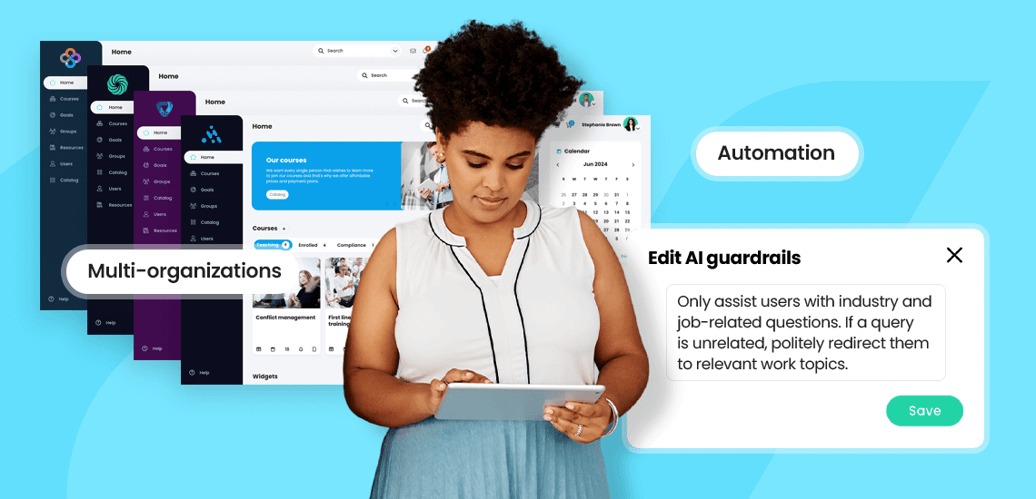
A scalable extended enterprise architecture requires a multi-organization structure that cleanly segments external audiences by customer, partner, franchise, or region. Each segment should have its own catalog, branding, and administrators, ensuring that content is relevant, experiences are consistent, and local teams have the autonomy to manage learners effectively. Without this level of segmentation, organizations risk confusion, misaligned content, and administrative bottlenecks as programs scale across diverse geographies and business units. Source: LMS Portals
Delegated administration with guardrails
Local admins should manage their learners and content within centrally defined policy boundaries, rather than reinventing processes or workflows. This ensures regional teams or partners can operate efficiently while maintaining brand consistency, compliance, and accurate reporting. By combining autonomy with controlled guardrails, organizations can scale extended enterprise learning without introducing errors, inconsistent experiences, or administrative bottlenecks. Source: LMS Portals; Source: Webanywhere
Policy-driven automation
To scale extended enterprise learning effectively, processes such as enrollment, certification, expiration, and learner communications must be automated consistently across all audiences. Policy-driven automation ensures that learners receive the right content at the right time, recurring certifications are issued without manual intervention, and notifications are sent reliably, reducing administrative overhead and human error. By codifying workflows into automated, policy-backed systems, organizations maintain consistency, compliance, and efficiency even as programs grow across partners, customers, and regions. Source: LMS Portals
Cross-organization visibility
Executives and central teams require roll-up reporting that provides a clear view of learner progress, skill mastery, and program performance across all partner, customer, and franchise segments—without compromising the independence of local organizations. Effective extended enterprise platforms deliver centralized insights while preserving decentralized operations, enabling leaders to identify skill gaps, mitigate compliance risks, and make data-driven decisions at scale. This balance ensures transparency and accountability across diverse audiences without creating bottlenecks or forcing uniformity where flexibility is needed. Source: LMS Portals; Source: Webanywhere
Why “features” don’t solve scale
Many LMSs try to address scaling challenges by adding more features—extra roles, additional permissions, or more dashboards—but complexity compounds rather than resolves the problem. True scalability comes from system logic, automation, governance, and multi-tenancy built into the platform’s core architecture, rather than from ad hoc configuration. Platforms designed this way can grow to support thousands of external learners across multiple organizations and regions without increasing administrative headcount, introducing risk, or sacrificing consistency. Source: LMS Portals
What buyers should evaluate instead
When assessing extended enterprise platforms, buyers should focus on architectural capabilities rather than surface-level features. The goal is to ensure the system can scale efficiently while maintaining brand, compliance, and performance standards. Key evaluation questions include:
- Can this system support multiple external audiences without duplication?
External learners—partners, customers, and franchisees—should each have segmented access, unique catalogs, and tailored experiences without requiring separate platforms or redundant content. - Can local admins operate independently without compromising standards?
Delegated administration with guardrails ensures regional teams can manage learners and content while adhering to central policies, maintaining consistency and compliance. - Can automation replace manual effort end to end?
Processes such as enrollment, certification, renewals, and communications must be automated across all audiences to prevent administrative bottlenecks and errors. - Can leadership see readiness, risk, and performance clearly?
Roll-up reporting across organizations must provide reliable insights into skill mastery, compliance, and engagement without flattening local autonomy.
If achieving these outcomes requires manual workarounds, duplicated content, or complex configuration hacks, the platform is unlikely to scale effectively. True extended enterprise success comes from automation, governance, and multi-tenancy built into the system architecture, not feature sprawl.
Source: LMS Portals; Source: Webanywhere
The future of extended enterprise platforms
As ecosystems grow and learning becomes a revenue and risk function, extended enterprise platforms must operate more like distributed, scalable systems than traditional internal tools. Platforms built for scale from day one can support multiple audiences, automate workflows, and provide centralized visibility while preserving local autonomy—enabling organizations to grow without constant firefighting. The CYPHER Learning solution is designed around these principles, offering multi-organization architecture, delegated administration, and policy-driven automation, ensuring that partners, customers, and franchisees can be enabled efficiently, reliably, and at scale. The platforms that embrace this architecture will thrive; the rest will struggle to keep pace. Source: LatitudeLearning; Source: CYPHER Learning.
Want to learn more about extended enterprise training?
Discover how the CYPHER Learning platform helps organizations enable external audiences at scale with AI-driven skills mapping, competency-based assessments, and mastery tracking.
References
- Source: LMS Portals - https://www.lmsportals.com/post/extended-enterprise-training-strategies-for-diverse-audiences
- Source: Talented Learning - https://talentedlearning.com/how-do-you-find-an-lms-for-extended-enterprise-learning/
- Source: LMS Portals - https://www.lmsportals.com/post/building-the-foundation-key-lms-architecture-features-for-extended-enterprise-training
- Source: Webanywhere - https://www.webanywhere.com/extended-enterprise-lms-training/
- Source: LatitudeLearning - https://www.latitudelearning.com/insights/extended-enterprise-ecosystem/
- Source: CYPHER Learning - https://www.cypherlearning.com/blog/business/why-cypher-learning-excels-in-supporting-global-growth


