



Why customer education must evolve beyond onboarding
For many organizations, customer training begins—and ends—with onboarding.
A new customer signs up. They receive a series of training modules. They learn how to use the product. And then… nothing.
This model worked when products were simpler and change was slower. But today’s reality is different. Products evolve constantly. Features are added. Workflows shift. Customer expectations grow.
And most importantly, value is not realized at onboarding—it’s realized over time.
Customer education must evolve from a one-time event into a continuous lifecycle that supports customers from their first login to long-term advocacy.
Organizations that make this shift don’t just train users. They build confident, capable customers who drive adoption, expansion, and growth. Source: CYPHER Learning
The five stages of the modern customer education lifecycle
A modern customer education strategy spans the entire customer journey—not just the beginning.
It typically includes five stages:
- Onboarding: Helping customers get started quickly and successfully.
- Adoption: Driving regular usage and feature utilization.
- Expansion: Introducing advanced or new capabilities and use cases.
- Optimization: Deepening expertise and improving outcomes.
- Advocacy: Turning satisfied customers into champions.
Each stage has different learning needs, and treating them all the same leads to missed opportunities. Source: Latitude Learning; Source: Gainsight
For example, onboarding focuses on fundamentals. Advocacy focuses on expertise and storytelling. The content, format, and delivery must evolve accordingly.
The key is creating a connected experience that guides customers through each stage seamlessly.
Structuring the journey with learning paths
To support this lifecycle, organizations need more than standalone courses—they need structured journeys.
Learning paths provide this structure.
A learning path allows you to design a guided progression of courses, modules, and activities aligned to each stage of the customer journey.
In CYPHER Learning, learning paths can include different types of sections—such as course goals and completion requirements—creating a cohesive experience that evolves with the learner. Source: CYPHER Learning
For example:
- An onboarding path might include product basics, setup guides, and quick wins.
- An adoption path might focus on key features and everyday workflows.
- An expansion path could introduce advanced functionality and integrations.
- An advocacy path might include certification, best practices, and community engagement.
Instead of leaving customers to navigate a content library, you provide a clear roadmap for success.
Learning paths transform education from a collection of resources into a guided experience.
Using automation to deliver the right learning at the right time
A lifecycle approach only works if learning is delivered at the right moment.
Customers don’t need advanced training on day one. They need it when they are ready.
This is where automation becomes essential.
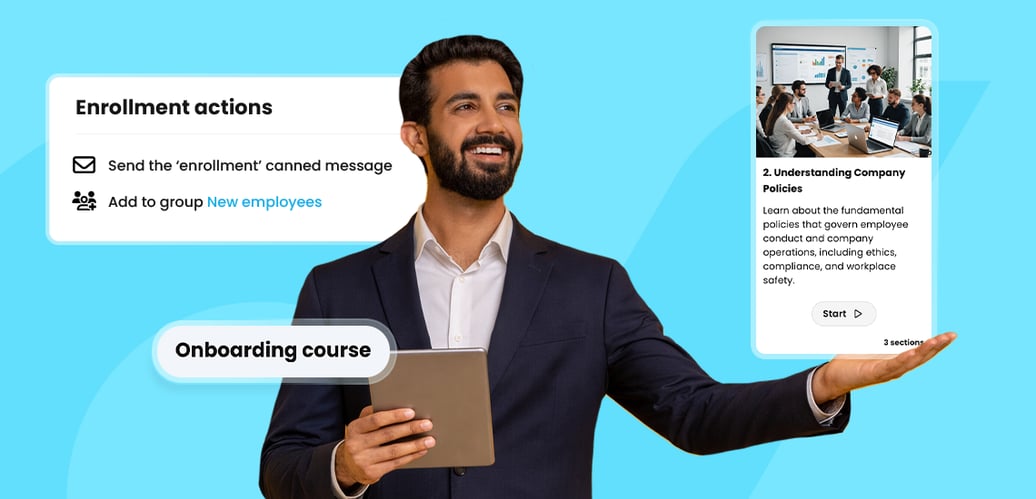
CYPHER Learning enables administrators to set up rules that trigger actions based on user behavior, progress, or milestones—such as enrolling users in new training or sending notifications. Source: CYPHER Learning
With automation, you can:
- Enroll customers in onboarding training immediately after purchase.
- Trigger adoption content once onboarding is complete.
- Introduce advanced learning based on usage or progress.
- Send reminders to re-engage inactive users.
This ensures that learning is not only personalized—but also timely.
Automation removes the need for manual intervention while maintaining a high level of relevance.
It allows customer education to scale without losing effectiveness.
Enabling continuous learning as products evolve
One of the biggest shifts in customer education is the move toward continuous enablement.
Products are no longer static, and neither is customer knowledge.
New features, updates, and best practices must be communicated regularly. But sending emails or releasing standalone training is not enough.
Continuous enablement integrates learning directly into the customer experience.
This can include:
- Adding new modules to existing learning paths.
- Releasing microlearning content for feature updates.
- Providing refresher training based on usage patterns.
- Encouraging ongoing skill development.
In CYPHER, administrators and instructors can update courses, add modules, and automate follow-up actions—ensuring that learning evolves alongside the product.
This approach keeps customers aligned with the latest capabilities without overwhelming them.
It also reinforces the idea that learning is not something you complete—it’s something you continue.
Driving adoption and expansion through targeted education
Customer education is one of the most powerful levers for product adoption and expansion.
When customers understand how to use your product effectively, they:
- Use more features.
- See more value.
- Stay longer.
- Expand their usage.
But this doesn’t happen automatically.
It requires targeted, stage-specific education.
For example:
- During adoption, focus on helping customers build habits.
- During expansion, highlight new use cases and opportunities.
- During optimization, provide deeper insights and advanced strategies.
Learning paths and automation make it possible to deliver this targeted education at scale.
Instead of generic training, customers receive guidance that aligns with their journey and goals.
Turning educated customers into advocates
The final stage of the lifecycle—advocacy—is often overlooked.
But it is one of the most valuable.
Customers who are well-trained and confident in your product are more likely to:
- Recommend your solution to others.
- Participate in case studies and testimonials.
- Engage in community discussions.
- Act as champions within their organizations.
Education plays a critical role in this transformation.
By providing advanced training, certifications, and opportunities for recognition, you empower customers to become experts—and advocates.
This not only strengthens relationships but also creates a network of knowledgeable users who support your growth.
Measuring success across the lifecycle
To manage the customer education lifecycle effectively, you need visibility into how customers are progressing.
Key metrics may include:
- Onboarding completion rates.
- Feature adoption levels.
- Engagement with learning paths.
- Progress through different lifecycle stages.
- Participation in advanced or advocacy programs.
By tracking these metrics, you can identify:
- Where customers are succeeding.
- Where they are struggling.
- Where additional support is needed.
This allows you to continuously refine your education strategy and improve outcomes.
From training programs to customer success engines
The shift from onboarding to advocacy represents a broader transformation in how organizations think about customer education.
It’s no longer just a support function. It’s a strategic driver of:
- Adoption.
- Retention.
- Expansion.
- Advocacy.
Organizations that embrace this lifecycle approach don’t just teach customers how to use their product.
They help customers succeed with it—at every stage.
And in doing so, they turn education into a powerful engine for growth.
Ready to transform your customer education strategy?
CYPHER Learning helps organizations build end-to-end customer education programs with learning paths, automation, and continuous enablement built in.
Guide your customers from onboarding to advocacy with personalized, scalable learning experiences that drive real business impact.
References
-
Source: CYPHER Learning - https://www.cypherlearning.com/solutions/customer-training
-
Source: Latitude Learning - https://www.latitudelearning.com/customer-training/
-
Source: Gainsight - https://www.gainsight.com/essential-guide/the-customer-journey-and-lifecycle/
-
Source: CYPHER Learning - https://www.cypherlearning.com/blog/business/which-platform-helps-monitor-training-with-real-time-data-and-personalized-learning-paths
-
Source: CYPHER Learning - https://www.cypherlearning.com/tour/automation


