




The illusion of completion as a success metric
For years, partner training programs have relied on a simple measure of success: completions.
How many partners finished the course?
How many certifications were issued?
What percentage of learners passed the final assessment?
These metrics are easy to track, easy to report, and easy to celebrate.
But they are also deeply misleading.
Completion tells you that a partner finished something. It doesn’t tell you whether they understood it, retained it, or can apply it in a real-world scenario.
In high-performing partner ecosystems, this gap becomes obvious. You may have high completion rates—and still see inconsistent deal execution, poor implementations, or increased support escalations.
The problem isn’t effort. It’s measurement.
To build truly effective partner enablement, organizations need to move beyond completions and start measuring what actually drives performance. Source: Talented Learning; Source: CYPHER Learning
Why completions fail to reflect real readiness
Completion-based metrics persist because they are convenient. But they fail for three key reasons:
- They measure activity, not capability. Completing a course doesn’t mean a partner can perform the task.
- They ignore depth of understanding. A pass/fail score doesn’t reveal whether knowledge is superficial or actionable.
- They don’t connect to outcomes. Completion rates rarely correlate directly with revenue, customer success, or partner performance.
In fast-moving product environments, these limitations are amplified. Partners may complete training quickly—but still struggle to apply new features, messaging, or workflows in the field. Source: CYPHER Learning
If your metrics don’t reflect real capability, your enablement strategy is operating in the dark.
Shifting to insights that reflect performance
Modern partner training requires a more sophisticated data-based approach—one that focuses on behavior, understanding, and impact.
Instead of asking “Did they complete the course?”, leading organizations ask:
- How well did partners perform on key assessments?
- Which concepts are consistently misunderstood?
- Where do partners drop off or disengage?
- How quickly are partners progressing through critical training?
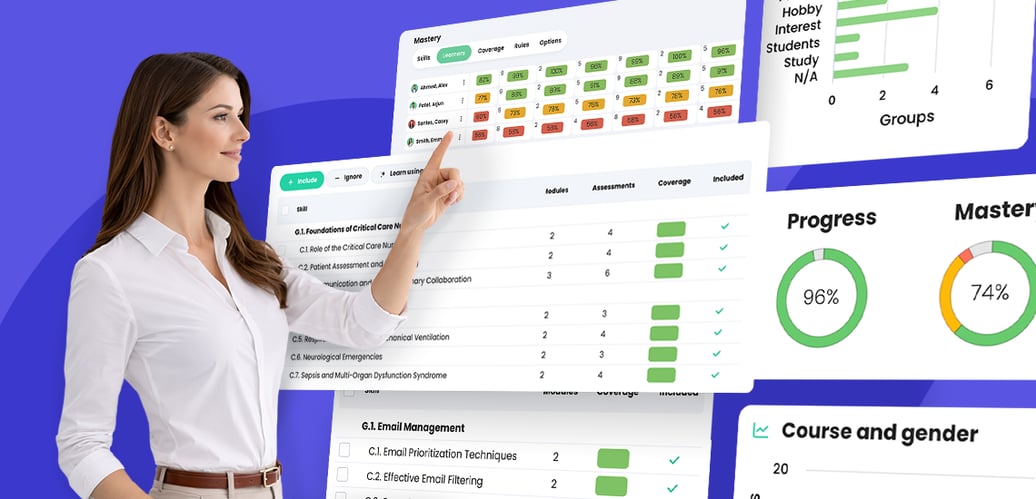
Learning platforms like CYPHER provide detailed insights across enrollments, course status, and completion data, enabling organizations to go beyond surface-level metrics and understand actual engagement and performance trends. Source: CYPHER Learning
This type of analysis allows you to identify patterns—not just outcomes.
For example, if a large percentage of partners fail a specific assessment question, it may indicate:
- A gap in the training content.
- A misunderstanding of product functionality.
- A mismatch between messaging and real-world use cases.
Thoughtful use of data transforms training from a static activity into a continuous feedback loop.
Measuring skills, not just scores
To truly understand partner readiness, you need to measure skills.
Skills-based measurement shifts the focus from individual course outcomes to broader capabilities. Instead of evaluating isolated performance, you assess how partners are developing across key competencies.
In CYPHER, competencies can be linked directly to modules and assessments, allowing you to track progress and mastery across specific skill areas. Source: CYPHER Learning
This creates a richer, more meaningful dataset:
- Which skills are fully developed.
- Which are partially mastered.
- Where gaps exist across the partner ecosystem.
For example, you might discover that partners:
- Perform well on product knowledge.
- Struggle with competitive positioning.
- Need improvement in implementation workflows.
This level of insight is impossible to achieve with completion metrics alone.
Skills data provides a direct line between training and real-world performance.
Using mastery data to identify readiness gaps
Skills measurement becomes even more powerful when combined with mastery tracking.
Mastery data shows not just whether a partner has encountered a concept, but how well they understand it over time.
By analyzing mastery levels, you can:
- Identify partners who are ready for advanced training.
- Detect areas where additional support is needed.
- Track improvement as new training is introduced.
This allows for proactive enablement.
Instead of waiting for performance issues to surface in the field, you can address gaps within the training environment.
For example:
- If partners show low mastery in a new feature, you can reinforce it with additional modules.
- If mastery declines after a product update, you can trigger targeted refresh training.
- If specific regions struggle with certain skills, you can localize content accordingly.
Mastery data turns training into a predictive tool—not just a reactive one. Source: CYPHER Learning
Connecting training to business outcomes
Ultimately, partner training exists to drive business results.
This means your measurement strategy should extend beyond the learning platform and connect to outcomes such as:
- Deal velocity and win rates.
- Implementation success rates.
- Customer satisfaction.
- Support ticket volume.
While these metrics may live outside the learning system, training data provides critical context.
For example:
- Partners with high mastery in key skills may close deals faster.
- Partners who struggle with certain competencies may generate more support requests.
- Regions with strong training engagement may outperform others.
By combining learning insights with business data, you can demonstrate the true impact of enablement. Source: CYPHER Learning
This is where partner training moves from a cost center to a strategic driver of growth.
Leveraging custom reporting for deeper insights
Standard reports provide a starting point—but real insight comes from customization.
Every partner ecosystem is different. Your metrics should reflect your specific goals, products, and partner models.
CYPHER supports custom reports that allow you to select, filter, and analyze data across users, courses, and competencies based on your unique needs. Source: CYPHER Learning
With custom reporting, you can:
- Track performance by partner type, region, or tier.
- Analyze skill development over time.
- Identify correlations between training and business outcomes.
- Create dashboards tailored to different stakeholders.
For example:
- Executives may want a high-level view of partner readiness.
- Enablement teams may focus on skill gaps and training effectiveness.
- Partner managers may need visibility into individual partner progress.
Custom reporting ensures that each audience gets the insights that matter most.
From reporting activity to enabling action
The goal of measurement is not just visibility—it’s action.
When you move beyond completions, your metrics become tools for decision-making:
- Which training needs to be updated?
- Where should you invest in new content?
- Which partners need additional support?
- How can you improve the partner experience?
This creates a continuous improvement cycle:
- Measure performance and skills.
- Identify gaps and trends.
- Adjust training and content.
- Reassess and refine.
Over time, this cycle drives stronger partner capability and better business outcomes.
Redefining success in partner training
Completions are not useless—they are just incomplete.
They tell you that something happened.
They don’t tell you whether it mattered.
A modern partner training strategy measures:
- Engagement and behavior.
- Skills and competencies.
- Mastery and readiness.
- Business impact.
This broader view provides a more accurate, actionable understanding of partner enablement.
It allows you to move from reporting activity to driving performance.
And in a competitive partner ecosystem, that difference is everything.
Ready to measure what really matters?
CYPHER Learning gives you the tools to go beyond completions with advanced insights, skills tracking, and custom reporting built into the platform.
Gain full visibility into partner readiness, identify skill gaps, and connect training to real business outcomes—so your enablement strategy delivers measurable impact.
References
- Source: Talented Learning - https://talentedlearning.com/how-to-measure-partner-training-roi/
- Source: CYPHER Learning - https://www.cypherlearning.com/solutions/partner-enablement
- Source: CYPHER Learning - https://www.cypherlearning.com/blog/business/rise-of-the-learning-network-training-customers-partners-franchises
- Source: CYPHER Learning - https://www.cypherlearning.com/tour/reporting-and-insights
- Source: CYPHER Learning - https://www.cypherlearning.com/tour/skills-development
- Source: CYPHER Learning - https://www.cypherlearning.com/blog/business/which-platform-helps-monitor-training-with-real-time-data-and-personalized-learning-paths


