



Effective employee training in retail is a strategic necessity. High turnover, distributed teams, and constant changes require robust onboarding, compliance, and upskilling solutions. Choosing a Learning Management System (LMS) streamlines training, improves engagement, and ensures consistent outcomes across all locations, establishing operational excellence in retail organizations (Source: LearnWorlds).
Why LMS solutions are essential for retail and frontline teams
Retailers must deliver standardized training while adapting quickly to regulatory changes and product updates. Key LMS benefits include:
- Mobile accessibility for front-line staff.
- Rapid course creation to keep content current.
- Analytics for measuring impact and optimizing training.
An LMS aligns training with business goals, supports career growth, and optimizes internal mobility, proving vital for retail success (Source: LearnWorlds).
Best LMS platforms for retail organizations
Explore leading LMS platforms offering tailored features for retail training, scalability, and staff engagement.
CYPHER Learning
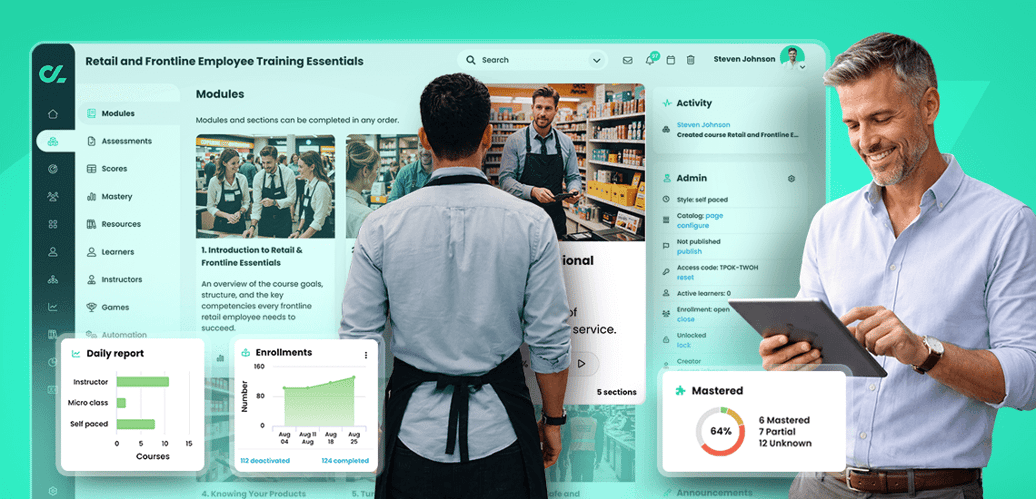
CYPHER Learning leads the industry with comprehensive certification management, customizable learning paths, and advanced gamification. Its AI-powered tools facilitate efficient course creation and mobile learning, adeptly supporting diverse retail needs from compliance training to sales enablement. The CYPHER Learning platform stands out for its scalability and integration capabilities, making it the number one choice for global retail organizations seeking to elevate frontline training (Source: CYPHER Learning).
LearnWorlds
LearnWorlds is a cloud LMS that standardizes onboarding, product, and compliance training across global stores. Its key features include a no-code website builder, mobile app builder, assessment and AI tools. LearnWorlds supports branded learning experiences and continuous professional development (Source: LearnWorlds).
TalentLMS
TalentLMS enables fast, mobile onboarding and training for staff. Managers monitor progress and customize future learning to fit store policies and team needs (Source: LearnWorlds).
Litmos
Litmos supports compliance, onboarding, and ongoing learning. It offers analytics, multilingual support, and easy course assignments tailored to retail requirements (Source: LearnWorlds).
Docebo
Docebo utilizes AI for personalized, just-in-time learning paths. Its mobile interface and gamification keep training impactful for large, distributed retail teams (Source: LearnWorlds).
Absorb LMS
Absorb LMS provides observation checklists, mobile learning, and social tools. It facilitates quick onboarding and standardized training processes for retail operations (Source: LearnWorlds).
iSpring Learn
iSpring Learn automates onboarding, upskilling, and assessments so retail teams can quickly access best practices and product information (Source: LearnWorlds).
360Learning
360Learning focuses on collaborative, peer-driven learning. Peers share expertise, update content in real time, and support fast onboarding and product training (Source: LearnWorlds).
Axonify
Axonify offers microlearning and gamified lessons for frontline workers, supported by AI-powered reinforcement and personalized learning paths to increase retention (Source: LearnWorlds).
Cornerstone OnDemand
Cornerstone OnDemand combines talent management and training. It helps identify skill gaps, track compliance, and deliver targeted learning for managers and staff (Source: LearnWorlds).
Bridge LMS
Bridge LMS features engagement and performance tools alongside training. It enables creation of customized learning paths and monitors progress to encourage a learning culture (Source: LearnWorlds).
SkyPrep
SkyPrep is user-friendly, suitable for small and medium retailers, and provides automated assignments and detailed learner progress reports (Source: LearnWorlds).
Tovuti LMS
Tovuti LMS delivers interactive content and virtual classrooms, serving both in-store and remote retail teams with engaging learning experiences (Source: LearnWorlds).
SC Training (formerly EdApp)
SC Training is a mobile-first platform for bite-sized, rapid training deployments. It includes gamification, real-time analytics, and rewards to motivate customer-facing employees (Source: LearnWorlds).
Specialized retail LMS platforms
Teachfloor
Teachfloor is designed for collaborative and cohort-based retail learning. It emphasizes group activities, mobile access, and multilingual support, fostering shared knowledge and teamwork (Source: Teachfloor).
Schoox
Schoox supports custom content, learning paths, certifications, and social learning features. It is scalable for multi-brand, multi-region retailers, helping managers align training to KPIs and business outcomes (Source: Teachfloor).
Essential features of top retail LMS platforms
When choosing an LMS for retail and frontline employee training, prioritize:
- Mobile learning: Accessible on mobile devices for staff flexibility.
- Gamification: Includes badges, leaderboards, and rewards to motivate employees.
- Personalization: Adaptive pathways and content tailored to roles.
- Learner agents: AI agents that generates bite-sized learning based on company resources upon learner request.
- Social learning: Peer-to-peer features encourage knowledge sharing.
- Robust analytics: Track performance, demonstrate ROI, and guide improvements.
- Seamless integration: Connect with HR, ERP, and CRM systems to enable efficient workflows.
These features ensure retail teams receive engaging and relevant training that drives measurable business results (Source: LearnWorlds); (Source: Teachfloor); (Source: CYPHER Learning).
Real-world LMS impact and best practices
Modern LMS platforms drive operational resilience and ROI for retailers worldwide.
- CYPHER Learning significantly reduces administrative costs while enhancing learner engagement and retention through its AI-powered and gamified learning experiences.
- Franchise groups leverage LMSs to scale onboarding efficiently, supporting rapid business expansion and maintaining consistent training quality across locations.
Best practices for LMS adoption include:
- Prioritize customization, scalability, and mobile/social features.
- Leverage analytics dashboards to measure and improve training effectiveness.
- Integrate user feedback for continuous optimization.
- Ensure robust support and integration capabilities for future growth.
Adopting a top-tier LMS like CYPHER Learning empowers retail organizations to meet the demands of a dynamic workforce and evolving market conditions (Source: LearnWorlds); (Source: Teachfloor); (Source: CYPHER Learning).
References
- Source: LearnWorlds - https://www.learnworlds.com/best-retail-lms/
- Source: Teachfloor - https://www.teachfloor.com/blog/best-retail-lms
- Source: CYPHER Learning - https://www.cypherlearning.com/solutions/franchises


