




Most companies think of customer training as a support function—something that helps users get started and reduces tickets.
But that view dramatically underestimates its impact.
In reality, undertrained customers represent one of the most significant—and least visible—sources of revenue loss. It shows up in slower adoption, lower retention, missed expansion opportunities, and disengaged users who never fully realize value.
High-growth organizations understand this. They treat customer education not as a cost center, but as a revenue driver—and they measure it accordingly.
Here’s where the hidden costs show up, and what leading companies do differently.
Poor adoption is a silent revenue leak
Customer adoption is one of the clearest predictors of long-term revenue. If users don’t adopt your product deeply, they won’t renew, expand, or advocate.
Yet many organizations track adoption at a surface level—logins, feature usage, or basic engagement metrics—without connecting it to training.
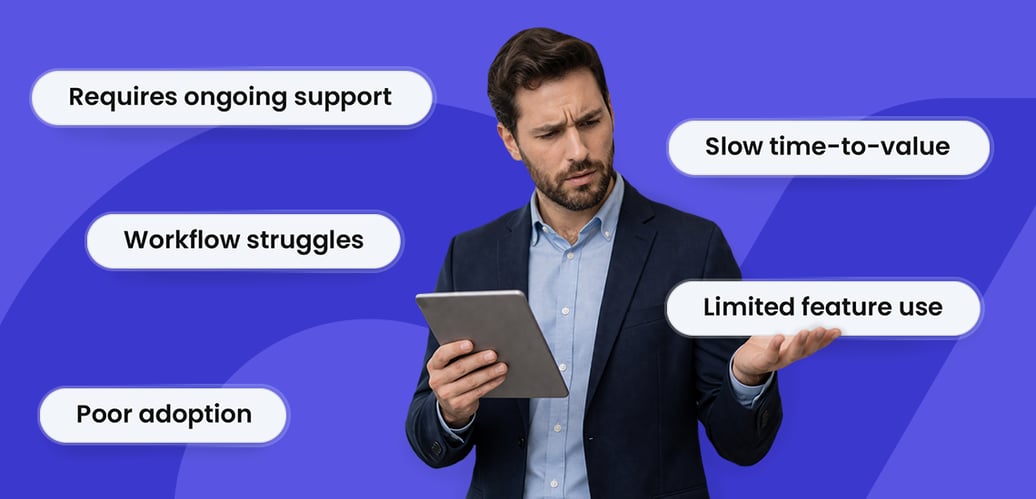
Undertrained customers typically:
- Use only a fraction of available features.
- Struggle to complete key workflows.
- Take longer to reach first value.
- Require ongoing support to perform basic tasks.
This creates a compounding effect. Low adoption leads to low perceived value, which leads to churn or stalled expansion.
The hidden cost? Revenue that never materializes.
High-performing companies address this by linking training directly to adoption metrics. They monitor how learning completion, skill acquisition, and engagement correlate with product usage—and use that data to continuously optimize onboarding and education.
Training isn’t separate from adoption. It’s the engine behind it.
Skills readiness determines customer success
Adoption alone isn’t enough. The real driver of value is skills readiness—whether customers actually know how to use your product effectively.
This is where many training programs fall short.
Traditional approaches focus on content delivery: courses completed, videos watched, certifications earned. But none of these guarantee that a customer can perform critical tasks or apply knowledge in real scenarios.
High-growth companies take a different approach. They define the specific skills customers need to succeed—and measure progress against those competencies.
Modern learning platforms support this by mapping training content and assessments to skills, then tracking mastery over time. For example, competencies can be linked to modules and assessments, allowing organizations to see exactly where learners are progressing or struggling. Source: CYPHER Learning
This creates a much clearer picture of readiness:
- Which skills are mastered.
- Which require reinforcement.
- Where gaps exist across customer segments.
Without this visibility, companies are flying blind. They may believe customers are “trained,” when in reality they are unprepared.
The cost of that gap is missed value—and missed revenue.
Undertrained customers increase support and operational costs
There’s a direct operational impact to undertrained customers: they require more help.
Support teams spend time answering repetitive questions. Customer success managers step in to guide basic workflows. Onboarding timelines stretch longer than expected.
While these costs are visible, they’re often treated in isolation.
The deeper issue is that they signal a failure in the training system.
If customers were properly enabled:
- Support tickets would decrease.
- Onboarding would accelerate.
- Teams could focus on strategic, high-value interactions.
Automation can help address this at scale. Training platforms can trigger actions such as sending targeted messages, enrolling users in relevant content, or surfacing reminders when learners fall behind—reducing manual intervention. Source: CYPHER Learning
The result is a more efficient operation—but more importantly, a more capable customer base.
Lack of data-driven insights hides growth opportunities
One of the biggest missed opportunities in customer training is data.
Many organizations collect data—but don’t use it effectively.
They track:
- Course completions.
- Attendance.
- Satisfaction scores.
But they fail to connect learning data with business outcomes.
High-growth companies take a data-driven approach. They combine learning analytics with product and customer data to uncover insights such as:
- Which training paths lead to faster adoption.
- Which skills correlate with higher retention.
- Where customers drop off in onboarding journeys.
- Which segments are most at risk of churn.
Modern reporting tools make this possible by enabling custom reports, filtering by attributes like organization or role, and visualizing trends across time. Source: CYPHER Learning
This transforms training from a static program into a dynamic system that continuously improves.
Without these insights, companies miss opportunities to:
- Optimize onboarding.
- Personalize learning experiences.
- Identify upsell-ready customers.
- Prevent churn before it happens.
In other words, they leave revenue on the table.
Expansion revenue depends on continuous enablement
Most revenue growth doesn’t come from new customers—it comes from existing ones.
But expansion requires more than access. It requires capability.
Customers won’t adopt advanced features, upgrade plans, or expand usage if they don’t understand how to use what they already have.
This is where continuous training becomes critical.
High-growth companies design learning as an ongoing journey:
- Foundational onboarding for new users.
- Role-based paths for different stakeholders.
- Advanced training for power users.
- Just-in-time resources for new features.
Learning paths help structure this progression, guiding customers from basic knowledge to advanced mastery in a scalable way. They can even adapt dynamically, enrolling users in follow-up content or unlocking new modules based on performance or behavior.
This ensures that training evolves alongside the customer relationship—supporting expansion at every stage.
Measuring what actually matters
To uncover the true cost of undertrained customers, companies need to rethink how they measure success.
Instead of focusing on activity metrics, high-growth organizations prioritize outcomes.
Key metrics include:
- Time-to-value: How quickly customers achieve meaningful results.
- Feature adoption: Depth and breadth of product usage.
- Skills mastery: Competency levels across critical tasks.
- Retention and churn: Long-term customer outcomes.
- Expansion revenue: Growth within existing accounts.
These metrics provide a direct link between training and revenue.
They also create accountability. Training is no longer judged by how much content is delivered—but by the impact it has on the business.
Turning training into a revenue driver
The hidden revenue cost of undertrained customers is real—but it’s also preventable.
The companies that outperform their peers don’t just invest more in training. They invest smarter.
They:
- Align training with adoption and business outcomes.
- Focus on skills readiness, not just content delivery.
- Use data to continuously optimize learning experiences.
- Scale training through automation and personalization.
- Extend education across the entire customer lifecycle.
By doing this, they transform customer training from a reactive function into a proactive growth engine.
Ready to unlock the revenue potential of customer training?
CYPHER Learning helps organizations turn training into measurable business impact with an AI-powered platform built for scale, personalization, and data-driven insights. From skills mapping and adaptive learning to advanced analytics and automation, CYPHER enables you to drive adoption, accelerate readiness, and maximize customer lifetime value.
Discover how CYPHER Learning can help you turn customer training into a revenue engine
References
- Source: CYPHER Learning - https://www.cypherlearning.com/tour/skills-development
- Source: CYPHER Learning - https://www.cypherlearning.com/tour/automation
- Source: CYPHER Learning - https://www.cypherlearning.com/tour/reporting-and-analytics
- Source: CYPHER Learning - https://www.cypherlearning.com/solutions/customer-training


