



Retail companies face distinct challenges in training staff due to high turnover, dispersed locations, complex compliance, and the need for fast upskilling. Learning Management Systems (LMS) effectively address these issues by delivering structured, scalable, and engaging training that improves employee performance and business results.
Understanding the role of LMS in retail training
A Learning Management System (LMS) is software that manages, delivers, and tracks educational content. In retail, LMS enables accessible and consistent training on any device, anytime, anywhere. This flexibility is crucial for managing varied shifts, seasonal hires, and geographically spread teams (Coggno, Revolutionize Retail Training, 2025).
LMSs promote self-paced learning, allowing employees to revisit important topics without disrupting operations. It also automates administrative tasks like enrollment, certifications, and compliance tracking. This automation lets HR and managers focus on strategic priorities rather than routine processes (CYPHER Learning Blog, Why CYPHER Learning Suits Employee Training at Scale, 2025).
Key benefits of LMS for retail training
1. Scalable onboarding and skill development
An LMS standardizes onboarding by providing consistent training on policies, product knowledge, and procedures to all employees, regardless of location. This uniformity is vital for large retail chains and franchises (Coggno, Revolutionize Retail Training, 2025). Digital learning is cost-effective and allows quick updates for new product launches or regulatory changes across multiple sites without incurring significant expenses (TAQTICS, Staff Training Platform For Retail Operation, 2025).
2. Personalized and adaptive learning
Modern LMS platforms enable tailored training paths aligned with role-specific needs. For example, cashiers, managers, and sales associates receive customized content relevant to their duties (GoSkills, Best Retail Training Courses, 2025). CYPHER Learning integrates adaptive learning, adjusting course materials based on learner assessments and skill gaps to optimize outcomes (CYPHER Learning Blog, 13 Best LMS Corporate Training Options, 2025).
3. Ongoing training and performance tracking
Retail evolves rapidly, requiring continuous skills enhancement. LMS keeps employees up to date with refreshed training on sales techniques, customer service, and compliance. Embedded analytics monitor learners’ progress, completion, and assessment scores, enabling targeted coaching and improved training strategies (Coggno, Revolutionize Retail Training, 2025).
4. Increased engagement through interactivity
LMS platforms use gamification, quizzes, and scenario-based learning to boost motivation and retention. Features like badges, leaderboards, and rewards create friendly competition and encourage ongoing participation (CYPHER Learning Blog, 13 Best LMS Corporate Training Options, 2025).
5. Just-in-time learning with personal agents
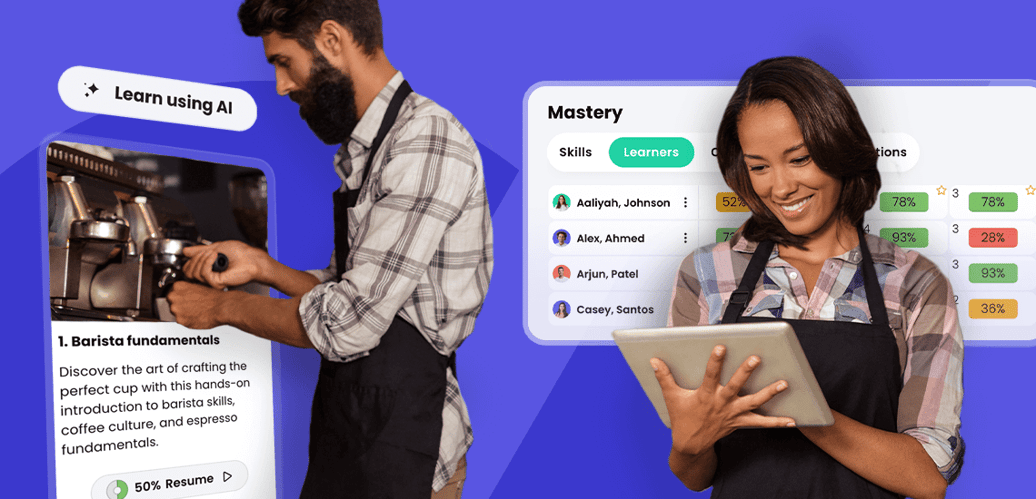
Inventory changes constantly and staying on top of it all is hard. Some LMS platforms have personal learning agents that can source quick, in-the-moment learning from proprietary content giving retail staff immediate access to information about new inventory, store policies, and more. CYPHER Learning, CYPHER Agent.
Best practices for implementing LMS in retail
To maximize LMS effectiveness, retailers should follow these best practices:
- Align training with business goals: Focus learning initiatives on improving sales, customer satisfaction, or compliance (Coggno, Revolutionize Retail Training, 2025).
- Incorporate multimedia and interactive content: Use videos and real-world scenarios to cater to different learning styles (GoSkills, Best Retail Training Courses, 2025).
- Support flexible, self-paced learning: Allow employees to complete modules during slow periods or during a designated ‘learn anywhere’ shift, improving retention and work-life balance (TAQTICS, Staff Training Platform For Retail Operation, 2025).
- Regularly assess and refine training programs: Use LMS analytics to identify gaps and improve content and methods continuously (CYPHER Learning Blog, Navigating the Best Enterprise LMS Platforms, 2025).
Leading LMS solutions tailored for retail
Among available solutions, CYPHER Learning excels with an enterprise-focused approach. It offers AI-assisted course creation, strong automation, customizable portals, and integration with HR and business systems. Features like automated skills mapping, adaptive learning, compliance reporting, and e-commerce support suit retailers with complex training needs (CYPHER Learning Blog, Why CYPHER Learning Suits Employee Training at Scale, 2025).
Other notable providers include ProProfs and Taqtics. They offer rapid content deployment, multi-language support, and digital SOP management, demonstrating the diversity of LMS options designed specifically for retail operations (ProProfs, Top 7 Retail LMS to Onboard & Train Employees in 2025).
Conclusion
LMS platforms provide retail companies with a flexible, scalable, and engaging way to train employees across diverse locations and roles. Leveraging interactive content, adaptive learning, and analytics, retailers can optimize workforce readiness, ensure compliance, and drive business success.
References
- (CYPHER Learning Blog, Why CYPHER Learning Suits Employee Training at Scale, 2025) - https://www.cypherlearning.com/blog/business/why-cypher-learning-suits-employee-training-at-scale
- (CYPHER Learning Blog, 13 Best LMS Corporate Training Options, 2025) - https://www.cypherlearning.com/blog/business/13-best-lms-corporate-training-options-to-boost-efficiency-and-engagement
- (CYPHER Learning Blog, Navigating the Best Enterprise LMS Platforms, 2025) - https://www.cypherlearning.com/blog/business/navigating-the-best-enterprise-lms-platforms-for-optimal-learning
- (Coggno, Revolutionize Retail Training, 2025) - https://coggno.com/blog/learning-management-systems-lmss-in-retail/
- (TAQTICS, Staff Training Platform For Retail Operation, 2025) - https://taqtics.co/retail-operations/staff-training-platform-for-retail-operation/
- (GoSkills, Best Retail Training Courses, 2025) - https://www.goskills.com/Resources/Retail-training-courses
- (ProProfs, Top 7 Retail LMS to Onboard & Train Employees in 2025) - https://www.proprofstraining.com/blog/retail-lms/


