



Organizations often treat employee and customer training as two separate worlds.
Employees need onboarding, product knowledge, process training, and continuous development. Customers need implementation guidance, product education, best practices, and support as their needs become more sophisticated.
The audiences are different, but there is an important connection between them: much of the knowledge they need comes from the same organization.
A product update may require employees to understand how a feature works while customers need to learn how to use it. A new service may require internal teams to understand how to deliver it while customers need guidance on getting value from it.
Separating those training experiences completely can create duplication precisely when organizations need knowledge to move quickly.
Research from the Technology & Services Industry Association has long connected customer education with outcomes including product adoption, customer success, and the ability to help customers gain value from technology. Source: TSIA
AI creates an opportunity to rethink the architecture behind these experiences. Instead of building completely separate knowledge systems for every audience, organizations can connect people to the same intelligence while controlling the experience around who they are.
The same knowledge can serve different needs
Imagine a software company launching a new capability. Internally, sales teams need to understand its value. Customer success teams need to know common use cases. Support teams need deeper product knowledge. Externally, customers may need to understand how to configure the feature, when to use it, and how it fits into their existing workflow.
The underlying company knowledge overlaps considerably. Yet organizations often recreate that information for different audiences, distribute it across multiple systems, and expect people to know where the relevant answer lives. This becomes increasingly difficult as products and customer expectations evolve.
Salesforce describes customer engagement as creating connected experiences rather than isolated interactions, with customers increasingly expecting organizations to understand and adapt to their changing needs. Source: Salesforce
Training should reflect that same principle.
An employee and a customer do not necessarily need the same course. They may not even need the same explanation. But they can benefit from training experiences connected to a common foundation of organizational knowledge.
The opportunity is to separate the audience experience without unnecessarily separating the intelligence behind it.
Context makes one agent relevant to different audiences
A generic AI assistant knows nothing about the particular way an organization operates unless it is given appropriate context. That limitation becomes especially apparent in customer training.
A customer asking how to accomplish something with a particular product does not need a general explanation of how similar products usually work. They need information that reflects the product they actually use.
The same principle applies internally. This is where contextual AI changes the learning experience. Organizations can make proprietary resources available through the CYPHER Agent knowledge base. CYPHER Agent can then use those resources as context for personalized learning experiences. Source: CYPHER Learning
Those resources could include product documentation, process information, guides, policies, sales materials, or other organizational content administrators choose to make available.
- An employee might explore that knowledge to understand how to support a customer.
- A customer might use relevant knowledge to understand the product itself.
The context starts with the organization, but the learning experience can respond to the individual using it.
Personalized learning matters on both sides of the relationship
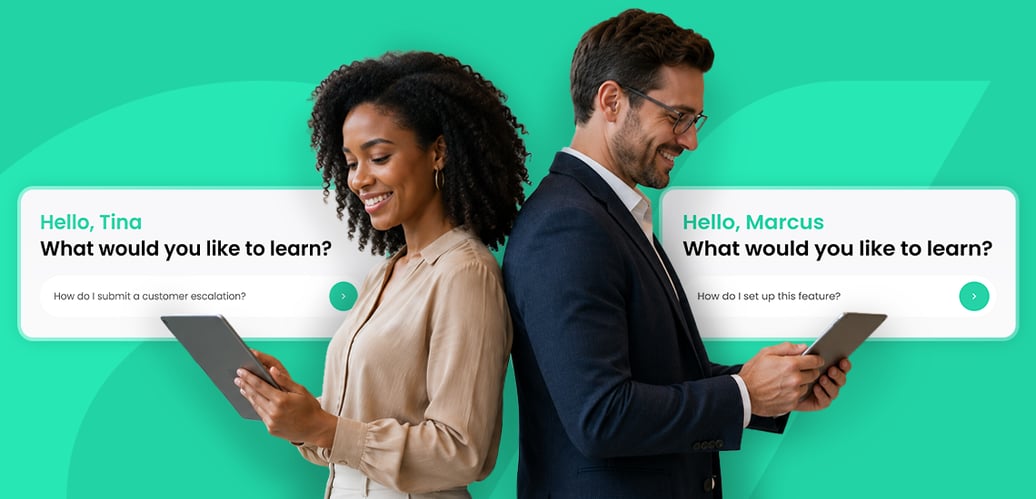
Customers rarely arrive with identical knowledge. One may be completely new to a product. Others may have used it for years but need to understand an advanced capability. An administrator, practitioner, and executive sponsor may each have very different reasons for training.
Employees are equally varied, this makes personalization important for both audiences.
CYPHER Learning supports personalized learning experiences that can adapt training around individual needs, while CYPHER Agent: Learn allows learners to explore subjects they want to understand in greater depth. Source: CYPHER Learning
A new customer could ask to learn about a fundamental concept. A more experienced user could investigate a specific workflow. An employee could explore the same product area from the perspective of supporting customers.
Personalization does not mean creating a separate knowledge universe for every person. It means making shared knowledge more relevant to the person using it.
For customer training, this is particularly valuable because education rarely stops after onboarding. As customers become more capable, their questions change. Training can evolve with them rather than continually returning everyone to the same starting point.
Company data can become a shared foundation
Most organizations already possess enormous amounts of useful knowledge. The challenge is making it accessible in a meaningful way.
Product documentation may sit in one location. Training materials in another. Process guidance somewhere else. Customer resources, FAQs, implementation guides, presentations, and internal documentation continue accumulating as the organization grows.
CYPHER Agent's knowledge base allows organizations to make proprietary resources available for AI-supported training, giving the Agent company specific context alongside universal knowledge. Source: CYPHER Learning
That creates the potential for company knowledge to become a shared foundation for training rather than a collection of disconnected resources.
For customer education teams, this can reduce the pressure to anticipate every question and turn it into another course.
Structured customer training remains essential. Courses can guide onboarding, certification, implementation, and deeper product education. But when a question falls outside those predefined journeys, learners can have another way to explore relevant knowledge.
The same foundation can support employees who need to understand that information from a different perspective.
The organization creates knowledge once. The learning experience helps make it useful in different contexts.
Access still needs boundaries
Sharing an intelligent training environment does not mean giving everyone access to everything.
An employee may need internal process information that should never be visible to a customer. A customer may need resources associated with a particular organization, product, or learning experience. Administrators need control over what different users can see and do.
This is where roles and permissions become fundamental.
CYPHER Learning includes configurable roles and permissions that allow administrators to control access and capabilities for different types of users across the platform. Source: CYPHER Learning
That matters when AI becomes part of the learning experience because intelligence needs boundaries.
The goal is not to create one enormous pool of company information and expose it indiscriminately. It is to build training environments where relevant people can interact with appropriate knowledge according to how the organization has configured access.
A shared intelligent platform becomes useful when common knowledge and controlled access can coexist.
For organizations educating customers at scale, that provides a foundation for extending training beyond internal teams without abandoning governance.
Customer education becomes part of a larger knowledge ecosystem
Customer training has traditionally been measured through familiar activities: course registrations, completions, certifications, and engagement. Those remain useful signals, but customer education has a broader purpose. It should help customers become more capable with the products and services they have invested in.
Forrester research highlights how B2B customer service is evolving toward a greater focus on creating value for customers, with AI changing how organizations support customers after the sale. Source: Forrester
AI can expand how organizations approach that objective. Formal courses can provide structured journeys. Personalized training can make those journeys more relevant. Company data can provide richer organizational context. CYPHER Agent: Learn can support exploration when customers encounter questions beyond scheduled training.
Meanwhile, employees can draw on the same broader knowledge ecosystem to build the understanding they need to support those customers.
The result is not identical training. It is a more connected relationship between what the organization knows, what employees need to know, and what customers need to understand.
One intelligence can support many learning journeys
Organizations do not need fewer distinctions between employees and customers. They need better connections between the knowledge supporting them.
Employees have different responsibilities, permissions, and development needs from customers. Customers themselves have different roles, levels of expertise, and objectives. The learning experience should recognize those differences.
Beneath those experiences sits something shared: the organization's knowledge.
CYPHER Learning brings customer and employee training together on one AI-native platform, with personalized training, roles and permissions, organizational knowledge, contextual AI, and CYPHER Agent: Learn helping organizations create learning experiences appropriate to different audiences.
For businesses investing in customer training, that opens up a different way of thinking about scale. Instead of continually building isolated destinations for knowledge, organizations can build an intelligent learning environment where the right people can interact with relevant knowledge in ways suited to their needs.
The future of customer training may not be about giving customers more content. It may be about giving them a more intelligent relationship with what your organization already knows.
See how CYPHER Learning can help you turn company knowledge into more personalized customer training.
References
- Source: TSIA - https://www.tsia.com/blog/ai-in-customer-success-capabilities-framework
- Source: Salesforce - https://www.salesforce.com/service/digital-customer-engagement-platform/what-is-customer-engagement/
- Source: CYPHER Learning - https://www.cypherlearning.com/faq/cypher-agent-for-learners
- Source: CYPHER Learning - https://www.cypherlearning.com/ai-360/cypher-agent-for-learners
- Source: CYPHER Learning - https://www.cypherlearning.com/resources/webinars/cypher-live-custom-roles-and-permissions
- Source: Forrester - https://www.forrester.com/report/ai-will-reshape-how-b2b-customer-service-affects-value-for-customers/RES190984
- Source: CYPHER Learning - https://www.cypherlearning.com/solutions/customer-training
- Source: CYPHER Learning - https://www.cypherlearning.com/solutions/employee-training


