



Picking the right AI compliance training tools can determine whether your global workforce actually absorbs regulatory content or clicks through it on autopilot. CYPHER Learning gives you AI-powered course creation in 50+ languages, making it possible to roll out compliant, localized training in minutes rather than months.
With new regulations emerging across industries and regions, corporate training leaders need evaluation criteria that go beyond feature lists. This article walks you through the key factors that matter most when selecting an AI compliance training platform for a multilingual, distributed team.
Key takeaways: choosing AI compliance training tools
- AI-driven course creation speed directly affects how quickly your team responds to new regulatory changes.
- Multilingual support should include AI-native translation and localization, not just static language packs or manual work.
- Automated compliance workflows significantly reduce the administrative burden on L&D teams and cut missed deadlines.
- CYPHER Learning combines AI course creation, 50+ language support, and workflow automation in one unified platform.
- Insightful analytics and audit-ready reporting prove training outcomes and compliance status to regulators and leadership.
What to look for in AI compliance training platforms
1. AI-powered course creation speed
Regulations shift fast. If your content creation tool takes weeks to produce a single compliance module, you are already behind. Look for platforms where AI generates structured courses, complete with assessments and gamification, from your uploaded policies or documents.
This means your subject matter experts spend less time on formatting and more time validating accuracy. CYPHER Learning's CYPHER Agent creates full courses in minutes, including quizzes, rubrics, and skills mapping. That speed lets you respond to regulatory updates the same week they are published.
2. Content accuracy verification
AI-generated content can contain errors and hallucinations. For compliance training, inaccuracy is not just embarrassing, it is a liability that could expose your organization during an audit or regulatory review.
Evaluate whether the platform includes a built-in review mechanism that flags inconsistencies before courses go live. CYPHER Learning's AI Crosscheck uses a second, independent AI model to verify generated content and suggest corrections. You maintain full editorial control while trusting that your compliance material is credible content from day one.
3. Multilingual AI translation and localization
A global workforce needs more than a dropdown menu of languages. Your platform should create courses natively in your learners' languages, not just translate an English version after the fact.
According to the LRN 2026 Program Effectiveness Report, high-impact compliance programs are 1.4x more likely to integrate AI into training delivery. AI-powered translation closes gaps that static localization packs miss. CYPHER Learning supports AI course creation in 50+ languages and includes a Universal Translator for real-time message and notification translation.
4. Automated compliance workflows
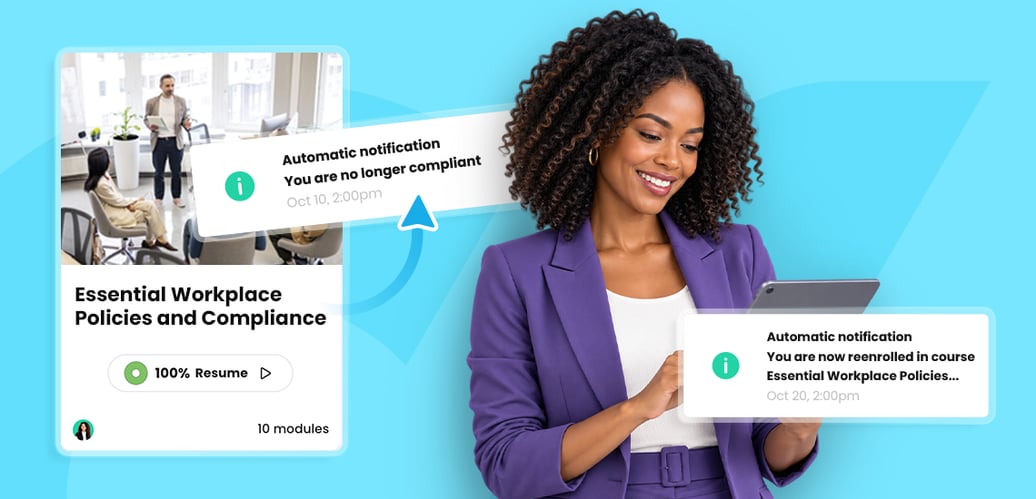
Tracking who needs training, who has completed it, and who needs retraining is tedious work when done manually. The right platform automates enrollments, sends reminders, and triggers renewal training based on certification expiration dates.
This reduces the risk of missed deadlines and failed audits. CYPHER Learning's automation engine lets you set rules at the course, group, or site level so compliance workflows run on their own. Automated processes free your L&D team to focus on course quality instead of spreadsheet tracking.
5. Competency-based and skills-based learning
Completion rates alone do not tell you whether employees understand the material. Skills-based learning connects training to specific competencies, so you can track mastery rather than clicks and course completions.
Look for platforms that let you tag assessments and modules with specific skills and then report on mastery-level proficiency across your entire organization. This approach directly aligns training outcomes with real workforce readiness and gives you clear, auditable evidence that employees can apply the knowledge they gained on the job.
6. Gamification and learner engagement
Compliance training has a reputation for being tedious. Gamification elements like badges, leaderboards, and point systems make the experience more engaging and interactive, which in turn improves knowledge retention.
When you turn dense regulations into interactive, gamified courses, completion rates climb and learners retain more information. A platform that generates gamification automatically during course creation saves your team from building these elements manually. This is especially valuable when you are rolling out new compliance modules frequently to keep pace with evolving regulations.
7. Insightful analytics and audit-ready reporting
Your regulators and your board want proof that training works. Basic completion dashboards are not enough. Instead, look for insightful analytics that track actual learning time, competency progression, and compliance status at both the department and individual level.
CYPHER Learning's time tracking tracks the real time each learner spends engaging with course material, and its compliance reporting tools generate audit-ready summaries on demand. These detailed reports can be exported and shared with regulators, HR leadership, or board members in seconds.
8. Integration with existing HR and business systems
Your compliance training platform should not operate in a silo. It needs to connect with your HRIS, CRM, and other enterprise tools to sync learner data, automate role-based enrollments, and consolidate reporting across departments.
Evaluate whether the platform supports enterprise-class integrations with tools like Workday, Salesforce, and Microsoft Teams. CYPHER Learning offers integrations through APIs, SSO, LTI, and Zapier, making it straightforward to embed learning into your existing tech stack. A well-connected platform removes data silos and keeps learner records consistent.
9. White-labeling and multi-tenant portals
If you operate across multiple regions, brands, or business units, you need separate training portals with localized branding. Multi-tenant architecture lets you maintain centralized control while giving each unit its own fully customized portal.
This is especially relevant for compliance, where regional regulations may require different course libraries and certification paths. Centralized administration with localized flexibility keeps everything organized without doubling your workload. You manage all portals from one dashboard, yet each regional team sees only the content relevant to them.
10. Mobile accessibility and offline learning
Field workers, manufacturing floor employees, and distributed teams do not always have reliable internet access. Mobile-first design with offline capabilities ensures every learner can complete their compliance training on their own schedule, wherever they are.
A platform that syncs progress automatically when connectivity resumes removes barriers to completion. CYPHER Learning's mobile apps for iOS and Android include offline mode, so your team stays on track regardless of location. This is critical for industries like manufacturing and healthcare where desk access is limited.
How to select the right AI compliance training platform
Choosing an AI compliance training platform starts with understanding your organization's specific needs. Consider the size of your global workforce, the number of languages you require, and how frequently your regulatory landscape changes.
Prioritize platforms that combine AI course creation, multilingual delivery, automated workflows, and insightful analytics in one platform. CYPHER Learning's LMS unifies all of these capabilities, helping you scale compliance training without increasing your administrative effort.
Request a demo, test the AI course creation tools with your own policies, and evaluate whether the reporting meets your audit requirements before committing.
FAQs about key factors in choosing AI compliance training tools
What makes AI compliance training tools different from a standard LMS?
AI compliance training tools generate courses from your policies and regulations automatically. CYPHER Learning creates structured, gamified compliance content in minutes, including assessments and skills mapping, rather than requiring weeks of manual authoring.
How does multilingual AI translation improve compliance training?
AI translation creates courses natively in each learner's language instead of manually translating after the fact. CYPHER Learning supports over 50 languages and includes a Universal Translator that converts messages and notifications in real time.
Can AI-generated compliance content be trusted for accuracy?
Accuracy depends on the platform's verification process. CYPHER Learning includes AI Crosscheck, which uses a separate AI model to flag errors and suggest corrections before content goes live.
How do automated workflows reduce compliance risk?
Automated workflows assign courses, send reminders, and trigger retraining when certifications expire. This removes the manual tracking that often leads to missed deadlines and audit failures.
What role does gamification play in compliance training engagement?
Gamification adds points, badges, and leaderboards to training, making it more interactive. This boosts engagement and knowledge retention, especially for dense regulatory topics that learners would otherwise skim.
How should I evaluate compliance training reporting for audit purposes?
Look for platforms that track actual learning time, competency progression, and certification status at both the individual and department level. Reports should be exportable and ready to share with auditors on demand.


