



Giving employees access to AI does not make a workforce AI-ready.
An organization can roll out ChatGPT, Microsoft Copilot, Gemini, or another generative AI tool overnight. What takes longer is developing the knowledge and judgment people need to use those tools effectively in their actual work.
Employees need to understand what AI can do, recognize where it can genuinely help, know how to work with it, evaluate its outputs, and understand when AI should not be used at all.
That makes AI workforce development a learning challenge as much as a technology challenge.
An AI-ready workforce is one where people can make informed decisions about how, where, and when to use AI. Building one requires a combination of literacy, practical skills, judgment, governance, role specific application, and continuous learning.
Here is what those elements look like in practice.
What does an AI-ready workforce actually mean?
An AI-ready workforce is not simply a workforce that uses AI.
Usage tells you that adoption is happening. It does not tell you whether people are using AI well.
Someone can use generative AI every day while still struggling to construct useful prompts, recognize unreliable outputs, protect sensitive information, or determine whether AI is appropriate for a particular task.
Readiness is better understood as the capability to use AI effectively and responsibly within the context of someone's work.
That distinction changes how organizations approach AI workforce training.
Instead of focusing exclusively on tool adoption, training can develop the knowledge, skills, and judgment people need to apply AI to real situations.
The exact capabilities will vary between organizations and roles, but six areas provide a useful foundation.
1. Build AI literacy before expecting AI fluency
People need a working understanding of AI before they can make good decisions about using it.
That does not mean everyone needs to understand machine learning models or become an AI specialist.
AI literacy should give people enough knowledge to understand what they are interacting with. What is generative AI? What is it good at? Where does it struggle? Why can outputs be inaccurate? What happens to the information someone enters? Where is human judgment still necessary?
This creates a shared vocabulary across the organization.
It can also help employees approach AI with an appropriate level of confidence. The goal is neither blind trust nor unnecessary skepticism. People should understand enough to decide when an AI tool could be useful and when its output deserves closer scrutiny.
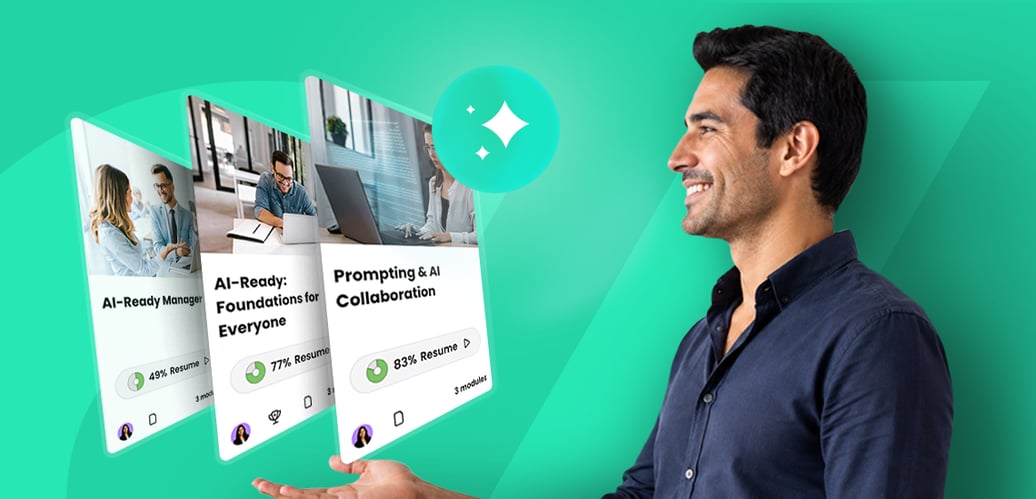
For organizations developing an AI Academy or broader AI workforce training program, literacy provides a logical starting point before learners move into practical applications. CYPHER's AI Academy approach similarly positions foundational AI understanding as the basis for more advanced development.
2. Turn knowledge into practical AI skills
Knowing what generative AI is does not automatically mean someone can use it productively.
The next stage of AI workforce development should therefore focus on doing.
Learners can explore prompting, workflows, scenarios, exercises, and examples that reflect the kinds of tasks they encounter at work.
-
A salesperson might practice using AI to prepare for an account meeting or organize research.
-
A marketer could explore how AI supports ideation, analysis, or the development of a first draft.
-
A manager might learn how to synthesize information or prepare for a difficult conversation.
The objective is not to teach people a library of clever prompts. Tools and interfaces will change.
Instead, develop transferable skills around working with AI to accomplish something useful.
That makes the learning more resilient as individual technologies evolve.
3. Develop judgment, not just prompting ability
Some of the most important AI skills happen after an AI tool produces an answer.
- Is the response accurate?
- Is important context missing?
- Does the recommendation make sense?
- Should the information be verified?
- Is the output appropriate for the intended audience?
- Does a person need to make the final decision?
These questions require human judgment.
Effective AI workforce training should give learners opportunities to encounter imperfect situations rather than presenting AI as a tool that always produces the correct answer.
For example, an exercise could give learners an AI generated response and ask them to identify assumptions, missing information, potential inaccuracies, or situations where additional verification is necessary.
The employee is then learning something more valuable than how to generate an answer. They are learning how to work critically with AI generated information.
As AI becomes easier to access, that ability becomes increasingly important to genuine readiness.
4. Make governance part of everyday AI use
Organizations can establish detailed AI policies and still leave employees unsure about what they should actually do.
A policy might tell people not to enter confidential information into an unapproved AI service. Training can show them what that means when they are summarizing a customer conversation, analyzing internal data, or preparing a document.
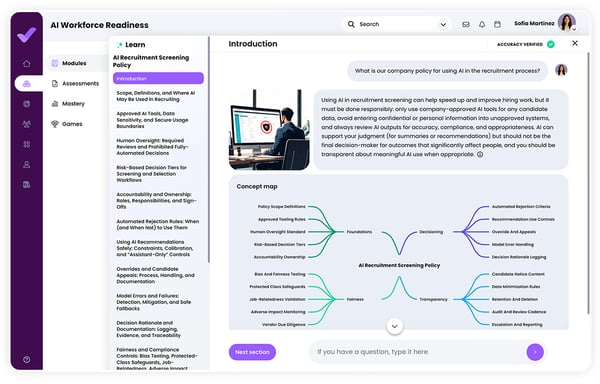
AI governance education can cover areas such as approved tools, organizational policies, privacy, security, responsible use, verification expectations, and situations requiring human oversight.
The important step is connecting those principles to real decisions.
Instead of treating governance as a separate compliance exercise, organizations can incorporate it throughout their AI workforce training.
A sales scenario can include questions about customer information. A marketing exercise can address intellectual property and verification. A management scenario can explore when an AI generated recommendation should and should not influence a decision.
Governance becomes more meaningful when learners see how it applies at the moment they use AI.
5. Build role specific AI capability
One of the limitations of generic AI training is that it answers the same question for everyone: “What can AI do?”
Employees usually need an answer to a different question: “What can AI help me do?”
Those answers depend heavily on the role.
Sales, marketing, customer success, finance, operations, management, and other functions have different workflows, responsibilities, information, risks, and opportunities.
Even people within the same department may need different capabilities depending on their responsibilities and existing AI experience.
That is why effective AI workforce development needs both common foundations and differentiated learning.
An organization might establish core learning around AI literacy, governance, and responsible use for everyone. Learners could then move into paths aligned with their role, skill level, department, or use case.
CYPHER supports organizations in creating different learning paths for different audiences rather than requiring everyone to complete the same training experience.
That helps shift AI training away from generic education and toward practical capability.
6. Make continuous learning part of AI readiness
There is a fundamental problem with treating AI workforce training as a one time initiative.
The subject keeps changing.
AI products introduce new functionality. Organizations approve new tools. Teams discover better workflows. Policies mature. New risks emerge. Employees who were beginners six months ago may be ready for much more sophisticated applications today.
The learning environment needs to accommodate that change.
Organizations can begin with foundational training, then introduce new role specific learning, assessments, skills, and more advanced material as their AI strategy develops.
CYPHER Agent can help teams use existing organizational knowledge and trusted resources to create structured learning experiences, including course content, assessments, skills, and gamified elements. Subject matter expertise and organizational review remain important parts of determining what should ultimately be delivered to learners.
This approach makes continuous learning part of AI readiness rather than something that happens after the initial rollout.
How do you build an AI-ready workforce?
Building an AI-ready workforce starts with understanding where your people are today.
Organizations can assess existing knowledge and identify the capabilities different roles actually require. From there, they can define foundational skills, establish role specific expectations, and build learning experiences around the gaps between current and desired capability.
That journey might look like:
- Establish a baseline. Understand existing AI knowledge, experience, confidence, and relevant skills.
- Define the capabilities that matter. Identify what people in different roles should understand and be able to do with AI.
- Create a common foundation. Develop shared learning around AI literacy, responsible use, security, organizational policies, and critical evaluation.
- Build role specific learning. Connect AI skills to the workflows and situations employees encounter in their jobs.
- Provide opportunities to apply and assess skills. Use practical exercises and assessments to move beyond passive awareness.
- Measure learning progress. Track relevant learning activity, assessment performance, skills development, and progression using your learning platform, while using appropriate business systems and feedback mechanisms to evaluate outcomes beyond the LMS.
- Keep developing the program. Update learning as tools, policies, organizational priorities, and employee capabilities change.
The result is not a workforce that has simply “completed AI training.”
It is an organization developing AI capability deliberately.
From scattered AI experimentation to workforce capability
In many organizations, AI adoption is already underway informally.
People are experimenting with tools, sharing prompts with colleagues, finding shortcuts, and discovering useful applications through trial and error.
That curiosity is valuable. But leaving AI workforce development entirely to individual experimentation creates uneven capability.
Some employees will advance quickly. Others may struggle to understand where AI fits into their role. People may develop inconsistent practices around verification, governance, or responsible use.
Structured learning gives organizations a way to build on the experimentation already happening.
With CYPHER Learning, organizations can create AI workforce training around their own audiences, knowledge, skills, and business priorities. Build foundational AI literacy, develop learning for different roles and skill levels, assess progress, and continue expanding the experience as your people and AI strategy mature.
AI readiness is not about giving everyone an AI tool. It is about giving people the capability to use AI well.


