


Infographic
CYPHER Learning


The CYPHER platform optimizes efficiency. See how much you could save.
Try our ROI Calculator
Get LMS, LXP, and AI-enabled course creation in one powerful platform. Training made easy, scalable, and measurable.
Start tour
From employee training to customer training, and everything in between.
See solutions
Meet the customers who achieved amazing results with CYPHER Learning in 2025
2025 Winners
Hands-on, guided demos of our AI-powered platform led by CYPHER experts.
Register or replay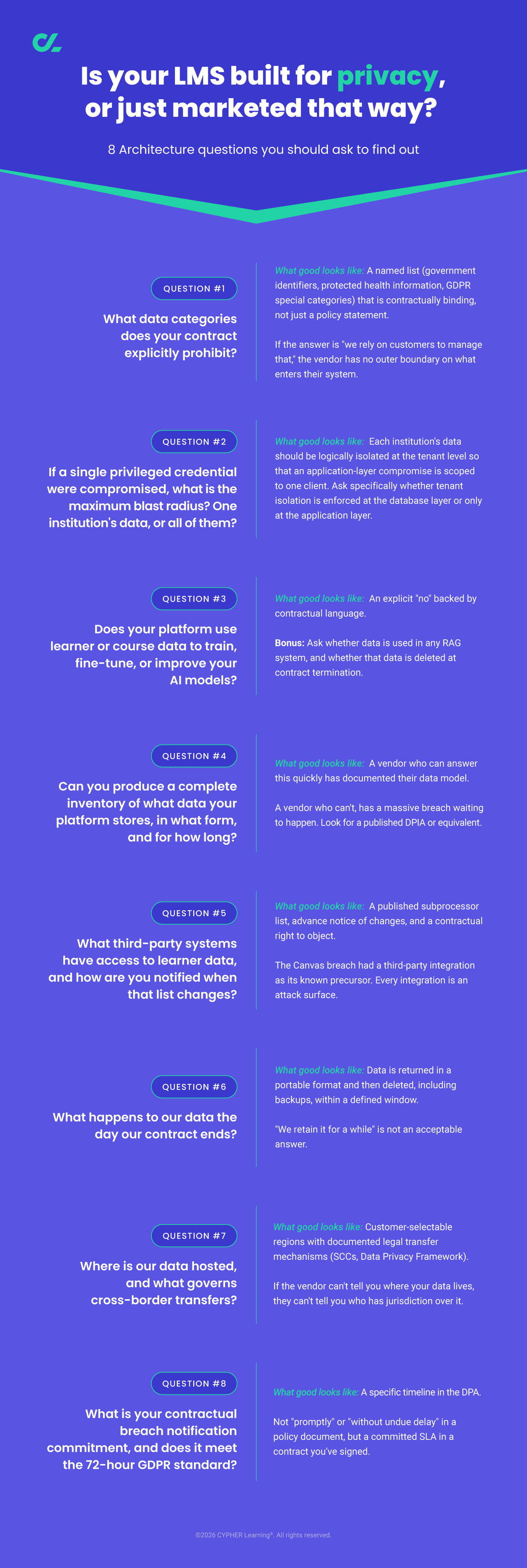
What good looks like: A named list (government identifiers, protected health information, GDPR special categories) that is contractually binding, not just a policy statement.
If the answer is "we rely on customers to manage that," the vendor has no outer boundary on what enters their system.
What good looks like: Each institution's data should be logically isolated at the tenant level so that an application-layer compromise is scoped to one client. Ask specifically whether tenant isolation is enforced at the database layer or only at the application layer.
What good looks like: An explicit "no" backed by contractual language.
Bonus: Ask whether data is used in any RAG system, and whether that data is deleted at contract termination.
What good looks like: A vendor who can answer this quickly has documented their data model.
A vendor who can't, has a massive breach waiting to happen. Look for a published DPIA or equivalent.
What good looks like: A published subprocessor list, advance notice of changes, and a contractual right to object.
The Canvas breach had a third-party integration as its known precursor. Every integration is an attack surface.
What good looks like: Data is returned in a portable format and then deleted, including backups, within a defined window.
"We retain it for a while" is not an acceptable answer.
What good looks like: Customer-selectable regions with documented legal transfer mechanisms (SCCs, Data Privacy Framework).
If the vendor can't tell you where your data lives, they can't tell you who has jurisdiction over it.
What good looks like: A specific timeline in the DPA.
Not "promptly" or "without undue delay" in a policy document, but a committed SLA in a contract you've signed.
Download infographic