




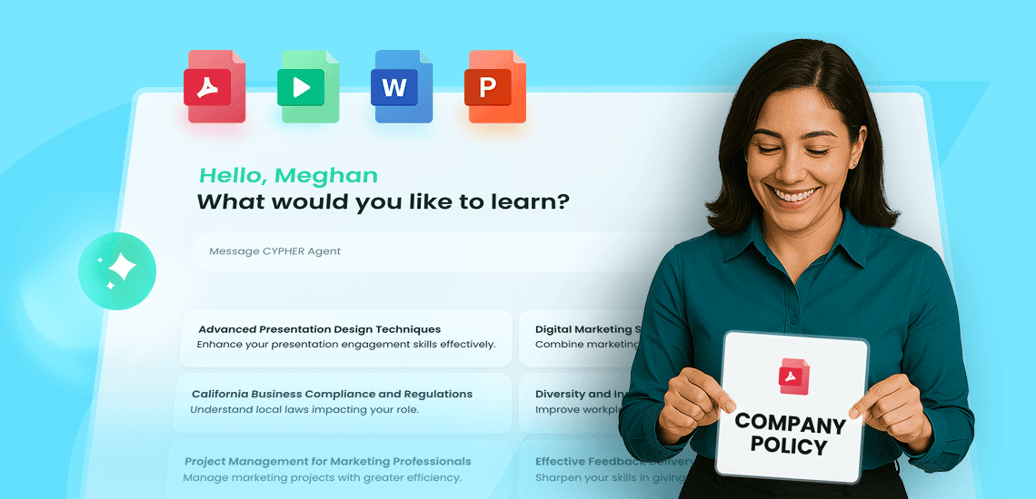
We don’t have a content shortage; we have a relevance shortage. Employees are drowning in:
- PDFs with titles like Final_v7(2).
- Five versions of “the” slide deck floating in chat.
- Courses that are great… if you have time to complete them.
When someone’s on the job, they’re not asking for “a course on negotiation.” They’re asking: “What do I say when procurement asks for a 12-month discount?” They need a sentence, a policy snippet, a playbook excerpt. And they need it right now.
Traditional search trawls everything and hopes you click the right blue link. The GenAI systems people are using, sanctioned or not, need access to all the proprietary files. And static courses, even great ones, are overkill for the moment of performance.
Why AI? And why AI inside the LMS?
AI’s job in JIT learning isn’t to be clever; it’s to be useful. Three things matter:
- Context: Who is the learner, what is their role, and what are their goals?
- Precision: What source is true for this company/team/version?
- Discoverability: Can the learner zero in on what they want to know, and what they didn’t know they needed to know?
Plain LLMs are brilliant pattern finishers, but they’re not your policy library. They’ll happily make up a new expense code if you let them. That’s where RAG earns its keep.
RAG in one paragraph (no buzzword bingo)
RAG (Retrieval-Augmented Generation) is a simple idea: before the AI answers, it fetches the specific snippets from your approved knowledge (courses, help docs, SOPs, decks, FAQs, tickets) and grounds its answer in those sources. The model writes; your content decides. Think of it as guardrails plus fuel: the rail keeps the car on the road; the fuel makes it go fast.
What changes when you add RAG to a platform like CYPHER
Let’s make this real. With RAG wired into your learning ecosystem:
- Micro-answers from macro-content
That 90-page policy guide? RAG pulls the three bullets that matter for this task and links back to the source for depth. You can still do an annual policy course based on the guide for compliance purposes, but when your people need to know what to do right now? They can jump right to it, not sit through it. Again. - From search to solutions
Instead of a list of files, learners get:
“To file a non-standard discount, do A → B → C. Here’s the approval form. Here’s the policy clause.”
That’s the difference between knowing and doing. - Personalization without stalking
The answer can reflect role, region, product line, and seniority—because the retriever filters by those dimensions before it generates. - Security with barriers
The same security roles that allow you to restrict confidential training to learners also governs which documents are used to source answers. One agent safely serves all users. - Confidence with citations
Every response points to the paragraph, timestamp, or slide it came from. Learners can peek under the hood and trust the guidance. - Living content
Update the policy once; the next answer honors it. You stop playing “catch the outdated slide” across ten wikis.
CYPHER Agent & RAG in action
Lina gets instant guidance on policy
Anatomy of a solid RAG stack for learning
- A clean, governed pool of knowledge
Courses, SOPs, help articles, release notes, support macros, and tribal knowledge—tagged by audience, product, region, and lifecycle stage. - Chunking that respects meaning
Split content into semantically coherent “thoughts”, not random 500-token slices. Good chunks = good answers. - A presentation layer tuned for action
The information “chunks” are formatted for skim-readers, arranged in logical groups, and designed to zero in on what’s needed. - A retriever that knows your business
A search that knows about your role, your region, and your business, and recency bias for time-sensitive docs like pricing and legal. - Guardrails and governance
- Secured documents: the same controls that govern the catalog, govern the docs so if you can’t view the doc it won’t be a part of your answer.
- Reference enforcement: answers must include sources so learners can be confident in the knowledge, and know where to look for more info.
- Red-flag filters: restrict topics to keep learning on track.
Where this shows up in CYPHER-style workflows
- Inside a course
A new hire hits a stubborn concept, asks a question, gets a grounded chunk of learning—without leaving the flow. - Outside a course
An employee wants to grow in their role but is missing a key skill–negotiation. When reviewing their job skills, they decide to do something about it, opting to learn with AI. - Customer support
A customer admin wants a crash-course in some advanced features. RAG pulls the latest documentation and developer notes, answers, cites, done. - For creators
SMEs upload a deck and a few SOPs; the system drafts a course outline, knowledge checks, and scenario prompts—and makes those assets searchable for RAG at runtime.
“But what about hallucinations?”
Great question. Three practical guardrails:
- Crosscheck. Answers are always run through a second premium AI to double-check for accuracy. Any discrepancies are flagged for the learner.
- Cite aggressively. Every source gets a pointer to the doc and paragraph.
- Test the top tasks. Don’t measure accuracy in a vacuum; measure whether your 20 most common workflows produce correct, consistent answers.
The mindset shift
The most powerful change isn’t technical—it’s cultural. We stop equating “learning” with “courses” and start measuring it as outcomes. Courses remain essential for depth and transformation. But at the moment of need, getting right to what is needed beats a brilliant 45-minute module.
Just-in-time learning wasn’t waiting for more content. It was waiting for the connective tissue: AI with retrieval. With RAG in the loop, your best knowledge shows up at the exact moment it can do the most good—on the call, in the ticket, at the machine, or with a looming deadline.
If you’re ready to try this, start small with the pieces people ask about most and let the results pull you forward. The rest—depth, courses, mastery—will follow naturally once people can do the next right thing right now.
More CYPHER Agent


