




Completion rates are one of the most common metrics in learning and development.
They are easy to track, simple to report, and useful for understanding whether learners finished assigned material. For years, many training businesses treated completion rates as the primary signal of program success. But stakeholders are demanding more.
Training providers today are increasingly expected to demonstrate measurable business value, workforce readiness, and learner impact. Customers don’t want participation points. They want evidence that learning improves performance. This creates a problem for completion focused measurement models.
Completion data shows activity. It does not necessarily show capability, engagement quality, or business outcomes. As learning ecosystems become more sophisticated, training businesses need more meaningful indicators of success.
Completion rates measure exposure, not capability
One of the biggest limitations of completion rates is that they measure exposure to content rather than demonstrated understanding.
A learner can finish a course without developing meaningful proficiency. They may move quickly through modules, retain little information, or struggle to apply concepts in real scenarios.
This becomes especially problematic in professional learning environments where certifications, compliance, or customer outcomes require genuine capability.
Completion rates cannot reliably answer questions such as:
- Can learners apply what they learned?
- Did they demonstrate measurable skill development?
- Are they prepared to perform effectively in practice?
This is why many organizations are shifting toward skills-based learning and competency validation models.
Competency-based education emphasizes the importance identifying the desired outcome or behavioral change and of measuring demonstrated mastery rather than instructional participation alone. Source: Competency Based Education Network
For training businesses, the distinction matters because customers increasingly expect evidence of learning effectiveness, not just course attendance.
Thoughtful analysis reveals how learners actually engage
Completion rates flatten the learning experience into a single number. Learning leaders who want to drive results will look at the bigger picture.
Modern learning platforms and reporting engines provide a much richer understanding of learner behavior and progression. Instead of simply asking whether a learner finished a course, organizations can evaluate:
- Where learners disengage.
- Which activities drive participation.
- How learners progress through pathways.
- Which content correlates with stronger outcomes.
This visibility allows training providers to improve learning design continuously rather than relying on surface level metrics.
For example, a course with lower completion rates but strong assessment performance and sustained learner engagement may be far more effective than a course with high completion and weak retention.
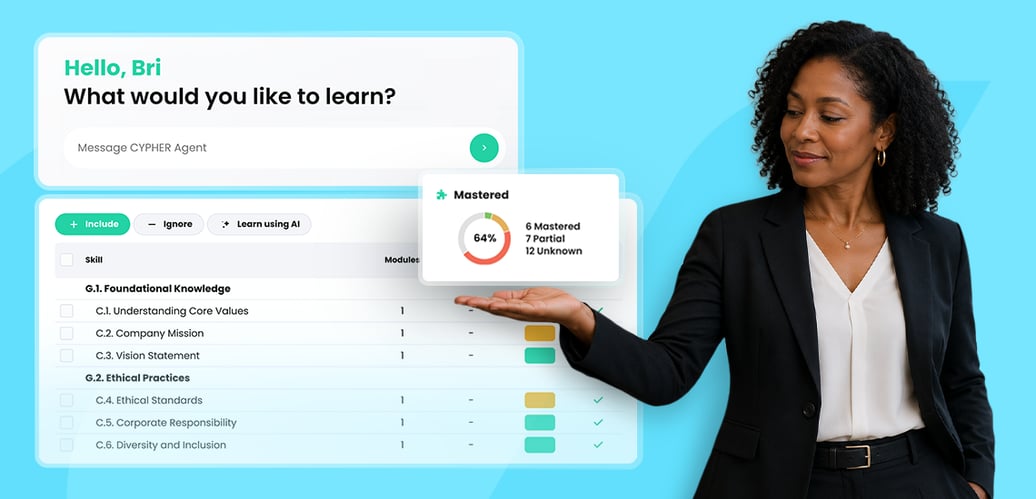
CYPHER Learning supports reporting capabilities that help organizations track learner progression, engagement, and certification activity across learning pathways. Source: CYPHER Learning
As learning ecosystems grow more complex, robust analysis becomes essential for understanding not only what learners completed, but how they learned.
Skills evidence matters more than participation
Many training businesses are moving toward certification and professional development models tied to measurable skills. In these environments, skills evidence becomes more valuable than completion data alone.
Organizations increasingly want visibility into:
- Demonstrated competencies.
- Mastery progression.
- Assessment performance over time.
- Certification readiness.
- Applied skill validation.
This shift reflects broader changes in workforce development. Employers increasingly prioritize verified capability and transferable skills rather than static credentials alone.
Research on workforce readiness consistently highlights the growing importance of measurable skills validation in professional development ecosystems. Training providers that focus only on completions risk overlooking the metrics that customers increasingly care about most. Source: World Economic Forum
Completion tells organizations whether learners reached the end. Skills evidence helps determine whether learning actually created value.
Outcome measurement connects learning to business value
Perhaps the biggest weakness of completion rates is that they rarely connect directly to business outcomes.
Training businesses increasingly operate in environments where customers expect measurable return on investment. They want to know whether learning improved productivity, accelerated onboarding, reduced errors, increased sales readiness, or strengthened compliance.
Completion rates alone cannot provide that visibility. Outcome measurement requires broader data points that connect training activity to operational or performance indicators. Depending on the environment, this may include:
- Certification attainment.
- Role readiness.
- Retention and renewal rates.
- Customer adoption metrics.
- Operational performance indicators.
For training businesses, outcome measurement increasingly differentiates strategic learning providers from content distributors.
How can training providers measure learner outcomes? Unlike internal training programs that can pull directly from employee performance metrics, training providers have to proactively gather outcome information. This means defining what success should look like and following up with learners, or the employers who sent them, to get the feedback. Keep these post-training surveys clear and crisp and focused on demonstrable value.
The future of learning measurement is multidimensional
Completion rates are not useless. They still provide operational visibility and can help organizations understand participation trends.
The problem arises when completion becomes the primary definition of success.
Modern learning providers increasingly require broader measurement models that combine:
- Learner insight.
- Skills evidence.
- Progression visibility.
- Assessment performance.
- Business outcome alignment.
- AI-supported learner insight.
Together, these metrics provide a more complete understanding of learning effectiveness and organizational impact.
The training businesses that thrive in the future will likely be those that can demonstrate measurable capability development rather than simply reporting participation volume.
Ready to move beyond completion based learning metrics?
CYPHER Learning helps training organizations build more intelligent learning ecosystems through insight, skills visibility, learner progression tracking, and AI-powered support.
- Track learner engagement and progression more effectively.
- Measure skills development and certification readiness.
- Support learners with AI-powered guidance through CYPHER Agent.
- Connect learning data to meaningful organizational outcomes.
Explore how CYPHER Learning can help you build learning experiences designed around measurable capability, not just course completion. Schedule a demo today.
References
- Source: Competency Based Education Network - https://www.cbenetwork.org/competency-based-education/
- Source: CYPHER Learning - https://www.cypherlearning.com/tour/reporting-and-analytics
- Source: World Economic Forum - https://www.weforum.org/reports/the-future-of-jobs-report-2023/
- Source: CYPHER Learning - https://www.cypherlearning.com/ai-360/cypher-agent-for-learners


