




AI is changing professional certification in two very different ways at the same time.
On one hand, AI is making learning more accessible, scalable, and personalized. Organizations can generate content faster, support learners conversationally, and deliver more adaptive learning experiences.
On the other hand, AI is creating new questions around trust. If learners can use AI tools to assist with assessments, complete assignments faster, or generate responses automatically, what does certification actually prove? How do organizations validate genuine capability in environments where AI can support performance?
These questions are becoming increasingly important as employers, regulators, and learners place greater scrutiny on the meaning of credentials.
The future of certification credibility will likely depend on four factors:
- Assessment rigor.
- Skills validation.
- Transparency.
- Responsible AI integration.
The challenge is no longer simply issuing certifications. It is ensuring those certifications remain credible in AI-enabled learning environments.
Completion alone no longer signals capability
For years, many certification programs focused heavily on completion. Learners progressed through courses, passed standardized assessments, and received credentials at the end of the process. That model is becoming less convincing.
Completion-based certification creates an assumption that exposure equals competence. But in practice, completing content does not necessarily demonstrate practical readiness or sustained proficiency.
This gap becomes more visible in AI-assisted environments where learners may complete tasks more efficiently without fully developing underlying understanding.
Organizations increasingly need certification systems that can answer deeper questions:
- Can learners apply knowledge in realistic scenarios?
- Do they demonstrate consistent proficiency?
- Are skills transferable into practical environments?
- Does certification reflect current capability rather than temporary completion?
Competency-based education consistently emphasizes the importance of measuring demonstrated mastery instead of participation alone. Source: Competency Based Education Network
As AI reshapes learning workflows, the value of certification increasingly depends on the strength of the validation model behind it.
Assessment rigor matters more in AI-enabled environments
Assessment quality has always mattered, but AI increases the stakes significantly.
Simple recall based assessments are becoming less reliable indicators of proficiency because AI tools can often assist learners in retrieving or generating answers quickly. This does not necessarily invalidate AI-supported learning, but it does require organizations to rethink assessment design.
More credible certification models increasingly focus on:
- Applied problem solving.
- Scenario-based evaluation.
- Multi-step reasoning.
- Practical demonstrations of capability.
- Continuous assessment rather than single event testing.
The goal is not to eliminate AI from learning environments. It is to ensure assessments evaluate meaningful understanding and application rather than basic information retrieval.
Strong assessment rigor creates confidence that credentials represent real competence even in AI-assisted learning environments.
Skills validation is becoming more important than course completion
As industries evolve faster, organizations increasingly care about validated skills rather than static educational pathways. This is accelerating the shift toward competency aligned certification systems.
Skills validation focuses on whether learners can demonstrate measurable capabilities connected to professional outcomes. Instead of organizing certification primarily around seat time or course sequences, organizations are increasingly mapping credentials to competencies and performance expectations.
This approach allows certification providers to:
- Align credentials with workforce needs.
- Measure progression more effectively.
- Identify proficiency gaps.
- Support continuous skill development.
CYPHER Learning supports competency and skills development through structured learning pathways and personalized progression aligned to measurable learning outcomes. Source: CYPHER Learning
In AI-enabled environments, skills validation becomes especially important because employers and learners need clearer evidence that certifications reflect genuine capability.
Transparency builds trust in AI-supported learning
One of the biggest risks in AI-enabled certification environments is opacity.
If learners, employers, or organizations do not understand how AI is being used in content generation, learner support, or assessment workflows, trust can erode quickly.
Transparency is becoming an essential part of certification credibility.
Organizations increasingly need clarity around:
- How AI supports learning experiences.
- Where AI-generated content is used.
- How assessment integrity is maintained.
- What safeguards exist to reinforce accuracy and consistency.
This does not mean avoiding AI. It means integrating AI responsibly and visibly.
CYPHER Learning’s AI Crosscheck capability is designed to help reinforce confidence in AI generated outputs by validating responses across multiple AI models to improve consistency and reliability.
As AI becomes more deeply embedded into learning ecosystems, transparency will become part of the credential itself. Trust depends not only on outcomes, but on how those outcomes are produced.
AI can strengthen certification when used responsibly
Much of the conversation around AI and certification focuses on risk. But AI also creates significant opportunities to strengthen learning and credentialing systems when implemented thoughtfully.
AI-powered learning support can help learners:
- Access guidance more efficiently.
- Reinforce concepts during progression.
- Receive support in the moment of need.
- Navigate complex certification pathways.
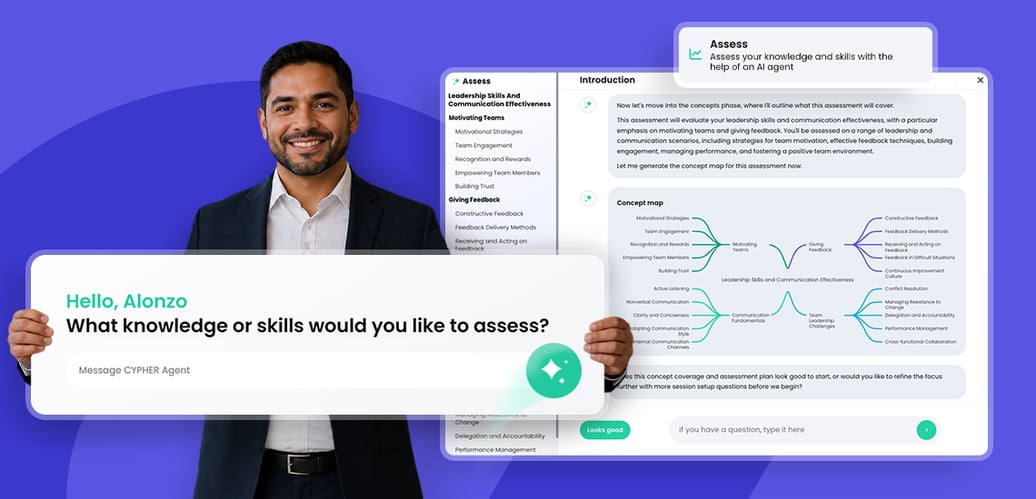
CYPHER Agent is designed to provide conversational learner support within the LMS environment, helping learners access relevant information and guidance more efficiently. Source: CYPHER Learning
Importantly, responsible AI integration does not replace instructional quality, assessment rigor, or competency validation. It enhances scalability, responsiveness, and learner support while preserving structured oversight.
The organizations that succeed will likely be those that balance AI-enabled efficiency with strong validation and governance frameworks.
Certification credibility will increasingly depend on proof of mastery
The broader shift happening across professional learning is clear: certification is moving from participation tracking toward evidence based mastery.
Modern certification ecosystems increasingly require:
- Rigorous assessment models.
- Measurable skills validation.
- Transparent AI usage.
- Continuous learning support.
- Insight driven visibility into progression.
Together, these capabilities help organizations maintain trust in credentials even as AI changes how learning operates.
Research on workforce readiness consistently shows that employers increasingly prioritize demonstrable skills and verified competency over static educational indicators alone. Source: World Economic Forum
In the age of AI, certification credibility will not come from restricting technology. It will come from building systems capable of validating real expertise within AI-enabled environments.
Ready to build trusted certification experiences in the age of AI?
CYPHER Learning helps organizations create certification programs designed for credibility, transparency, and measurable skill validation.
- Support competency aligned learning pathways.
- Strengthen assessment confidence with AI Crosscheck.
- Guide learners with AI-powered support through CYPHER Agent.
- Build certification experiences designed for long term trust and workforce readiness.
Explore how CYPHER Learning can help you create professional certification programs built for the realities of AI-enabled learning.
References
-
Source: Competency Based Education Network - https://www.cbenetwork.org/competency-based-education/
-
Source: CYPHER Learning - https://www.cypherlearning.com/tour/skills-development
-
Source: CYPHER Learning - https://www.cypherlearning.com/ai-360/cypher-agent-for-learners
-
Source: World Economic Forum - https://www.weforum.org/reports/the-future-of-jobs-report-2023/


