




At first glance, one-size-fits-all training seems like the most efficient solution for franchise organizations. Create a single program, distribute it across all locations, and ensure everyone receives the same information—simple, scalable, and consistent.
But in practice, this approach rarely delivers the results organizations expect.
Franchise networks are inherently complex, made up of different roles, regions, experience levels, and operational realities, and when training fails to reflect that complexity, it leads to disengagement, inefficiency, and ultimately inconsistent performance.
The real challenge isn’t scaling training—it’s scaling relevant training.
The illusion of efficiency in standardized training
Standardized training is often designed with the best intentions: to maintain consistency, reduce duplication, and simplify management.
However, what looks efficient on the surface often creates hidden inefficiencies beneath it.
When everyone receives the same training regardless of role or context:
- Frontline employees are overwhelmed with irrelevant information.
- Managers lack depth in the areas that matter most to them.
- Experienced staff are forced to repeat basic content.
- New hires struggle to identify what is actually important.
The result is a learning experience that feels disconnected from real work, where completion becomes the goal instead of competence.
In franchise environments, where execution quality directly impacts the brand, this disconnect is particularly costly. Source: CYPHER Learning
Why franchise networks demand a different approach
Franchise networks are not uniform organizations—they are ecosystems.
Within a single network, you may have:
- Entry-level employees focused on daily operations.
- Store managers responsible for performance and team leadership.
- Franchise owners managing business outcomes.
- Regional leaders overseeing multiple locations.
Each of these roles requires different knowledge, different skills, and different levels of depth.
Add to this:
- Regional regulations.
- Cultural differences.
- Varying levels of experience.
And it becomes clear that a single, standardized training path cannot meet everyone’s needs.
To be effective, training must be both consistent in standards and flexible in delivery. Source: CYPHER Learning
Role-based learning paths: delivering relevance at scale
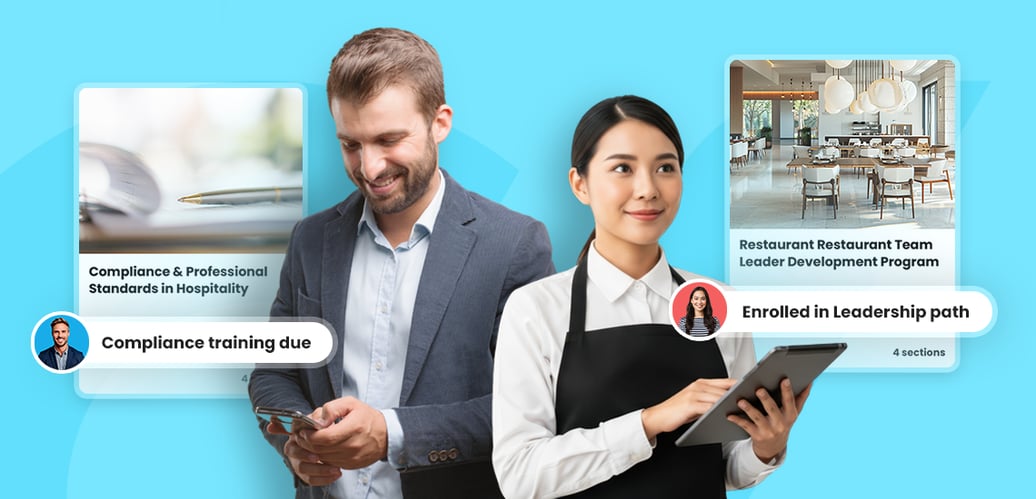
The first step in moving beyond one-size-fits-all training is implementing role-based learning paths.
Instead of pushing the same content to everyone, organizations design structured paths aligned to specific roles, such as:
- Frontline staff onboarding.
- Store manager development.
- Franchise owner enablement.
Each path includes:
- Relevant courses and modules.
- Skills and competencies tied to the role.
- Clear progression from foundational to advanced topics.
This ensures that:
- Learners only see what matters to them.
- Training is directly tied to job performance.
- Time-to-competency is reduced.
For example, a new cashier doesn’t need advanced financial reporting training, while a franchise owner doesn’t need detailed instruction on basic transactions.
By aligning learning to roles, organizations create a more efficient and engaging experience—without sacrificing consistency.
Adaptive visibility: showing the right content to the right people
Even within role-based paths, not every learner needs to see the same content at the same time.
This is where adaptive visibility becomes critical.
Adaptive visibility allows organizations to control what learners can see based on:
- Role.
- Location.
- Organization or franchise group.
- Progress or performance.
- Custom attributes such as job title or experience level.
Instead of overwhelming learners with everything at once, the platform dynamically presents only the most relevant content.
For example:
- Compliance training may only be visible in regions where it applies.
- Advanced modules may only unlock after foundational content is completed.
- Premium or specialized content may only be available to certain roles.
This creates a cleaner, more focused learning experience, where learners are guided through a path that feels tailored to their needs.
Automation filters: scaling personalization without complexity
Personalization at scale would be impossible to manage manually.
This is where automation filters play a transformative role.
Automation filters allow organizations to define rules that automatically assign, manage, and adapt training based on specific conditions.
For example:
- “If user role = Store Manager → assign Manager Learning Path”.
- “If location = Region A → assign Region A Compliance Training”.
- “If course completed → enroll in the next course in sequence”.
These rules ensure that:
- The right learners receive the right training automatically.
- Updates are applied consistently across the network.
- Administrative workload is minimized.
Automation filters effectively turn training into a self-regulating system, where personalization happens in the background without requiring constant oversight. Source: CYPHER Learning
From content distribution to learning orchestration
When role-based paths, adaptive visibility, and automation filters work together, training evolves from simple content distribution into learning orchestration.
In this model:
- Learners are automatically guided through relevant paths.
- Content adapts based on their role and progress.
- The system ensures consistency while enabling flexibility.
This approach addresses one of the biggest challenges in franchise training: delivering a unified experience across a highly diverse network.
Instead of forcing uniformity, organizations create structured flexibility—where everyone follows the same standards, but through pathways designed for their specific context.
Improving engagement and performance
One-size-fits-all training doesn’t just fail operationally—it fails experientially.
Learners quickly disengage when:
- Content feels irrelevant.
- Training is too long or repetitive.
- There is no clear connection to their role.
By contrast, personalized, role-based training:
- Increases engagement by focusing on what matters.
- Reduces time spent on unnecessary content.
- Improves retention and application.
This has a direct impact on performance.
When learners understand exactly what they need to do—and why—it becomes easier to apply training in real-world situations, leading to more consistent execution across locations.
Maintaining consistency without rigidity
A common concern with personalized training is that it may lead to inconsistency.
In reality, the opposite is true.
By defining:
- Core standards centrally.
- Role-based paths aligned to those standards.
- Rules that govern visibility and assignment.
Organizations can ensure that:
- Everyone meets the same baseline requirements.
- Training is delivered in a way that makes sense for each learner.
- Variability is controlled and intentional, not accidental.
This allows franchise networks to maintain brand consistency while still adapting to the realities of different roles and regions.
The role of modern learning platforms
Delivering this level of personalization and control requires more than traditional LMS capabilities.
Organizations need a platform that can:
- Build and manage role-based learning paths.
- Dynamically control content visibility.
- Automate training assignments with filters and rules.
- Provide visibility into learner progress and performance.
CYPHER Learning is designed to support exactly this approach.
With CYPHER, organizations can:
- Create structured, role-based learning journeys.
- Use adaptive visibility to tailor the learner experience.
- Apply automation filters to manage training at scale.
- Deliver consistent, personalized learning across the entire franchise network.
This enables organizations to move beyond generic training and create experiences that are both scalable and relevant.
Personalization is the path to consistency
The idea that standardization requires uniformity is outdated.
In complex environments like franchise networks, consistency is not achieved by treating everyone the same—it is achieved by ensuring that everyone receives the training they need to perform their role effectively.
By moving beyond one-size-fits-all training and embracing role-based paths, adaptive visibility, and automation filters, organizations can deliver learning experiences that are:
- More relevant.
- More engaging.
- More effective.
And ultimately, more aligned with the realities of how franchise networks operate.
Ready to deliver training that actually works for every role?
CYPHER Learning helps franchise organizations move beyond generic training—delivering personalized, scalable learning experiences that drive real performance.
Discover how CYPHER can help you modernize your training strategy.
References
- Source: CYPHER Learning - https://www.cypherlearning.com/blog/business/training-solutions-that-work-for-franchise-networks-and-multi-location-teams
- Source: CYPHER Learning - https://www.cypherlearning.com/solutions/franchisee-training
- Source: CYPHER Learning - https://www.cypherlearning.com/tour/automation


