




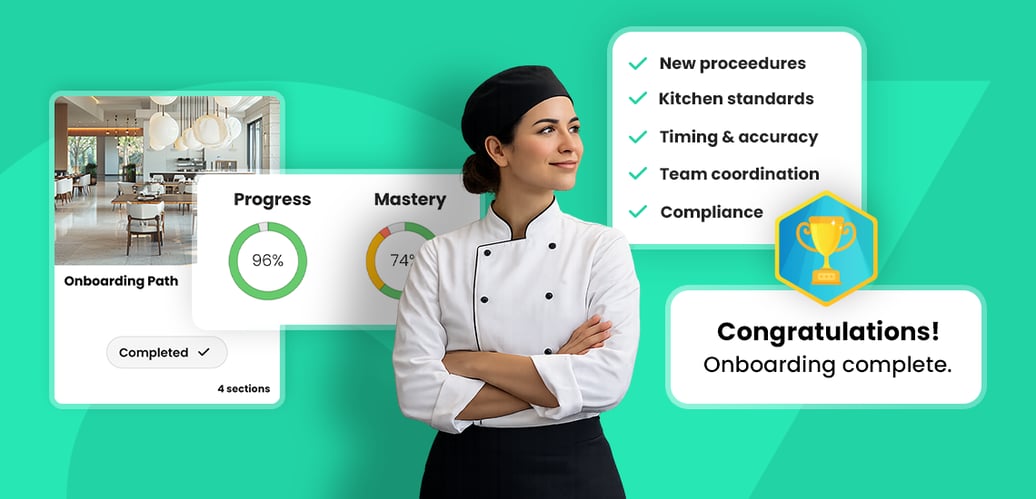
For franchise organizations, speed and consistency often feel like opposing forces.
On one hand, there is constant pressure to get new franchisees up and running as quickly as possible—minimizing time to productivity, accelerating revenue, and ensuring rapid expansion.
On the other hand, there is an equally critical need to maintain brand standards, ensuring that every location delivers a consistent experience from day one.
The challenge is clear:
How do you reduce ramp time without cutting corners?
The answer lies in rethinking onboarding and enablement—not as a one-time event, but as a continuous, intelligent learning journey powered by structured learning paths, AI support, and just-in-time learning.
Why ramp time matters more than ever
Ramp time is more than just an operational metric—it’s a strategic lever.
The faster a franchisee can:
- Understand the business model.
- Execute operational processes.
- Deliver the expected customer experience.
The faster they can contribute to the success of the network.
However, traditional onboarding approaches often slow this down:
- Overloaded training programs that try to cover everything upfront.
- Static content that lacks relevance or context.
- Limited support once training is complete.
This creates a paradox where organizations either:
- Slow down onboarding to ensure quality, or
- Accelerate onboarding at the expense of consistency.
Neither is sustainable.
The problem with front-loaded training
Many franchise onboarding programs are designed as intensive, front-loaded experiences.
New franchisees are expected to:
- Complete extensive training before launching.
- Absorb large amounts of information in a short time.
- Retain knowledge they may not use immediately.
- Onboard new employees while still absorbing the knowledge themselves.
In reality, this approach is inefficient.
Learners forget much of what they consume upfront, and when real-world challenges arise, they often lack the support needed to apply what they’ve learned.
The result is longer ramp times, inconsistent execution, and increased reliance on support teams.
Learning paths: structuring the journey to productivity
The first step in reducing ramp time is replacing one-time onboarding programs with structured learning paths.
Learning paths organize training into a sequence that reflects how franchisees actually learn and operate, guiding them from foundational knowledge to advanced capabilities over time. Source: CYPHER Learning
Instead of overwhelming learners, paths:
- Break content into manageable stages.
- Align training with real-world milestones.
- Ensure logical progression from basic to complex tasks.
For example:
- Pre-launch: core business concepts and brand standards.
- Launch phase: operational tasks and daily workflows.
- Post-launch: optimization, growth, and advanced skills.
This approach ensures that franchisees learn what they need, when they need it—reducing cognitive overload while accelerating time-to-competency.
AI support: providing guidance beyond onboarding
Even the best-designed learning path cannot anticipate every question or challenge a franchisee will face.
This is where AI-powered learning support becomes essential.
AI assistants transform the learning experience by providing:
- Instant answers to questions.
- Context-aware guidance based on user activity.
- Personalized recommendations for next steps.
Instead of searching through manuals or waiting for support, franchisees can:
- Ask questions in real time.
- Receive structured, easy-to-understand responses.
- Explore related topics instantly.
This reduces friction during critical moments, allowing franchisees to move forward without delays.
Just-in-time learning: meeting needs in the moment
One of the most effective ways to reduce ramp time is through just-in-time learning, which delivers knowledge exactly when it is needed.
Rather than relying solely on pre-training, just-in-time learning allows franchisees to:
- Access information during real tasks.
- Solve problems as they arise.
- Reinforce learning through application.
For example:
- A franchisee encounters an unfamiliar process → accesses a quick learning module.
- A team member needs guidance → uses AI support for immediate answers.
- A compliance requirement changes → receives updated training instantly.
This approach ensures that learning is directly tied to action, improving retention and reducing errors.
Combining structure and flexibility
The real power comes from combining learning paths, AI support, and just-in-time learning into a single, cohesive experience.
In this model:
- Learning paths provide structure and direction.
- AI support fills in gaps, answers questions, and provides coaching.
- Just-in-time learning enables immediate application.
Together, they create a system where franchisees are:
- Guided through a clear progression.
- Supported in real time.
- Empowered to learn continuously.
This balance between structure and flexibility is key to reducing ramp time without sacrificing standards.
Maintaining standards while accelerating speed
A common concern with faster onboarding is that it may lead to inconsistencies.
However, when implemented correctly, modern learning approaches actually strengthen standards.
By:
- Defining clear learning paths aligned to brand requirements.
- Embedding standards into every stage of the journey.
- Providing real-time support to prevent errors.
Organizations can ensure that:
- Every franchisee follows the same foundational framework.
- Learning is reinforced through practice.
- Deviations are minimized.
In this way, speed and quality are no longer in conflict—they reinforce each other.
The role of continuous learning
Reducing ramp time is not just about onboarding—it’s about what happens next.
Franchisees and their teams must continue to learn and improve as:
- Processes evolve.
- Products change.
- Markets shift.
A continuous learning approach ensures that:
- Skills are reinforced over time.
- Knowledge stays current.
- Performance continues to improve.
This creates a culture where learning is ongoing, not a one-time requirement.
The business impact of faster ramp times
Organizations that successfully reduce ramp time while maintaining standards see measurable benefits:
- Faster time to revenue: Franchisees become productive more quickly, accelerating business outcomes.
- Greater consistency: Structured learning ensures alignment across all locations.
- Reduced support burden: AI and just-in-time learning decrease reliance on central teams.
- Improved franchisee satisfaction: Learners feel supported, confident, and capable.
- Scalable growth: Training becomes an enabler of expansion rather than a bottleneck.
Why modern platforms make this possible
Achieving this level of speed and consistency requires more than traditional training tools.
Organizations need a platform that can:
- Build and manage learning paths.
- Deliver AI-powered support for learners.
- Enable just-in-time learning experiences.
- Connect learning to real-world workflows.
CYPHER Learning is designed to support this transformation.
With CYPHER, you can:
- Create structured, adaptive learning paths for franchisees.
- Provide an AI-driven learner agent for real-time learning support.
- Deliver consistent training at scale.
This allows organizations to accelerate onboarding while maintaining the standards that define their brand. Source: CYPHER Learning
Conclusion: speed and standards can coexist
The idea that you must choose between fast onboarding and high standards is outdated.
With the right approach, organizations can achieve both:
- Faster ramp times through structured, efficient learning.
- Stronger standards through continuous reinforcement and support.
By embracing learning paths, AI support, and just-in-time learning, franchise organizations can create a training ecosystem that is not only scalable, but also highly effective.
In this new model, learning doesn’t slow growth—it drives it.
Ready to accelerate franchisee success without compromising quality?
CYPHER Learning helps organizations reduce ramp time while maintaining consistency—empowering franchisees to succeed from day one and beyond.
Discover how CYPHER can transform your franchise training.
References
- Source: CYPHER Learning - https://www.cypherlearning.com/tour/automation
- Source: CYPHER Learning - https://www.cypherlearning.com/ai-360/cypher-agent-for-learners
- Source: CYPHER Learning - https://www.cypherlearning.com/solutions/franchisee-training


