




For franchise organizations, compliance is non-negotiable.
Whether it’s health and safety regulations, operational standards, or industry-specific requirements, every location must meet defined criteria—not just once, but continuously.
Yet despite its importance, compliance is often one of the most frustrating and resource-intensive aspects of franchise operations.
Manual tracking, inconsistent processes, and limited visibility create a constant risk of gaps, missed deadlines, and audit failures.
The challenge isn’t understanding what needs to be done—it’s ensuring it happens consistently, at scale, across every location.
That’s why leading organizations are shifting toward automated compliance systems, where technology handles the complexity, and teams can focus on execution. Source: Talented Learning; Source: CYPHER learning; Source: eLearning Industry
Why franchise compliance becomes unmanageable at scale
In a single-location business, compliance is relatively straightforward.
But in a franchise network, complexity multiplies quickly.
Organizations must manage:
- Hundreds or thousands of employees.
- Multiple locations with different regulations.
- Ongoing certification and recertification requirements.
- Changing policies and standards.
Without automation, this often leads to:
- Spreadsheets tracking completion.
- Manual reminders and follow-ups.
- Inconsistent enforcement across locations.
- Limited visibility into compliance status.
The result is a reactive approach, where issues are discovered only when something goes wrong—often during audits or after incidents.
The hidden cost of manual compliance management
Manual compliance processes don’t just create inefficiency—they introduce real business risk.
Common consequences include:
- Missed certifications or expired credentials.
- Incomplete training records during audits.
- Increased administrative workload.
- Inconsistent standards across locations.
Perhaps most importantly, manual systems rely heavily on human intervention, which makes them inherently unreliable at scale.
In franchise environments, where consistency is critical, this creates a gap between intention and execution. Source: CYPHER Learning
Compliance automation: from reactive to proactive
The most effective way to address these challenges is through compliance automation, which transforms compliance from a manual, reactive process into a proactive, system-driven one.
With automation, organizations can:
- Assign required training based on role, location, or regulation.
- Track completion in real time.
- Trigger reminders before deadlines.
- Automatically re-enroll learners for required updates.
Instead of relying on individuals to remember what needs to be done, the system ensures that:
- Every learner is assigned the right training.
- Deadlines are enforced consistently.
- Nothing falls through the cracks.
This shift dramatically reduces risk while improving efficiency.
Recertification: managing ongoing compliance with ease
One of the most complex aspects of compliance is recertification.
It’s not enough for employees to complete training once—they must:
- Renew certifications regularly before they expire.
- Stay up to date with changing standards.
- Demonstrate continued competence.
Without a structured system, recertification quickly becomes chaotic.
Automation simplifies this by:
- Setting expiration timelines for certifications.
- Triggering notifications before deadlines.
- Automatically reassigning training when required.
- Tracking completion across cycles.
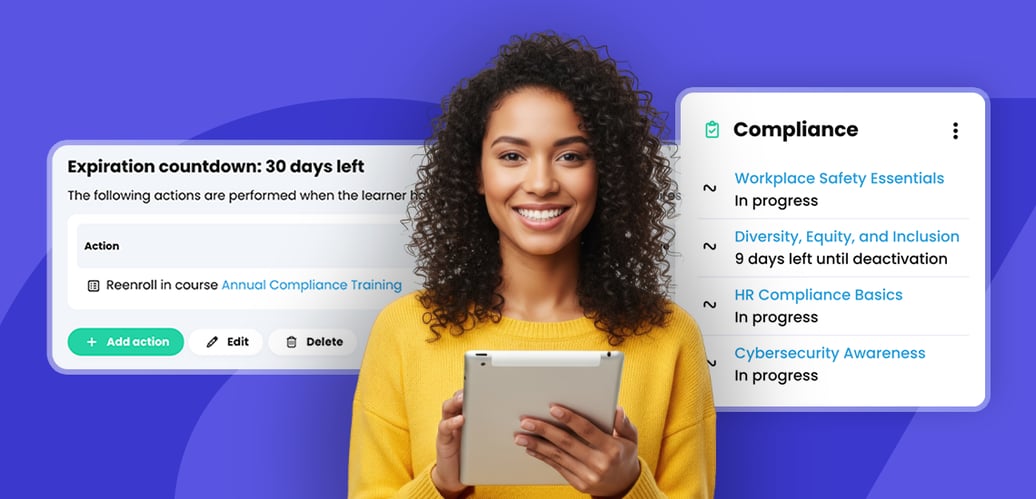
For example with a certification that’s valid for one year, the system will:
- Send reminders 30, 15, and 7 days before expiration.
- Automatically re-enroll the learner.
- Notify managers of overdue items.
This ensures continuous compliance without constant manual oversight.
Reporting: turning compliance into visibility
Even with strong processes in place, compliance is only effective if organizations have visibility into what’s happening across the network.
This is where reporting becomes essential.
Modern compliance systems provide real-time insights into:
- Completion rates across locations.
- Certification status for each learner.
- Upcoming expirations.
- Areas of risk or non-compliance.
This allows organizations to:
- Identify issues early.
- Take targeted action.
- Prepare for audits with confidence.
Instead of scrambling to gather data, teams can access accurate, up-to-date reports instantly. Source: CYPHER Learning
From fragmented processes to a unified system
The real transformation happens when compliance automation, recertification, and reporting are integrated into a single system.
In this model:
- Training assignments are automated.
- Certification cycles are managed seamlessly.
- Data is captured and analyzed in real time.
This creates a closed-loop system where:
- Requirements are defined centrally.
- Execution is automated.
- Outcomes are continuously monitored.
The result is a compliance strategy that is not only more efficient, but also more reliable.
Reducing administrative burden while increasing control
One of the biggest benefits of automation is the ability to reduce administrative workload without losing control.
Instead of spending time on:
- Manual enrollments.
- Follow-up emails.
- Tracking spreadsheets.
Teams can focus on:
- Improving training quality.
- Supporting learners.
- Addressing performance gaps.
At the same time, centralized control ensures that:
- Standards are applied consistently.
- Policies are enforced across all locations.
- Changes can be implemented quickly.
This balance between efficiency and control is critical for scaling franchise operations.
Supporting franchisees without overwhelming them
Compliance can often feel like a burden for franchisees, especially when processes are unclear or difficult to manage.
Automation helps shift this perception by:
- Providing clear, structured requirements.
- Delivering timely reminders.
- Simplifying the completion process.
Instead of chasing compliance, franchisees are guided through it.
This not only improves adherence but also strengthens the relationship between the brand and its franchise network.
The business impact of automated compliance
Organizations that adopt automated compliance systems see significant benefits:
- Reduced risk: Fewer missed deadlines and audit failures.
- Improved consistency: Standardized processes across all locations.
- Greater efficiency: Less time spent on manual administration.
- Better visibility: Real-time insights into compliance status.
- Scalable operations: Systems that grow with the organization.
Compliance becomes a strength rather than a liability.
Why modern platforms are essential
Achieving this level of automation and visibility requires more than basic tools.
Organizations need a platform that can:
- Automate compliance workflows.
- Manage certification and recertification cycles.
- Provide real-time reporting and analytics.
- Scale across multiple locations and roles.
CYPHER Learning is designed to support these needs.
With CYPHER, you can:
- Automate compliance training and tracking.
- Manage certification lifecycles with ease.
- Monitor compliance across your entire network.
- Ensure consistency without increasing workload.
This allows organizations to simplify compliance while maintaining the highest standards.
Conclusion: compliance without complexity
Compliance will always be a critical part of franchise operations—but it doesn’t have to be complicated.
By automating what matters most—training assignments, recertification, and reporting—organizations can transform compliance from a reactive burden into a proactive, scalable system.
In this new model, compliance is not something you chase. It’s something that happens—consistently, reliably, and without the headaches.
Ready to simplify franchise compliance?
CYPHER Learning helps organizations automate compliance, manage recertification, and gain real-time visibility—so you can focus on growing your business with confidence.
Discover how CYPHER can streamline your compliance strategy.
References
- Source: Talented Learning - https://talentedlearning.com/compliance-training-from-obligation-to-opportunity/
- Source: CYPHER learning - https://www.cypherlearning.com/solutions/compliance
- Source: eLearning Industry - https://elearningindustry.com/rethinking-compliance-training
- Source: CYPHER learning - https://www.cypherlearning.com/solutions/franchisee-training
- Source: CYPHER learning - https://www.cypherlearning.com/tour/reporting-and-analytics


