




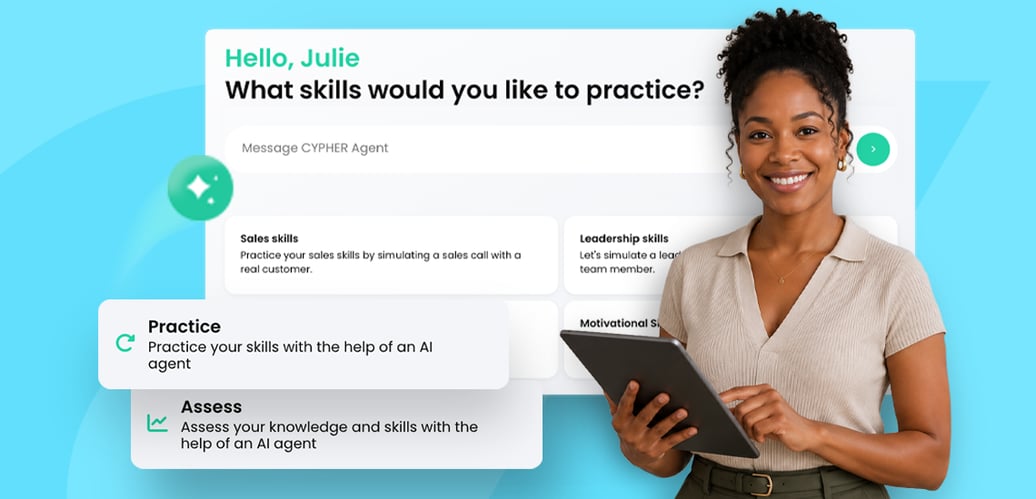
For years, learning technology has been very good at organizing learning activities. Courses lived in one place. Assessments appeared at predetermined points. Skills frameworks often sat alongside the learning itself. Practice, when it happened, depended on managers, coaches, instructors, or separate tools.
Each element had value, but the learner was expected to make the connections.
That is beginning to change. AI is creating an opportunity to connect formal courses with personalized learning, knowledge assessment, skills practice, and ongoing development in a much more continuous experience. Instead of asking learners to move through a sequence of disconnected activities, learning can respond to what they know, what they need to develop, and what they are trying to do next.
For L&D leaders, this is a more important shift than simply adding AI to course creation. It changes the relationship between learning and capability. The question moves from “What content have we delivered?” toward “How are we helping this person move from knowledge to confident performance?”
CYPHER Learning brings Learn, Practice, and Assess together through CYPHER Agent for learners, supporting people as they build knowledge, identify gaps, practice skills, and progress alongside more traditional courses and learning paths.
Courses provide structure, but they cannot anticipate every learning need
Courses remain valuable because structure matters. Organizations need a reliable way to introduce concepts, sequence learning, provide exercises, and ensure that important material is covered consistently. There are plenty of situations where letting every learner determine their own curriculum would make little sense.
The limitation appears when we expect the course to do everything.
No instructional designer can anticipate every question a learner will have. Two people can complete the same module and come away with very different gaps in understanding. Another learner may already understand most of the material but need considerably more depth on one concept. Someone else may discover a new learning need only when they try to apply what they learned.
This is where CYPHER Agent: Learn adds another layer to formal learning. Learners can use it to explore a subject that is not covered by existing material, investigate something in greater depth, or access learning in the moment they need it. CYPHER Agent can also be launched from within a course, creating a connection between structured content and personalized exploration. Source: CYPHER Learning
The course does not disappear. It becomes the foundation of a learning experience that can respond when individual needs inevitably diverge from the planned path.
Skills give learning a destination
One reason learning programs can feel disconnected from performance is that content becomes the organizing principle. We build courses, assign courses, complete courses, and report on courses. Yet the reason most organizations invest in learning is not because they need more completed content. They need people to develop knowledge, skills, and competence.
Skills provide a way to make that purpose explicit.
Within CYPHER Learning, skills can be mapped to learning content and assessments, helping organizations connect what people are learning with the capabilities they are expected to develop. CYPHER Agent can also support skills development by giving learners opportunities to explore relevant skills through AI supported learning experiences.
That connection creates a more purposeful journey:
- Courses provide structured knowledge and learning experiences.
- Skills establish what the learner is working toward.
- Assess helps establish what the learner understands and where gaps remain.
- Practice creates opportunities to apply knowledge before it matters in the real world.
- Learn gives learners another way to build understanding when they need greater depth.
Consider someone developing customer objection handling. A structured course might introduce the underlying techniques and examples. The skill gives that learning a clear developmental purpose. But knowing the theory is only the beginning. The learner still needs an opportunity to understand what they genuinely know and whether they can use it.
That is where assessment and practice become much more valuable. Source: CYPHER Learning
Assessment becomes more useful when it identifies what happens next
Traditional assessment is often treated as the end of learning. Take the quiz, receive the score, and move on. That makes sense when the primary goal is recording whether someone passed, but it is less useful when the objective is development.
A developmental assessment should do more than tell someone what they got wrong. It should help reveal where understanding is strong, where gaps remain, and where development should focus next.
CYPHER Agent: Assess approaches assessment conversationally. Learners can assess their knowledge of a topic or skill and receive an evaluation of their understanding, creating another way to identify areas that may need further attention.
This creates a different relationship with assessment. Instead of functioning only as a gate at the end of a course, it can become part of the learning process itself. A learner might use Assess before deciding what to learn, after completing formal training, or when they want to understand whether they need additional development. Source: CYPHER Learning
Assessment stops being only a verdict and starts becoming an input into what happens next.
Practice closes the gap between understanding and doing
Even a strong assessment has limits. Someone can explain the right approach to a difficult conversation and still struggle when they have to conduct one. They can understand the principles of customer service but react poorly when faced with an angry customer. They can know the steps of a sales methodology without being able to use them naturally in conversation.
Capability requires application.
CYPHER Agent: Practice gives learners an environment in which they can practice skills through interactive scenarios and receive feedback. This is particularly valuable for capabilities that cannot be developed through reading and recall alone.
Think about the situations where practice matters most: handling a difficult customer conversation, preparing for a sales interaction, managing a challenging workplace scenario, or communicating an unfamiliar idea clearly. These are skills people develop by doing, reflecting, adjusting, and trying again.
For training companies, this creates an opportunity to extend the value of a program beyond the content itself. Instead of a learner simply completing a course and assessment, providers can create experiences where learners have opportunities to apply what they have learned. A sales training provider, for example, could combine structured instruction with assessment and realistic practice scenarios, giving learners more ways to develop the capability the program was designed to build.
Practice has historically been difficult to scale. Coaching and role play can be highly valuable, but they require time, people, coordination, and consistency. For training companies serving large numbers of learners or multiple customer organizations, those requirements can make hands-on practice particularly difficult to deliver consistently.
AI changes the economics of that experience. A learner can practice before the real situation arrives, identify where they struggle, and use that insight to continue developing. The goal is not to replace human coaching where it adds value. It is to make meaningful practice available in many more moments where previously there may have been none.
The real opportunity is the loop between all four
The most interesting development is not Learn, Practice, or Assess in isolation. It is what happens when they become part of the same development journey.
Imagine a learner who needs to improve a specific skill. Instead of automatically assigning another course, the development journey could work differently:
- Assess what the learner already understands and identify areas that need attention.
- Learn by exploring those areas through personalized learning or relevant structured content.
- Practice applying the knowledge in a scenario where mistakes become opportunities to improve.
- Return to learning, assessment, or further practice as the learner's needs evolve.
Learning becomes a loop rather than a line.
That model is much closer to how capability develops in the real world. People learn something, attempt it, discover where their understanding breaks down, improve, and try again. Formal courses still have an important role, but they become one component of a broader development experience rather than the entire experience.
CYPHER brings these elements closer together by connecting skills aligned training with personalized learning, conversational assessment, and interactive practice through CYPHER Agent. Source: CYPHER Learning
L&D can start designing for capability, not content consumption
For training companies, this can also change how programs are designed and differentiated. Rather than defining an offering primarily by the courses it contains, providers can start with the capabilities learners are expected to develop, then combine structured learning, skills, assessment, personalized support, and practice around that outcome.
For L&D teams, this creates a useful set of design questions:
- What does the learner need to know?
- What skill are we actually trying to develop?
- How will we understand what they already know?
- Where can they safely practice applying it?
- What happens when they encounter a gap we did not anticipate?
- How can the experience continue after the course is complete?
This does not make learning design less important. It makes its role broader. L&D can move from producing content toward orchestrating the experiences that help someone become capable.
CYPHER Learning's approach to skills development supports this shift by connecting skills with learning content, assessment, personalized development, and CYPHER Agent experiences rather than treating skills as a separate layer of the learning environment. Source: CYPHER Learning
Ready to connect learning to real skill development?
The future of learning is not about choosing between courses and AI. It is about connecting the different ways people actually develop capability.
CYPHER Agent brings Learn, Practice, and Assess into the learner experience so people can build knowledge, understand their gaps, apply what they know, and continue developing the skills that matter. Combined with structured courses and skills aligned learning, these experiences can create a more continuous journey from knowing to doing.
Explore how CYPHER Learning can help you connect courses, skills, learning, practice, and assessment in one AI-native training platform, and schedule a demo today.
References
- Source: CYPHER Learning - https://www.cypherlearning.com/ai-360/cypher-agent-for-learners
- Source: CYPHER Learning - https://www.cypherlearning.com/blog/news/smarter-personalized-learning-with-cypher-agent-for-learners
- Source: CYPHER Learning - https://www.cypherlearning.com/tour/skills-development
- Source: CYPHER Learning - https://www.cypherlearning.com/blog/news/new-cypher-agent-practice-and-assess-tools-for-learners
- Source: CYPHER Learning - https://www.cypherlearning.com/ai-360


