




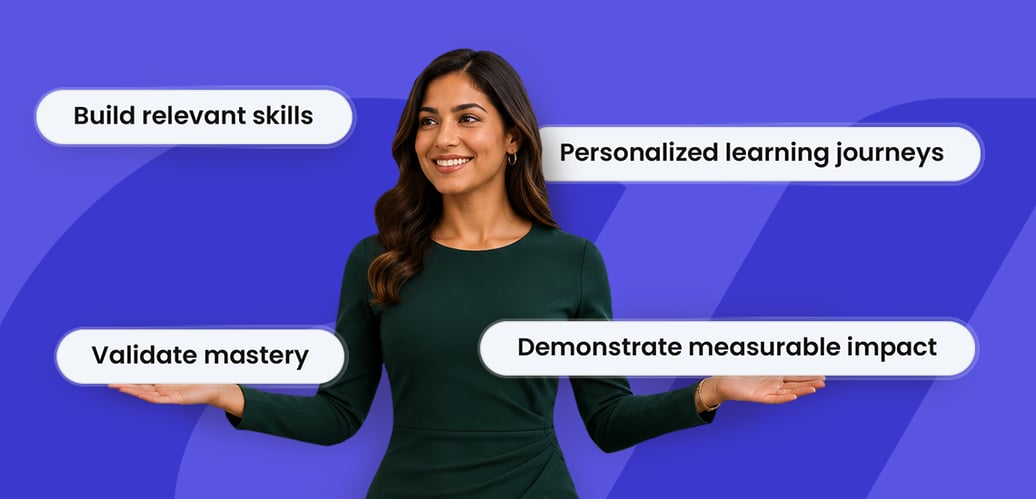
The online training market is crowded with courses, certifications, and subscription libraries. Learners have more content available than ever before. Yet many training businesses still struggle with learner engagement, renewals, and proving ROI to customers.
Why? Because content alone is no longer enough.
Today’s buyers are not investing in training because they want more videos or PDFs. They are investing because they want measurable improvement. They want employees who can perform better, customers who can adopt products faster, and teams who can build verified skills that drive business results.
The most successful training businesses understand this shift. Instead of positioning themselves as content providers, they position themselves as outcome partners.
That means focusing on skills development, mastery tracking, and data driven validation that proves learning is making a real impact.
According to Brandon Hall Group, competency based learning is becoming a defining factor in modern workforce development because organizations increasingly need evidence of skills progression, not just course completion. Source: Brandon Hall Group
Content is easy to replicate. Outcomes are not
Creating content has become dramatically easier. AI tools can generate outlines, quizzes, videos, and even full courses in minutes. As a result, the value of content alone is declining.
What cannot be easily replicated is a learning experience that consistently produces measurable results.
Training businesses that lead the market focus on questions like:
- Did learners build the right skills?
- Can they demonstrate mastery?
- Are they applying knowledge successfully?
- Can managers or customers verify improvement?
This is where outcome focused learning creates a competitive advantage.
Platforms that support competency mapping, adaptive learning, and mastery tracking help training providers connect learning activity directly to business goals. Instead of simply reporting that a learner watched six videos, they can show progress toward specific competencies and learning objectives.
Research from IDC also highlights the growing importance of measurable training impact, with organizations increasingly prioritizing platforms that provide actionable analytics and performance visibility. Source: IDC
Four ways top training businesses shift from content to outcomes
1. They build programs around skills, not courses
Traditional course catalogs are often organized around topics. Outcome driven training businesses organize learning around skills.
For example, instead of offering a generic “Leadership Essentials” course, they define measurable competencies such as:
- Coaching conversations.
- Conflict resolution.
- Team decision making.
- Performance feedback.
This shift matters because skills are easier to measure, personalize, and align with business objectives.
Modern learning platforms now support competency frameworks that connect modules, assessments, and learning paths directly to skills. Instructors can map assessments to competencies and track learner progress across each skill area.
This creates a much stronger value proposition for customers because they can see exactly what learners are gaining from the program.
It also opens the door to personalized learning recommendations, adaptive learning paths, and role based development plans.
The World Economic Forum continues to emphasize that skills based workforce development is becoming essential as organizations adapt to rapid technological and economic change. Source: World Economic Forum; Source: CYPHER Learning
2. They prove mastery with measurable validation
Completion rates alone do not prove learning effectiveness. High performing training businesses use mastery tracking and assessments to validate learner capability. This includes:
- Skills aligned quizzes and assignments.
- Practical assessments.
- Rubrics tied to competencies.
- Progress dashboards.
- Mastery grids that identify strengths and gaps.
Some platforms now allow every assessment question to be linked directly to a skill or competency, making it possible to track proficiency at a granular level. This approach transforms learning analytics from passive reporting into meaningful business intelligence.
For example, a customer success training provider could show that learners improved onboarding proficiency by 35% across specific competencies after completing a program. That kind of insight is far more valuable than simply reporting attendance or completion.
Data driven validation also strengthens customer retention because clients can clearly connect training investment to measurable progress. Source: CYPHER Learning
3. They personalize learning journeys
Not every learner starts from the same place. Outcome focused training businesses recognize that personalization improves engagement, completion, and knowledge retention. Instead of forcing every learner through identical content, they use adaptive learning techniques such as:
- Skill based recommendations.
- Conditional learning paths.
- Score based content unlocking.
- Personalized remediation.
- AI guided learning support.
Modern LMS platforms increasingly support adaptive learning workflows that automatically show or hide modules based on assessment performance or learner attributes.
This creates a more efficient learning experience because learners spend less time reviewing concepts they already know and more time strengthening skill gaps.
Personalization also helps training businesses scale premium learning experiences without dramatically increasing instructor workload. When combined with automation, adaptive learning can guide learners through customized journeys while still maintaining consistency and measurable outcomes. Source: CYPHER Learning
4. They use data to strengthen customer relationships
Training businesses that sell outcomes treat reporting and analytics as a strategic asset, not an administrative feature. Reporting dashboards, compliance summaries, course analytics, and mastery tracking all help demonstrate value to customers over time.
This is especially important for B2B training providers serving enterprise clients.
Decision makers increasingly expect training vendors to answer questions like:
- Which learners are progressing?
- Which skills are improving?
- Where are learners struggling?
- What training produces the strongest outcomes?
- Which programs contribute to compliance readiness?
Detailed reporting helps training providers move from being viewed as content vendors to becoming trusted strategic partners. It also supports stronger renewal conversations because clients can clearly see business impact backed by data. Source: CYPHER Learning
The future of training businesses is outcome driven
The shift from content delivery to measurable outcomes is already happening across the training industry. As AI makes content creation faster and more accessible, differentiation will increasingly come from the ability to:
- Build relevant skills.
- Validate mastery.
- Personalize learning.
- Demonstrate measurable impact.
Training businesses that embrace this model will be better positioned to retain customers, expand enterprise relationships, and prove long term value.
The good news is that modern learning platforms now make this much easier to achieve.
With tools for competency mapping, automation, adaptive learning, analytics, and mastery tracking, organizations can create scalable learning experiences that focus on real business outcomes rather than simple content consumption.
Turn learning into measurable business impact with CYPHER Learning
CYPHER Learning helps training businesses move beyond content delivery with AI-powered learning experiences built around skills development, mastery tracking, adaptive learning, and data driven validation.
From competency aligned assessments to personalized learning paths and advanced analytics, CYPHER gives training providers the tools they need to demonstrate measurable learner outcomes at scale.
Explore how CYPHER Learning can help you deliver learning that drives real business results.
References
- Source: Brandon Hall Group - https://brandonhall.com/measuring-what-matters-connecting-learning-outcomes-to-business-results-with-ai/
- Source: IDC - https://my.idc.com/getdoc.jsp?containerId=US53278525
- Source: World Economic Forum - https://www.weforum.org/publications/the-future-of-jobs-report-2025/in-full/3-skills-outlook/
- Source: CYPHER Learning - https://www.cypherlearning.com/tour/skills-development
- Source: CYPHER Learning - https://www.cypherlearning.com/tour/assessment-and-evaluation
- Source: CYPHER Learning - https://www.cypherlearning.com/tour/automation
- Source: CYPHER Learning - https://www.cypherlearning.com/solutions/training-organizations


