




Franchised businesses depend on knowledge being repeatable. A customer should encounter the same standards whether they walk into the original location or the hundredth. A new franchisee needs to understand how the brand operates. A manager needs to know how to lead according to established practices. Frontline teams need the right product, process, compliance, and customer knowledge to perform their roles confidently.
Traditionally, organizations have captured much of that knowledge in content: operations manuals, courses, PDFs, playbooks, policies, presentations, and resource libraries.
Those resources remain valuable. But there is a growing difference between having knowledge available and making knowledge useful at the moment someone needs it.
The International Franchise Association describes brand consistency as critical to franchising, supported by operational manuals, training programs, and ongoing support that help franchisees deliver a reliable customer experience across locations. Source: International Franchise Association
AI creates an opportunity to take that principle further.
Instead of organizational knowledge remaining static until someone finds, reads, and interprets it, learning can become more responsive to the people using it.
Knowledge can start behaving less like a library and more like a living part of the business.
Static knowledge creates a growing challenge
An operations manual can document exactly how something should be done. A course can explain a new process. A playbook can capture years of organizational experience.
The challenge appears when somebody needs that knowledge while doing their job.
Imagine a franchise location manager dealing with an unfamiliar operational situation. The answer may exist somewhere in the organization, but finding it could mean searching an intranet, locating the correct document, identifying the relevant section, and working out how the information applies.
The larger the franchise network becomes, the more significant this problem can become. Knowledge grows alongside the organization, while employees and franchisees still need to find the right information quickly.
The International Franchise Association has previously described the opportunity for franchise operations manuals to become interactive resources that are searchable, connected to training, and capable of evolving as information changes. Source: International Franchise Association
The next evolution is not simply making content easier to search. It is making knowledge easier to use.
That changes the role of the learning platform. Instead of only being somewhere people go to complete assigned training, it can also become part of how they continue learning as work happens.
Context turns information into relevant knowledge
Public AI tools have access to enormous amounts of information. But a franchise business does not operate according to the average answer from the internet. It has its own standards, processes, terminology, products, customer expectations, and ways of working.
That is why contextual AI matters.
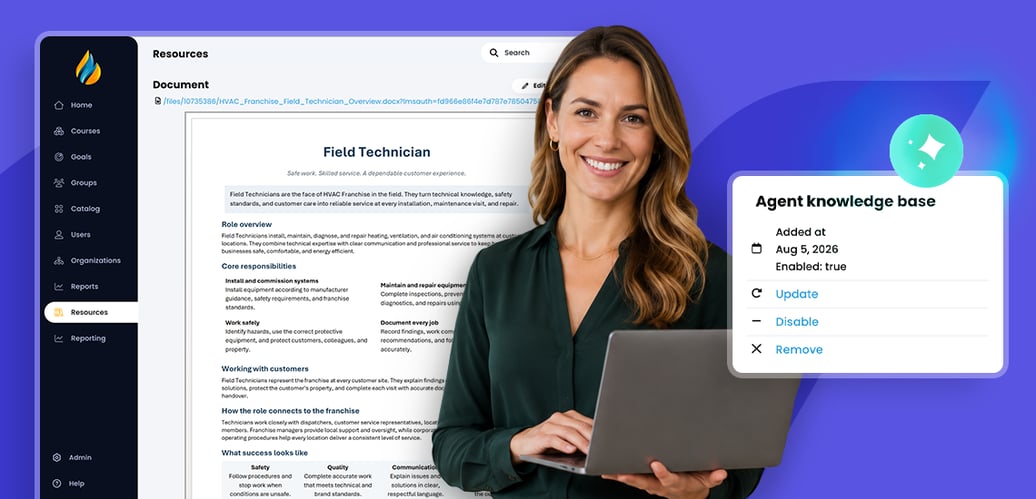
Within CYPHER Learning, organizations can make proprietary resources available through the CYPHER Agent knowledge base. These can include resources such as operational documentation, policies, sales materials, product information, and other approved organizational content.
CYPHER Agent can use those resources as context for personalized learning experiences. For a franchise network, this creates an important distinction. A franchisee does not simply need to know how businesses generally handle a particular situation. They need to understand how their brand expects that situation to be handled. Source: CYPHER Learning
A frontline employee may not need another broad course on customer service. They may need clarification about the service standard their organization has established.
Context connects learning to those realities.
The value of organizational knowledge increases when people can reach the right part of it in the context of what they are trying to accomplish.
Learning can move closer to the work
Traditional training usually has a defined beginning and end. Someone completes onboarding, attends a session, follows a learning path, or finishes a course.
Work is rarely as predictable. Questions emerge while serving customers, managing teams, introducing products, following new processes, or taking on unfamiliar responsibilities. This is where learning in the flow of work becomes particularly valuable for distributed franchise networks.
CYPHER Agent: Learn allows learners to ask for help understanding a subject and generates a personalized learning experience around that request. Learners can explore related concepts, ask further questions, and return to previous learning interactions. Experiences can draw from universal knowledge or proprietary resources provided through the organization's knowledge base. Source: CYPHER Learning
Consider a franchise manager preparing to coach an employee through a new responsibility. Instead of waiting for the next scheduled training session, they could explore the relevant subject when the need arises.
Or consider an employee who has completed formal training but encounters something they do not fully understand several weeks later. Their development does not necessarily need to stop because the course has finished.
That does not eliminate structured training. Onboarding, compliance programs, certifications, and formal learning paths still provide essential structure. It means formal learning can be supported by continuous learning around the moments where knowledge becomes useful.
Living knowledge should build capability
Making knowledge easier to access solves only part of the problem. Franchise businesses ultimately need people to become more capable. That requires a connection between knowledge and skills.
A completed course tells an organization that someone reached the end of an activity. Skills can provide another perspective by helping connect learning with the capabilities required for a particular role.
Within CYPHER Learning, skills can be associated with learning content and assessments, while mastery can provide insight into learner understanding. Learners can also set learning goals around skills and receive relevant course recommendations to support their development. Source: CYPHER Learning
This can be particularly useful across a franchise network because different roles require different capabilities. A franchise owner, location manager, team leader, salesperson, and frontline employee should not necessarily follow identical development journeys.
Skills provide a way to create clearer connections between what someone needs to know, what they need to be able to do, and the learning that can help them progress.
That becomes increasingly important as organizations face wider skills pressures. LinkedIn's 2025 Workplace Learning Report found that 49% of learning and talent development professionals say executives are concerned that employees lack the skills needed to execute business strategy. Source: LinkedIn Learning
For franchised businesses, those capability gaps can multiply across locations. Making development more relevant at the individual level can help organizations pursue consistency without assuming that everybody needs exactly the same learning.
Consistency needs continuous reinforcement
Franchise training has an unusual challenge: scale cannot come at the expense of consistency.
Every new location introduces more people who need to understand the brand. Every operational change needs to reach an increasingly distributed audience. Every new product, service, process, or requirement creates knowledge that needs to move through the network.
The International Franchise Association notes that digital training can help franchisees train new hires consistently while making it easier for franchisors to expand training or communicate changes across the organization. Source: International Franchise Association
Living knowledge builds on that principle. Instead of expecting a single training event to carry a standard indefinitely, organizations can create an environment where people continue interacting with relevant knowledge after formal training ends.
Structured courses establish the foundation. Skills provide direction for development. Contextual AI connects learning to approved organizational resources. CYPHER Agent: Learn gives people another way to explore knowledge when questions appear.
Together, these capabilities can help franchisors maintain central knowledge while giving franchisees and their teams more ways to use it locally.
Consistency becomes something the organization continually supports rather than something training is expected to achieve once.
From content management to knowledge activation
The distinction between static content and living knowledge is ultimately about what happens after information has been created. Static content waits. Living knowledge can be explored, connected to skills, grounded in organizational context, and brought into learning when a person encounters a need.
For franchised businesses, that shift matters because growth continually increases the distance between the people who define the brand and the people who represent it every day.
CYPHER Learning's approach to franchise training combines centralized control with the ability to support franchisees, operators, and frontline teams across distributed locations. Source: CYPHER Learning
The opportunity is not to replace operations manuals, courses, playbooks, or structured training. It is to make the knowledge inside them more useful.
When a new location opens, knowledge can support onboarding. When someone takes on a different role, skills can guide development. When a question emerges during work, contextual AI can help connect the learner with relevant organizational knowledge. When someone wants to understand a subject more deeply, CYPHER Agent: Learn can create an opportunity to continue exploring.
That creates a much more dynamic relationship between content, knowledge, skills, and performance.
Knowledge should move with the business
Franchise organizations will continue creating content. Standards need documenting. Courses need structure. Policies need communicating. Training programs need managing.
But the future of learning will increasingly be defined by what organizations can do with the knowledge those resources contain.
As franchise networks grow, their learning environments need to help knowledge travel without losing its context. They need to support consistency without making every learning experience identical. And they need to help people continue developing after formal training has finished.
That is the promise of living knowledge.
Not content that simply exists somewhere in the organization, but knowledge that remains connected to the people, skills, standards, and moments where it can make a difference.
CYPHER Learning brings together structured training, skills development, contextual AI, organizational knowledge, and CYPHER Agent: Learn in one AI-native learning platform, helping franchised businesses create consistent learning experiences while giving people more relevant support as their roles and needs evolve.
See how CYPHER Learning can help you scale franchise training without losing consistency.
References
- Source: International Franchise Association - https://www.franchise.org/franchising-overview/introduction-to-the-franchise-business-model/
- Source: International Franchise Association - https://www.franchise.org/2020/04/the-franchise-operations-manual-of-tomorrow-is-here-today/
- Source: CYPHER Learning - https://www.cypherlearning.com/ai-360
- Source: CYPHER Learning - https://www.cypherlearning.com/ai-360/cypher-agent-for-learners
- Source: CYPHER Learning - https://www.cypherlearning.com/tour/skills-development
- Source: LinkedIn Learning - https://business.linkedin.com/learn/resources/workplace-learning-report
- Source: International Franchise Association - https://www.franchise.org/2021/11/3-reasons-your-franchisees-need-a-digital-training-program/
- Source: CYPHER Learning - https://www.cypherlearning.com/solutions/franchisee-training
- Source: CYPHER Learning - https://www.cypherlearning.com/solutions/franchised-businesses


