




Franchisees occupy a unique position within any organization, operating at the intersection of independence and alignment, where they are expected to run their locations as business owners while simultaneously delivering a consistent brand experience that reflects the standards and values of the broader organization.
And yet, despite this fundamentally different role, many franchise training programs continue to treat franchisees as if they were employees—delivering standardized, compliance-driven learning experiences that prioritize uniformity over relevance and instruction over empowerment.
This disconnect is not just a design flaw; it is a strategic limitation that ultimately affects performance, engagement, and long-term franchise success.
If organizations want to unlock the full potential of their franchise networks, they must begin by rethinking how they train franchisees—not as employees who need to be told what to do, but as owners who need to be enabled to succeed. Source: The Power Within Training; Source: CYPHER Learning
Why traditional training models fall short for franchisees
Most franchise training programs are designed with a focus on consistency, control, and scalability, which often results in highly structured onboarding experiences, mandatory course completions, and tightly defined processes that are intended to ensure alignment across locations.
While these elements are important for protecting the brand, they often fail to address the reality that franchisees are responsible for making decisions, managing teams, and adapting to local conditions in ways that employees are not.
As a result, training that is overly prescriptive can feel restrictive, disconnected, and even irrelevant, particularly when it does not provide the context or flexibility needed to apply knowledge in real-world situations.
Franchisees are not simply executing tasks—they are running businesses—and training that does not reflect this reality risks limiting their effectiveness rather than enhancing it.
Shifting from instruction to enablement
To address this gap, organizations must shift from an instruction-based approach, where the primary goal is to deliver information, to an enablement-based approach, where the goal is to build capability, confidence, and decision-making skills.
This shift requires a fundamental change in mindset, moving away from questions like “What content do we need to deliver?” toward more strategic considerations such as:
- “What decisions do franchisees need to make?”
- “What challenges will they face in their markets?”
- “How can we support them in navigating complexity?”
Training, in this context, becomes less about enforcing compliance and more about equipping franchisees with the tools, insights, and frameworks they need to operate effectively within defined boundaries.
Personalized learning: aligning training with real-world needs
One of the most critical components of this approach is personalized learning, which recognizes that franchisees enter the system with varying levels of experience, expertise, and confidence, and therefore require different types of support.
Rather than forcing every learner through the same linear experience, personalized learning allows organizations to tailor content, pathways, and recommendations based on factors such as:
- Prior experience in business or the industry.
- Role and responsibilities within the franchise.
- Performance and progress over time.
This means that a first-time franchise owner, who may need foundational guidance on operations and decision-making, can receive a very different learning experience from an experienced operator who is focused on optimization, growth, and advanced strategy.
By delivering relevant, targeted learning experiences, organizations not only improve engagement but also accelerate the journey from onboarding to effective ownership. Source: CYPHER Learning
Autonomy with guardrails: creating structure without restriction
One of the most delicate aspects of franchise training is finding the right balance between autonomy and control, ensuring that franchisees have the freedom to operate their business while still adhering to the standards that protect the brand.
This is where the concept of autonomy with guardrails becomes essential.
Rather than imposing rigid rules that dictate every action, organizations can define clear, non-negotiable standards—such as brand guidelines, compliance requirements, and core operational processes—while allowing flexibility in how those standards are implemented at the local level.
This approach enables franchisees to:
- Make decisions based on their market and context.
- Adapt strategies to local conditions.
- Take ownership of their outcomes.
At the same time, the organization maintains control over what matters most, ensuring consistency without stifling innovation or engagement.
Designing training for ownership, not compliance
Training that is designed for employees often emphasizes completion, adherence, and process, but franchisees are motivated by very different factors, including performance, profitability, and long-term growth.
To resonate with this audience, training must be reframed in a way that connects directly to business outcomes, helping franchisees understand not just what to do, but why it matters and how it impacts their success.
For example, instead of presenting training as a requirement to be completed, organizations can position it as a resource for:
- Increasing customer satisfaction.
- Improving operational efficiency.
- Driving revenue growth.
This shift in framing transforms training from a compliance exercise into a strategic asset, aligning learning with the goals that matter most to franchisees.
User experience: making learning seamless and intuitive
Even the most thoughtfully designed training program will fail if it is difficult to access, navigate, or use, which is why user experience (UX) plays such a critical role in franchise training.
Franchisees are often time-constrained, balancing multiple responsibilities and priorities, which means they need learning experiences that are:
- Easy to access.
- Simple to navigate.
- Immediately relevant.
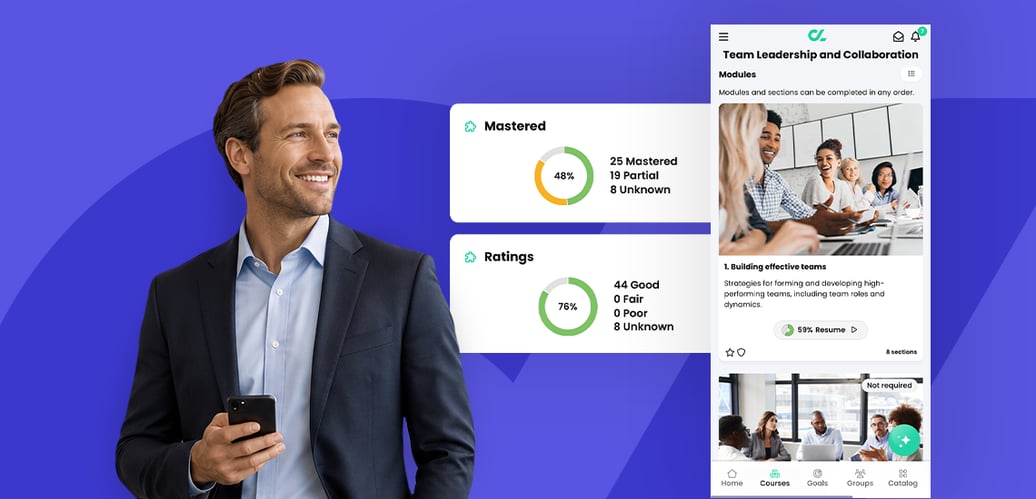
Modern platforms should provide intuitive dashboards, personalized recommendations, and seamless access to resources, allowing franchisees to quickly find what they need without unnecessary friction.
When UX is done well, learning becomes a natural extension of work rather than an additional burden, increasing both adoption and effectiveness. Source: CYPHER Learning
Supporting continuous, real-time learning
Franchise training should not end after onboarding; it should evolve into a continuous process that supports franchisees throughout their lifecycle, as they encounter new challenges, adapt to changes, and seek opportunities for growth.
This requires a shift toward more flexible, on-demand learning models, where franchisees can access guidance, resources, and support in real time, rather than relying solely on pre-defined training programs.
By enabling learning in the flow of work, organizations can ensure that franchisees are not only prepared at the start, but also supported as they navigate the complexities of running their business over time.
Strengthening the franchise relationship through better training
When training is designed around ownership rather than employment, it has a profound impact on the relationship between the organization and its franchisees.
Instead of feeling controlled or constrained, franchisees feel:
- Empowered to make decisions.
- Supported in their growth.
- Aligned with the broader brand.
This leads to higher levels of engagement, stronger adherence to standards, and ultimately better performance across the network.
Training becomes more than a functional requirement—it becomes a strategic tool for building trust and partnership.
The role of modern learning platforms
Delivering this level of personalization, flexibility, and usability requires more than traditional training tools, which were not designed to support the complexity of franchise environments.
Organizations need a platform that can:
- Deliver personalized learning experiences at scale.
- Support flexible, role-based pathways.
- Enable intuitive, user-friendly interfaces.
- Provide continuous, on-demand access to learning.
CYPHER Learning is built to support this approach, allowing organizations to create training experiences that align with how franchisees think, operate, and succeed.
Empowering owners drives better outcomes
The most successful franchise organizations are those that recognize that franchisees are not employees, and that training must reflect the realities of ownership rather than the constraints of traditional models.
By embracing personalized learning, autonomy with guardrails, and intuitive user experiences, organizations can create training programs that empower franchisees to take ownership of their success while maintaining the consistency that defines the brand.
In doing so, they transform training from a compliance requirement into a powerful driver of performance, engagement, and growth.
Ready to empower your franchisees with smarter training?
CYPHER Learning helps organizations design training experiences that reflect ownership, not compliance—delivering personalized, scalable learning that drives real business outcomes.
Discover how CYPHER can transform your franchise training strategy: www.cypherlearning.com
References
- Source: The Power Within Training - https://thepowerwithintraining.com/leadership-hub/how-to-build-a-team-that-thinks-like-owners-not-employees/
- Source: CYPHER Learning - https://www.cypherlearning.com/solutions/franchisee-training
- Source: CYPHER Learning - https://www.cypherlearning.com/blog/business/which-platform-helps-monitor-training-with-real-time-data-and-personalized-learning-paths
- Source: CYPHER Learning - https://www.cypherlearning.com/tour/ui-and-ux


