




Compliance is non-negotiable in partner ecosystems. Whether it’s regulatory requirements, product certifications, or operational standards, organizations must ensure that partners meet defined criteria before they can sell, implement, or support offerings.
But compliance introduces a familiar tension: the more rigor you apply, the more operational burden you create.
Many organizations fall into the same trap: centralizing compliance management so tightly that it slows down the entire ecosystem. Approvals take too long. Certifications expire unnoticed. Reporting becomes reactive. Partner onboarding stalls while teams validate requirements manually.
The result? Compliance becomes a bottleneck instead of a safeguard.
The challenge isn’t whether to enforce compliance. It’s how to do it at scale, without sacrificing speed, partner experience, or operational efficiency. Industry guidance on partner enablement consistently highlights the need for scalable systems to maintain standards across distributed networks. Source: Training Industry
Why compliance models break at scale
At a small scale, compliance can be managed manually. A central team tracks certifications, sends reminders, and validates completion before granting access or approvals.
But as partner ecosystems grow, this model starts to break down.
Common failure points include:
- Manual tracking of certifications and expirations.
- Delayed onboarding due to approval bottlenecks.
- Inconsistent enforcement across regions or partner tiers.
- Limited visibility into compliance status across the ecosystem.
These challenges are not just operational, they introduce risk. Expired certifications, missed renewals, or inconsistent enforcement can impact regulatory standing, brand integrity, and customer outcomes.
Research on compliance training emphasizes the importance of continuous monitoring and structured reporting to ensure adherence across distributed learners. Source: eLearning Industry
Without the right systems in place, compliance models become reactive and fragile.
Compliance rules create consistency without manual oversight
The foundation of scalable compliance is rule-based enforcement.
Instead of relying on manual validation, modern LMS platforms allow organizations to define compliance requirements as structured rules. These rules can determine who must complete specific training, when it must be completed, and what conditions must be met to maintain certification.
Compliance rules enable organizations to:
- Assign mandatory training based on role, partner tier, or region.
- Enforce prerequisites before accessing advanced certifications.
- Define certification validity periods and renewal requirements.
- Automatically restrict access when requirements are not met.
By embedding compliance directly into the system, organizations ensure consistency without relying on manual processes.
The CYPHER Learning reporting and data integration capabilities support tracking compliance-related data and managing compliance-related access across systems, helping organizations enforce standards at scale. Source: CYPHER Learning
Rules turn compliance from a checklist into a system.
Expiration automation prevents compliance gaps
One of the most common compliance risks in partner ecosystems is expired certifications.
Manual tracking often leads to missed deadlines, last-minute escalations, and periods where partners operate without valid credentials.
Expiration automation addresses this by managing the full lifecycle of certifications.
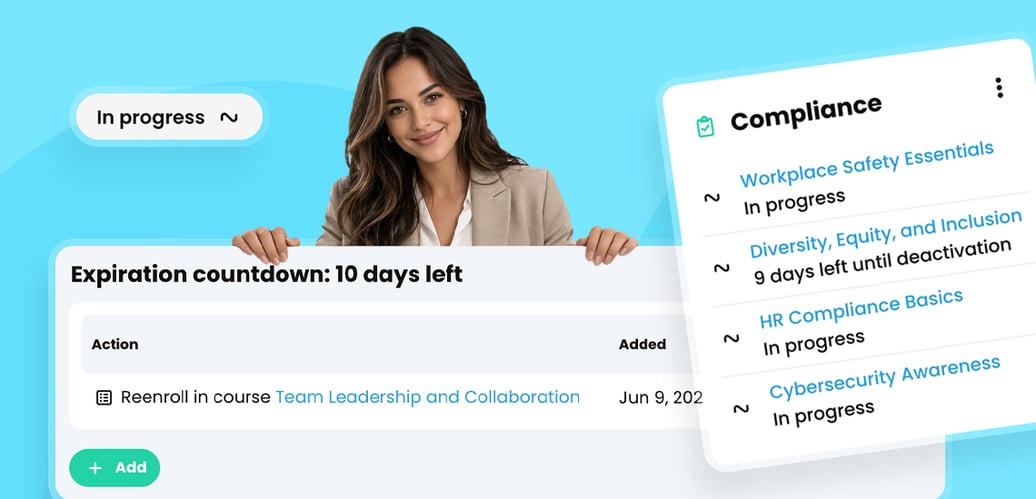
With automation in place, the LMS can:
- Track certification expiration dates automatically.
- Trigger renewal notifications in advance.
- Assign refresher or recertification training.
- Flag or restrict non-compliant users.
This shifts compliance from reactive enforcement to proactive management.
Automation also reduces the administrative burden on enablement teams, allowing them to focus on improving programs rather than chasing deadlines.
Continuous compliance models where certifications are actively maintained rather than periodically checked are widely recognized as more effective in reducing risk and ensuring readiness. Source: eLearning Industry
Reporting provides visibility without micromanagement
Compliance is only as strong as your visibility into it.
In many organizations reporting is fragmented, spread across spreadsheets, LMS exports, and manual tracking systems. This makes it difficult to answer critical questions:
- Which partners are fully compliant today?
- Where are certifications nearing expiration?
- Which regions or organizations have the highest compliance risk?
Modern LMS reporting centralizes this visibility.
With structured reporting, organizations can:
- Track certification status across partner organizations.
- Monitor renewal timelines and upcoming expirations.
- Identify gaps in compliance coverage.
- Generate reports for audits or internal stakeholders.
CYPHER Learning enables organizations to generate reports across users, courses, learning paths, certifications, and organizations, providing a unified view of compliance across the ecosystem. Source: CYPHER Learning
When reporting is built into the platform, compliance becomes transparent rather than opaque.
AI-powered support reduces compliance friction
Even with rules, automation, and reporting in place, compliance processes can still create friction for partners.
Partners may struggle to understand requirements, locate the right training, or determine what steps are needed to remain compliant.
AI-powered LMS capabilities help reduce this friction by providing in-the-moment guidance.
Instead of navigating multiple systems or contacting support teams, partners can ask questions and receive immediate answers about:
- Certification requirements.
- Renewal timelines.
- Required training modules.
- Next steps to maintain compliance.
AI-powered support helps ensure that partners not only meet compliance requirements, but understand them.
The CYPHER Learning AI assistant, CYPHER Agent, is designed to provide conversational support within the LMS, helping learners navigate requirements and access relevant resources. Source: CYPHER Learning
In distributed ecosystems, this reduces dependency on central teams and accelerates compliance alignment.
The shift from control to scalable compliance systems
The goal of partner compliance is not to control every action, it’s to ensure consistent standards across a distributed ecosystem.
When compliance is managed manually, control becomes a bottleneck. When it’s embedded into the LMS through rules, automation, reporting, and AI support, it becomes scalable.
A modern compliance model includes:
- Rule-based assignment and enforcement.
- Automated expiration and renewal workflows.
- Centralized reporting and visibility.
- AI-powered guidance for partners.
Together, these capabilities transform compliance from an operational burden into a system that supports both governance and growth.
Ready to manage partner compliance without slowing down your ecosystem?
CYPHER Learning helps organizations manage partner compliance at scale, without creating operational bottlenecks.
- Define and enforce compliance rules across your ecosystem.
- Automate certification expiration and renewal workflows.
- Gain visibility with centralized reporting across organizations.
- Support partners in the moment with AI-powered guidance through CYPHER Agent.
Explore how CYPHER Learning can help you build a compliance model that protects your business, while keeping your partner ecosystem moving forward.
References
- Source: Training Industry - https://trainingindustry.com/articles/learning-services-and-outsourcing/partner-enablement-using-training-for-channel-success
- Source: eLearning Industry - https://elearningindustry.com/compliance-training-best-practices
- Source: CYPHER Learning - https://www.cypherlearning.com/tour/reporting-and-analytics
- Source: Tenneo - https://tenneo.com/articles/lms-for-compliance-training-benefits-and-best-practices/


