




Growth is exciting for any training business. More learners, more customers, and more programs usually signal success.
But growth also creates pressure.
As training businesses expand, operational complexity increases quickly. More learners require more onboarding, more support, more content updates, more reporting, and more administration. Many organizations respond by hiring additional staff, which increases costs and often reduces scalability.
The challenge is not simply growing revenue. The challenge is growing efficiently.
The most successful modern training businesses are finding ways to scale operations without dramatically increasing headcount. They are doing this through automation, AI-powered course creation, and self-service learner workflows that reduce repetitive manual work while improving learner experience.
In many ways, the learning industry is undergoing the same operational transformation seen across SaaS, e-commerce, and customer success organizations.
Why traditional growth models create bottlenecks
Many training businesses still rely heavily on manual processes.
Teams often spend large amounts of time on tasks such as:
- Creating and updating courses.
- Managing enrollments.
- Responding to learner questions.
- Sending reminders.
- Issuing certificates.
- Building reports.
- Managing compliance renewals.
As learner numbers grow, these operational tasks expand alongside them.
This creates a scaling problem because labor costs increase almost linearly with customer growth.
The result is often operational fatigue. Teams become overwhelmed with administrative work instead of focusing on strategy, learner engagement, and program innovation.
Modern learning platforms are helping solve this challenge by automating operational workflows across the learner lifecycle. This allows training businesses to support larger audiences while keeping internal teams lean and efficient. Source: eLearning Industry; Source: CYPHER Learning
Automation reduces operational overhead
Automation is one of the most effective ways to scale a training business efficiently.
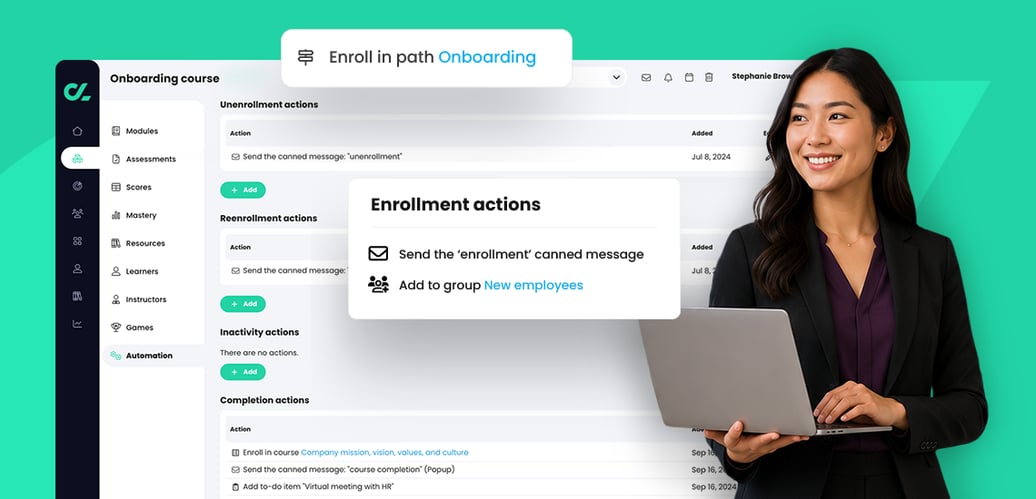
Instead of relying on staff to manually manage repetitive tasks, automation workflows can trigger actions based on learner activity, course completion, enrollments, compliance deadlines, and other events.
Modern LMS platforms now support automation across areas such as:
- Enrollment workflows.
- Notifications and reminders.
- Certificate delivery.
- Learning path progression.
- Compliance management.
- Gamification triggers.
- Subscription management.
For example, automation can:
- Enroll learners into follow up courses automatically.
- Send reminders when certifications are close to expiring.
- Award badges or certificates immediately after completion.
- Re-engage inactive learners.
- Deliver personalized onboarding messages.
These workflows reduce administrative burden while creating a more responsive learner experience.
Importantly, automation also improves consistency. Learners receive the right communication and next steps at the right time without relying on manual intervention. This becomes especially valuable for organizations managing large scale customer education, partner enablement, or compliance training programs. Source: CYPHER Learning
AI-powered course creation accelerates content production
Content development is often one of the largest bottlenecks for growing training businesses.
Traditional course creation can take weeks or months depending on the complexity of the material, review cycles, and production requirements.
AI-powered course creation is changing that.
Modern AI-enabled learning platforms now support workflows that can generate course structures, quizzes, assessments, competency mappings, and learning content far more efficiently than traditional development approaches.
This does not eliminate the role of instructional designers or subject matter experts. Instead, it allows them to focus on refinement, strategy, and learner outcomes rather than repetitive production tasks.
AI can help accelerate:
- Course outlines.
- Assessment generation.
- Skills mapping.
- Learning objectives.
- Gamification setup.
- Content organization.
Some platforms also support step-by-step AI workflows that allow instructors to review and edit materials throughout the creation process rather than generating everything at once.
This balance between automation and human oversight is important because training businesses still need quality control, accuracy, and instructional consistency.
The real advantage of AI-powered course creation is scalability. Training businesses can launch new programs faster, respond to changing market demands more quickly, and maintain fresher content libraries without proportionally increasing staffing. Source: CYPHER Learning
Self-service workflows create scalable learner experiences
Scaling efficiently is not only about reducing internal workload. It is also about giving learners greater autonomy.
Self-service learning experiences reduce dependency on support teams while improving convenience for learners.
Modern LMS platforms increasingly support self-service workflows such as:
- Self-enrollment.
- Subscription management.
- Course catalogs.
- Automated account creation.
- Access code registration.
- Progress tracking dashboards.
- On demand certifications.
This creates a smoother experience for learners while reducing the number of support requests and manual administrative actions required from internal teams.
For example, learners can:
- Register for training independently.
- Access learning paths directly from catalogs.
- Track certifications and progress.
- Download completion certificates.
- Purchase additional training through ecommerce portals.
These capabilities become especially important for external training businesses serving customers, partners, or global audiences at scale.
Self-service workflows also support scalability because they allow organizations to operate continuously across time zones and regions without requiring large operational teams. Source: Skilljar
Scaling smarter requires operational redesign
Technology alone does not create scalability.
The most successful training businesses rethink how their operations work from the ground up.
Instead of building processes around manual intervention, they design systems around:
- Automated learner journeys.
- AI-powered content development.
- Self-guided learning experiences.
- Data driven decision making.
- Scalable support models.
This operational redesign allows organizations to grow revenue and learner reach without expanding headcount at the same pace.
It also frees internal teams to focus on high value activities such as strategic partnerships, learner engagement, customer success, and program innovation.
As the training market becomes more competitive, operational efficiency will increasingly separate scalable businesses from those constrained by manual workflows.
Modern learning platforms now provide the infrastructure needed to support this shift through automation, AI-powered content creation, learning paths, e-commerce, analytics, and adaptive learning experiences.
Scale your training business with CYPHER Learning
CYPHER Learning helps training businesses scale efficiently with AI-powered course creation, automation workflows, and self-service learner experiences designed for modern growth.
From automated enrollments and lifecycle communication to AI-powered course development and scalable learning paths, CYPHER enables organizations to expand training operations without dramatically increasing administrative overhead.
Whether you are training employees, customers, or partners, CYPHER Learning gives you the tools to grow smarter, improve operational efficiency, and deliver engaging learning experiences at scale.
Explore how CYPHER Learning can help you scale your training business efficiently.
References
- Source: eLearning Industry - https://elearningindustry.com/why-traditional-training-businesses-struggle-to-scale-digitally
- Source: CYPHER Learning - https://www.cypherlearning.com/blog/business/scaling-partner-training-with-centralized-strategy-and-local-execution
- Source: CYPHER Learning - https://www.cypherlearning.com/tour/automation
- Source: CYPHER Learning - https://www.cypherlearning.com/ai-360/cypher-agent-for-course-creators
- Source: CYPHER Learning - https://www.cypherlearning.com/best-practices/daybreak-ai
- Source: Skilljar - https://www.skilljar.com/blog/be-more-productive-with-lms-workflow-automation
- Source: CYPHER Learning - https://www.cypherlearning.com/solutions/training-organization


