




Global partner ecosystems are expanding faster than ever. Whether you support resellers, distributors, franchisees, or service partners, your training program must scale across regions, languages, and business models.
But scale introduces risk.
As programs grow, organizations often lose control of brand consistency, content governance, and quality assurance. Regional teams begin modifying materials independently. Messaging drifts. Reporting becomes fragmented. Compliance oversight weakens. Source: We Brand
The challenge is not simply delivering more training. It is scaling with consistency, visibility, and control.
To achieve this, organizations must design partner training around three pillars: multi-portal branding, localization at scale, and structured permissions and governance.
Why scaling partner training often leads to brand erosion
When companies first expand globally, training is usually centralized. A single team builds content, manages enrollment, and controls messaging. Source: Paradiso
But as partner ecosystems grow, pressure increases to decentralize:
- Regional teams request autonomy.
- Partners want co-branded experiences.
- Local regulations require content adjustments.
- Sales enablement demands faster updates.
Without the right infrastructure, decentralization becomes fragmentation.
Common symptoms include:
- Multiple versions of the same course circulating.
- Inconsistent logos, terminology, and messaging.
- Local teams publishing outdated materials.
- Limited visibility into who completed what, and where.
- Compliance gaps across regions.
The problem is not decentralization itself. The problem is decentralization without governance. Modern partner training requires a structure that supports local flexibility within global guardrails.
Multi-portal branding enables scale without duplication
One of the most effective ways to scale globally is through a multi-portal architecture.
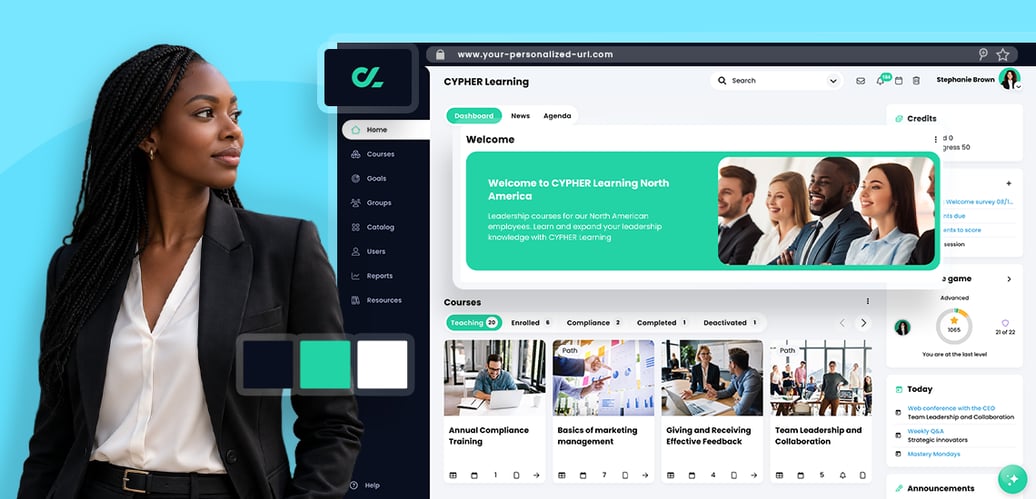
Instead of running separate systems for each region or partner type, organizations can create multiple branded portals within a single centralized platform. Each portal can maintain its own identity while sharing a common administrative backbone.
With multi-portal configuration, organizations can:
- Assign custom URLs or subdomains to different regions or partner groups.
- Apply distinct logos, color schemes, and terminology.
- Configure separate catalogs for different audiences.
- Tailor homepage messaging and promotional panels.
- Control which content is visible in each portal.
For example, a technology company might operate:
- A North America partner portal.
- An EMEA distributor portal.
- A franchise training portal.
- A customer certification portal.
Each portal looks and feels tailored to its audience. But from an administrative standpoint, governance remains centralized.
This model aligns with modern platform capabilities that support organization-level branding, separate catalogs, and configurable portal experiences. The key advantage is that you do not duplicate infrastructure. You extend it. Global brand standards are preserved, while local business units gain controlled flexibility. Source: CYPHER Learning
Localization without losing global consistency
Scaling globally means more than translating content. It requires thoughtful localization.
Partners need training in their own language. They need examples relevant to their market. They may need region-specific compliance modules.
However, uncontrolled localization can fracture your program.
The solution is structured localization built on shared templates and master content.
Effective global training programs use a master-course model:
- A centrally governed master course is created and approved.
- Regional versions inherit structure and core content.
- Local teams are allowed to modify designated sections.
- Updates to the master can sync to regional instances.
This approach ensures that:
- Core product messaging stays consistent.
- Certification criteria remain aligned globally.
- Compliance standards are enforced.
- Local adaptations occur only where permitted.
Platforms that support course synchronization and structured inheritance make this possible.
In addition, multilingual support is critical. When the platform supports dozens of languages natively, you reduce friction for partners worldwide and avoid the need for parallel systems. Source: CYPHER Learning
Localization should not mean reinvention. It should mean contextual refinement within a governed framework.
Permissions create guardrails without slowing innovation
Brand consistency is not only about visuals. It is about control over who can change what.
Granular permissions and role-based access are essential when scaling partner training globally.
As your ecosystem expands, you may have:
- Global administrators.
- Regional administrators.
- Partner managers.
- Instructors.
- Franchise operators.
- Compliance monitors.
Each role requires different levels of access.
A scalable model includes:
- Custom roles and permission grids.
- Organization-level admin controls.
- Read-only monitor accounts for audit visibility.
- Segmented user management by organization or region.
- Restrictions on content editing and publishing rights.
For example:
- A regional manager may enroll users and run reports but cannot alter core curriculum.
- A franchise operator may access only their organization’s portal and catalog.
- A compliance officer may have read-only visibility across all regions.
When permissions are structured properly, decentralization does not create chaos. It creates distributed execution under centralized policy. Modern platforms enable organization-level management, custom roles, and tailored permission structures to support this model.
The goal is simple: empower local leaders without risking brand dilution.
Governance and visibility at global scale
Scaling partner training also requires global oversight.
Without consolidated reporting, you cannot answer critical questions:
- Which regions are meeting certification targets?
- Where are partners falling behind?
- Are compliance deadlines being met?
- Which content drives the highest engagement?
To scale effectively, organizations must maintain:
- Organization-level reporting.
- Central dashboards across portals.
- Compliance tracking by region.
- Automated notifications for expirations.
- Consistent data structures across all portals.
When multi-portal branding, localization, and permissions operate within a unified reporting environment, leadership gains global visibility without micromanaging local teams.
This balance between autonomy and oversight defines mature partner training ecosystems.
The strategic mindset shift: from control to governed scalability
Many organizations think scaling means relinquishing control. In reality, scaling requires more intentional control—just structured differently. The shift involves moving from centralized everything to federated execution with centralized governance. It means designing infrastructure that supports growth before fragmentation begins.
When you implement:
- Multi-portal branding for audience differentiation.
- Localization frameworks that inherit from governed masters.
- Granular permissions that define clear boundaries.
- Organization-level management with consolidated reporting.
You create a partner training model that can expand globally without losing its identity. Your brand remains intact. Compliance stays measurable. Reporting stays unified. And partners experience a professional, consistent learning environment—no matter where they are in the world.
Scale globally. Stay in control.
Scaling partner training globally does not have to mean sacrificing brand integrity or operational oversight.
With the right platform architecture, you can:
- Deliver tailored, region-specific experiences.
- Preserve global brand standards.
- Govern content centrally.
- Empower local teams responsibly.
- Maintain full visibility across your partner ecosystem.
Want to see how to scale partner training without losing brand or control?
Discover how the CYPHER Learning platform enables multi-portal branding, localization at scale, and granular permissions—so you can empower global partners while maintaining complete governance and visibility.
References
- Source: We Brand - https://webrand.com/blog/brand-enablement/what-is-partner-enablement-foundation-of-scalable-partner-growth
- Source: Paradiso - https://www.paradisosolutions.com/blog/scale-partner-training-across-regions-with-ease
- Source: CYPHER Learning - https://www.cypherlearning.com/tour/administration
- Source: CYPHER Learning - https://www.cypherlearning.com/tour/languages
- Source: CYPHER Learning - https://www.cypherlearning.com/solutions/partner-enablement


