




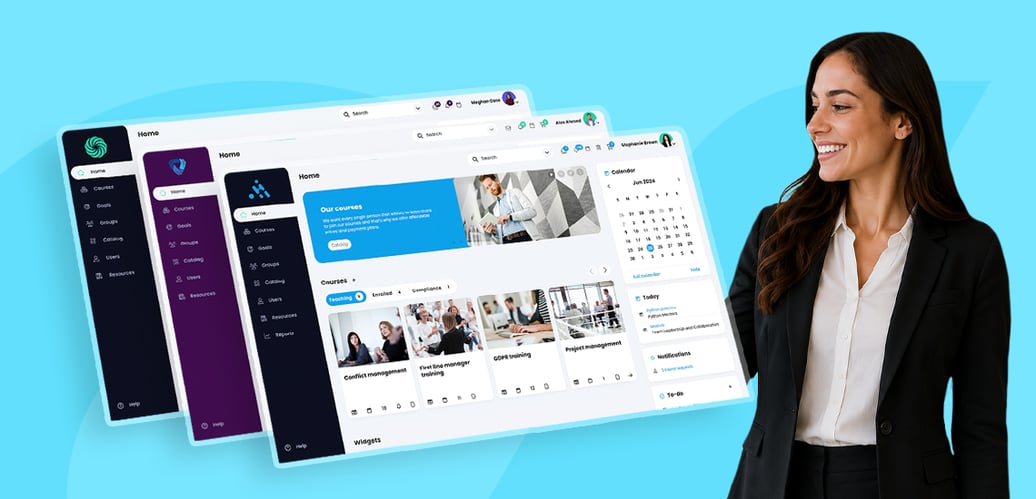
As training businesses grow, many expand beyond a single audience.
What starts as one training portal often evolves into multiple academies serving customers, partners, franchises, regional teams, or enterprise clients. Each audience may require its own branding, learning experience, catalog, and administrative structure.
The challenge is that managing separate learning environments can quickly become operationally complex.
Many organizations attempt to solve this by purchasing multiple LMS instances. Others rely on disconnected systems managed independently across departments or clients.
Both approaches create inefficiencies.
Operational costs increase. Reporting becomes fragmented. Content management becomes harder to maintain consistently. Administrative overhead grows rapidly.
The most scalable training organizations are taking a different approach. Instead of managing separate systems, they are building multiple branded academies from a single centralized learning platform.
Modern LMS platforms increasingly support multi-organization portals, white labeling, and delegated administration that allow organizations to create distinct learning experiences while maintaining centralized governance and operational efficiency. Source: eLearning Industry; Source: CYPHER Learning
Why separate LMS environments create long term friction
At first glance, running separate LMS environments for different audiences may seem logical.
A customer academy may need different branding than an employee learning portal. A franchise network may require independent administration. Enterprise clients may expect dedicated learning spaces.
But over time, managing multiple disconnected systems creates operational strain.
Organizations often encounter challenges such as:
- Duplicated administrative work.
- Inconsistent learner experiences.
- Fragmented reporting.
- Repeated content management tasks.
- Higher software and support costs.
- Limited visibility across audiences.
As learning operations scale, these inefficiencies compound.
This becomes especially difficult for organizations supporting external training ecosystems such as:
- Customer education.
- Partner enablement.
- Franchise training.
- Regional learning programs.
- Certification academies.
Modern multi-organization LMS architectures help solve this challenge by allowing organizations to manage multiple learning portals from a centralized platform while still maintaining separation between audiences.
Multi-organization portals create scalable learning ecosystems
Multi-organization learning environments allow organizations to create distinct portals for different audiences without deploying separate LMS platforms.
This creates a balance between centralized management and localized experiences.
Modern learning platforms increasingly support organization level structures that allow each academy to maintain:
- Separate branding.
- Independent user groups.
- Dedicated course catalogs.
- Customized permissions.
- Audience specific dashboards.
- Localized workflows.
For example, a training company could operate:
- A customer academy.
- A partner certification portal.
- An internal employee learning hub.
- Regional franchise training portals.
All from the same platform infrastructure.
This creates operational advantages because administrators can maintain centralized governance while allowing each organization or audience to manage its own day to day operations.
Multi-organization structures also simplify scalability. New academies can be launched without deploying entirely new systems or duplicating infrastructure.
White labeling strengthens brand consistency
Brand experience matters in modern learning environments.
Organizations increasingly want training platforms to feel like a natural extension of their brand rather than a generic third party system.
This is especially important for customer education, partner enablement, and commercial training businesses where the learning experience directly shapes brand perception.
Modern LMS platforms now support extensive white labeling capabilities, including:
- Custom domains.
- Branded portals.
- Custom logos and colors.
- Customized terminology.
- Branded email communications.
- Configurable navigation and themes.
Some platforms also support fully separated branded experiences across multiple portals while still operating from a single centralized environment.
This creates flexibility for organizations managing multiple brands, regions, or client specific academies.
For example, a software company could create dedicated partner academies with unique branding and learning catalogs for different reseller groups while still maintaining centralized operational oversight.
White labeling also improves learner trust and engagement because the experience feels more integrated and professional.
Delegated administration supports growth without operational bottlenecks
One of the biggest challenges in large scale learning operations is balancing centralized control with local autonomy.
If every portal, academy, or audience depends on a small central learning team for daily management, operational bottlenecks quickly emerge.
Delegated administration helps solve this problem.
Modern LMS platforms increasingly support role based permissions and organization specific administrative controls that allow local teams to manage their own environments within defined governance structures.
This means organizations can allow local administrators to manage tasks such as:
- User enrollment.
- Course assignments.
- Reporting.
- Content visibility.
- Communication workflows.
- Group management.
While central administrators still maintain oversight across the entire platform.
This approach creates several advantages:
- Faster operational response times.
- Reduced dependency on central teams.
- Greater flexibility for regional or client specific needs.
- Better scalability as programs expand.
Delegated administration is especially valuable for franchise networks, partner ecosystems, and enterprise customer training environments where different groups require operational independence. Source: CYPHER Learning
Centralized reporting becomes a strategic advantage
While localized experiences are important, centralized visibility remains critical.
Organizations running multiple academies still need unified insight into learner activity, compliance, engagement, and program performance.
Disconnected systems often make this difficult because reporting becomes fragmented across multiple environments.
Modern multi-organization learning platforms increasingly support centralized analytics and reporting that allow organizations to monitor activity across all academies from a single administrative layer.
This creates stronger visibility into:
- Learner engagement.
- Certification activity.
- Revenue performance.
- Completion trends.
- Compliance readiness.
- Cross organization adoption.
Centralized reporting helps learning leaders make better strategic decisions while still supporting independent academy operations.
It also simplifies executive reporting and operational governance because leadership teams can view organization wide performance without consolidating data manually.
As training ecosystems become more distributed, centralized visibility will become increasingly important for operational scalability and business growth.
The future of learning operations is centralized and flexible
The demand for multiple branded learning experiences will continue to grow as organizations expand customer education, partner enablement, and external training initiatives.
The challenge is scaling these ecosystems efficiently without creating operational fragmentation.
Modern learning platforms now provide the infrastructure needed to support both centralized governance and localized flexibility through:
- Multi-organization portals.
- White labeled learning experiences.
- Delegated administration.
- Centralized analytics.
- Shared infrastructure.
Organizations that adopt this model will be better positioned to scale learning operations, reduce complexity, and deliver more consistent learner experiences across audiences.
Scale branded academies with CYPHER Learning
CYPHER Learning helps organizations run multiple branded academies from a single AI powered learning platform designed for scalability.
With multi-organization portals, white labeling, delegated administration, and centralized reporting, CYPHER enables training businesses to create distinct learning experiences for customers, partners, franchises, and employees without managing disconnected systems.
Whether you are building customer education programs, partner certification ecosystems, or regional training academies, CYPHER Learning gives you the flexibility to scale efficiently while maintaining operational control.
Explore how CYPHER Learning can help you manage multiple branded academies from one platform.
References
- Source: eLearning Industry - https://elearningindustry.com/scaling-elearning-programs-with-white-label-lms-solutions
- Source: CYPHER Learning - https://www.cypherlearning.com/white-label-lms
- Source: CYPHER Learning - https://www.cypherlearning.com/tour/administration
- Source: CYPHER Learning - https://www.cypherlearning.com/solutions/training-organizations


