





AI adoption rarely begins with a formal strategy. It begins with people experimenting.
An employee tries ChatGPT to improve an email. A salesperson uses AI to research an account. A marketer tests a new content tool. A manager discovers that AI can summarize a lengthy document in seconds.
That experimentation can create valuable momentum, but it can also create significant variation in how confidently, effectively, and responsibly people use AI.
An AI Academy gives organizations a way to turn that scattered experimentation into a structured capability building program.
Unlike a single AI course or one time workshop, an AI Academy can provide a continuously evolving learning environment where people build AI literacy, develop role specific skills, practice practical applications, and demonstrate what they know.
Building one requires more than assembling a collection of courses. Organizations need to understand who they are training, which skills matter, how those skills connect to work, what guardrails should apply, and how progress will be measured.
Here is how to approach it.
What is an AI Academy?
An AI Academy is a structured learning program designed to help a defined audience understand, use, and develop skills around artificial intelligence.
For some organizations, that audience might be employees. For others, it could include customers, partners, association members, franchisees, agents, contractors, or an entire professional community.
The academy itself can encompass everything from introductory AI literacy to advanced, role specific applications.
A learner might begin by understanding what generative AI is, how it works at a practical level, what information they should avoid sharing, and when human judgment is essential. From there, they could progress into prompting, workflows, practical exercises, and applications specific to their role.
The important distinction is that an AI Academy is not simply a repository of AI content. It creates an intentional pathway from awareness to application and, ultimately, greater capability.
That distinction matters because organizations are increasingly moving beyond the question of whether people should learn about AI. The more pressing questions are what they should learn, how they should apply it, and how the organization can support responsible use at scale.
Step 1: define who your AI Academy is for
Before choosing courses or technology, define your audience.
It is tempting to begin with a universal program called something like “AI for everyone.” A shared foundation can certainly be valuable, but the practical applications of AI vary significantly between roles.
-
A salesperson might use AI to prepare for meetings, research accounts, organize notes, or improve follow up communication.
-
A manager might use it to synthesize information, prepare for conversations, or explore different approaches to a problem.
-
A customer might need to understand AI functionality within your product.
-
A real estate professional could be interested in productivity, marketing, research, and client communication.
Start by identifying the audiences the academy needs to support. Then consider their existing AI experience, responsibilities, workflows, goals, and level of access to AI tools.
CYPHER Learning supports different audiences and learning experiences from one platform, making it possible to create distinct paths rather than forcing every learner through identical training.
Step 2: map the AI skills people actually need
Once you know who you are training, define what capability looks like.
Avoid starting with course titles. Start with skills.
Ask what someone in each audience should be able to understand, do, evaluate, and demonstrate with AI.
A foundational skills map might include areas such as AI literacy, responsible AI use, data and security awareness, prompt development, critical evaluation of AI generated outputs, and knowing when human judgment should take precedence.
Role specific layers can then be added.
For example, a marketing team might need skills related to ideation, analysis, research, and content workflows, while a sales organization could prioritize research, meeting preparation, communication, and account planning.
This creates an important shift in thinking.
Instead of asking, “What AI courses should we offer?” organizations can ask, “What does effective AI use look like for this person, in this role?”
The curriculum can then be built around the answer.
Step 3: design a curriculum that moves from understanding to application
A strong AI Academy should create progression.
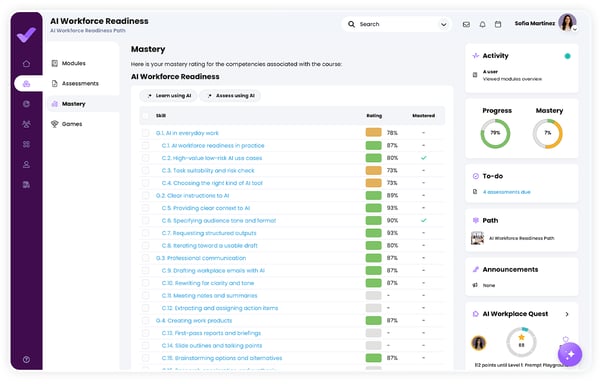
For many learners, that journey will begin with AI literacy. They need a common understanding of what generative AI can do, where its limitations lie, what responsible use looks like, and which organizational policies apply.
The next stage should move toward application.
Learners can explore prompts, workflows, scenarios, practical exercises, and examples connected to their work. Someone who already understands AI fundamentals should not have to repeatedly sit through introductory material before reaching something useful.
CYPHER supports courses, assessments, skills, certifications, badges, and learning paths that organizations can use to structure that progression.
The curriculum might therefore progress from:
-
Foundation: Understand AI concepts, limitations, policies, security, and responsible use.
-
Application: Learn how AI can support common tasks and workflows.
-
Role mastery: Develop skills around applications relevant to a specific job or audience.
-
Advanced capability: Explore more sophisticated workflows, prompting techniques, and applications as learners mature.
The result is not one enormous AI course. It is a learning ecosystem that can become more sophisticated alongside its learners.
Step 4: build governance into the learning experience
AI governance should not live exclusively inside a policy document.
People need to understand what responsible AI use means when they are actually doing their jobs.
That could include which tools have been approved, what information can be entered into them, when AI generated information needs verification, where human review is required, and which uses are inappropriate.
Training gives organizations an opportunity to translate those principles into practical scenarios.
Instead of simply telling learners to “use AI responsibly,” show them what responsible and irresponsible decisions look like in situations they are likely to encounter.
Governance should also evolve. As organizations introduce new AI tools, develop policies, encounter new risks, and discover new use cases, the learning around them needs to change too.
That makes maintainability an important consideration when designing the academy from the beginning.
Step 5: choose an AI Academy platform that can grow with you
Your technology should support the strategy rather than dictate it.
When evaluating an AI training platform, consider whether it can support multiple audiences, personalized learning paths, skills, assessments, certifications, reporting, branding, and ongoing content development.
Content agility is particularly important.
AI changes too quickly for organizations to assume that a curriculum created today will remain untouched for several years. New capabilities appear, tools change, organizational policies mature, and teams discover new ways of working.
CYPHER Agent can help teams turn existing organizational knowledge and trusted resources into structured learning experiences, including course content, assessments, skills, and gamified elements. Subject matter experts can then apply their expertise and review before that learning reaches the audience.
The platform should also reflect your organization. Branded and white label experiences can help an academy feel like an extension of the organization rather than an unrelated training destination.
Step 6: give learners opportunities to demonstrate capability
Completion alone tells you that somebody reached the end of a course.
It does not necessarily tell you what they can do.
Assessment should therefore be built into the AI Academy from the beginning. Organizations can use assessments to understand knowledge, identify areas that need further development, and give learners opportunities to demonstrate progress.
Certifications and badges can provide visible milestones along the journey.
You might create an introductory AI literacy certification followed by role specific or advanced credentials. Someone could progress from foundational AI literacy to an AI enabled sales certification, for example, while another learner follows a completely different pathway.
This creates a clearer sense of progression for learners and gives the organization greater structure around its AI capability building program.
Step 7: measure more than course completion
An AI Academy should ultimately help people use AI more effectively, not simply produce impressive enrollment numbers.
That means measurement needs several layers.
At the learning level, organizations can monitor participation, completion, assessment performance, certification progress, and skills development using the reporting capabilities available within their learning platform.
But the most meaningful measures may sit closer to the work itself.
Are people applying what they learned? Are teams discovering useful AI applications? Are learners becoming more confident? Are particular roles struggling with specific skills? Are people progressing into more advanced learning?
Some of those outcomes will need to be measured outside the LMS through surveys, operational metrics, manager feedback, or other business systems. An LMS can provide visibility into learning activity and performance, but it should not be treated as proof by itself that AI training caused a particular business result.
That distinction makes measurement more credible.
Step 8: treat your AI Academy as a living program
Perhaps the biggest mistake an organization can make is launching its AI Academy and considering the project finished.
AI will not stand still.
New tools will emerge. Existing products will introduce new functionality. Your organization will discover successful use cases. Policies will evolve. Beginners will become experienced users who need increasingly sophisticated learning.
Your academy should evolve with them.
Review the curriculum regularly. Look at assessment and skills data. Speak to learners. Work with subject matter experts. Identify emerging workflows. Retire material that has become outdated and introduce learning around capabilities that did not exist when the academy launched.
CYPHER's AI Academy approach is built around this idea of continuous development: learners can begin with AI literacy and move toward increasingly practical and advanced applications as their needs change.
Iteration is not maintenance around the edges of an AI Academy. It is part of the model.
What should an AI Academy include?
Although every organization will build its academy differently, the strongest programs bring several components together.
They establish a shared foundation in AI literacy and responsible use. They connect learning to specific roles and workflows. They provide opportunities for practical application and assessment. They create clear progression through skills, learning paths, certifications, or badges. They give administrators visibility into learner activity and progress. And they have a process for continually updating the curriculum as AI and organizational priorities change.
Most importantly, the academy should reflect the people using it.
Bright MLS offers one example. Serving more than 100,000 real estate professionals, Bright created the Bright AI Academy, powered by CYPHER Learning, to help its community build AI literacy, develop practical skills, and become more confident applying AI within their businesses.
The same model can look completely different elsewhere.
A software company could create an academy for customers learning its AI capabilities. An enterprise could build role specific AI pathways for different departments. An association could help members navigate the impact of AI on their profession. A partner ecosystem could use certification to establish shared standards of capability.
The technology is common. The learning strategy should be specific.
Start building AI capability, not just AI awareness
People are already experimenting with AI.
The opportunity for organizations is to turn that curiosity into capability.
An AI Academy creates a structure for doing that. Start with the people you need to support. Define the skills that matter. Build learning around real work. Establish appropriate governance. Create opportunities to practice and demonstrate capability. Measure progress. Then keep adapting the experience as AI evolves.
You do not need to build everything on day one.
Start with the audiences, skills, and use cases that matter most, learn from how people respond, and expand from there. That approach mirrors CYPHER's broader AI Academy model: begin with practical needs and build an ongoing learning experience around your organization, audience, brand, and goals.
Ready to build an AI Academy for your organization?
With CYPHER Learning, you can create, deliver, personalize, assess, certify, and evolve AI learning within one AI-native learning platform. Build an academy around your own knowledge and audiences, from foundational AI literacy to role specific skills and advanced applications.


