




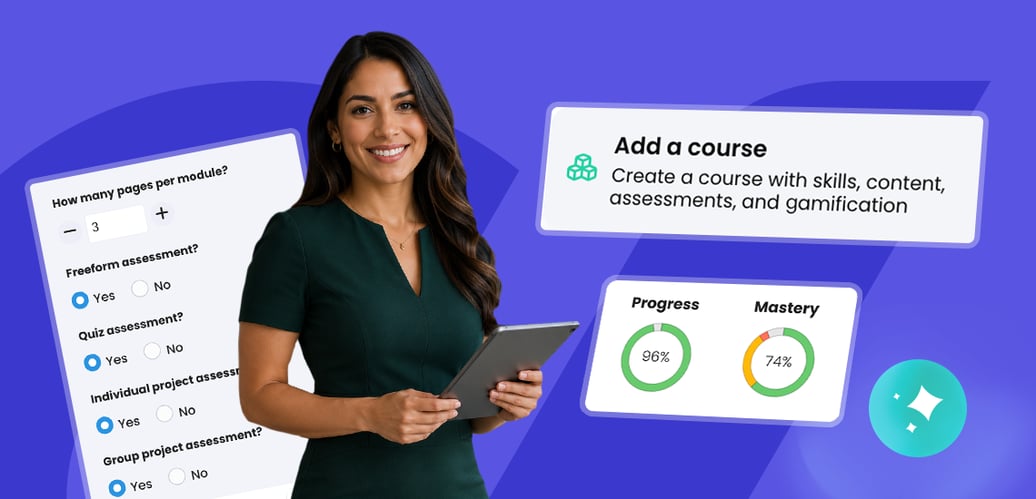
AI is changing the economics of learning.
For years, course development, assessment design, and credential management depended heavily on manual processes. Instructional teams spent significant time building content, generating assessments, reviewing learner progress, and maintaining certification programs.
AI is beginning to reshape that model.
But the shift is not simply about speed. The deeper change is that AI is altering how learning experiences are created, supported, evaluated, and validated across the entire lifecycle of education and training.
This matters because learner expectations are changing rapidly. Organizations increasingly need learning systems that can adapt quickly, scale efficiently, and maintain quality without dramatically increasing operational complexity.
The next phase of learning technology will not be defined by whether AI exists within platforms. It will be defined by how intelligently it is integrated into learning workflows.
AI is accelerating course creation without sacrificing adaptability
Traditional course creation is resource intensive. Instructional teams often spend weeks or months developing learning materials, structuring lessons, generating activities, and aligning assessments.
AI-powered course creation changes the pace of this process.
Instead of building every component manually, learning teams can use AI to accelerate early stage development, generate draft content, structure learning pathways, and support content refinement. This allows organizations to produce learning experiences more efficiently while still maintaining instructional oversight.
Importantly, this does not eliminate the role of instructional expertise. AI does not replace subject matter knowledge, learning strategy, or quality assurance. What it changes is the operational burden associated with repetitive content development tasks.
Modern AI-enabled learning platforms increasingly support:
- Rapid content generation.
- Learning activity suggestions.
- Adaptive learning structures.
- Scalable course updates.
CYPHER Learning incorporates AI-powered capabilities that support course development and content creation workflows within the learning environment. Source: CYPHER Learning
This becomes especially valuable in environments where learning content evolves continuously, such as product training, compliance education, and professional certification programs.
Assessment generation is becoming more dynamic and scalable
Assessment design has traditionally been one of the most time consuming parts of learning development. Creating effective quizzes, knowledge checks, and evaluations requires balancing difficulty, relevance, clarity, and alignment with learning objectives. As organizations scale training programs, maintaining assessment quality becomes increasingly difficult.
AI-powered assessment generation is changing this process by helping organizations create assessments more efficiently while supporting greater variation and adaptability.
AI-generated assessments can help:
- Create question variations aligned to learning objectives.
- Support broader assessment coverage across large content libraries.
- Reduce repetitive manual authoring tasks.
- Accelerate updates when content changes.
This improves scalability while also helping organizations keep assessments aligned with evolving material.
CYPHER Learning supports AI-driven assessment generation as part of its broader AI-enabled learning capabilities. Source: CYPHER Learning
The long term significance is not simply faster quiz creation. It is the ability to build more responsive and continuously evolving evaluation systems.
Credentialing is shifting from completion tracking to trusted validation
One of the most important changes AI is influencing is credential credibility.
Historically, many credentials were tied primarily to completion. Learners progressed through required material, passed an assessment, and received certification. But as digital learning expands, organizations increasingly need stronger validation of accuracy, mastery, and trustworthiness.
This is where AI-enabled validation systems become important.
CYPHER Learning’s AI Crosscheck is designed to help improve confidence in AI-generated outputs by validating responses across multiple AI models. This supports greater consistency and reliability within AI-assisted learning environments. Source: CYPHER Learning
As AI becomes more integrated into course creation and learner support, trust becomes critical. Organizations need mechanisms that help ensure learning content, assessments, and guidance remain accurate and aligned with organizational standards.
At the same time, credentialing itself is becoming more skills focused and evidence driven. Modern certification ecosystems increasingly emphasize:
- Demonstrated mastery.
- Applied competency.
- Ongoing validation.
- Measurable progression over time.
AI is accelerating this transition by helping organizations scale validation, personalization, and learner support simultaneously.
AI-powered support changes the learner experience
AI is not only transforming administrative workflows. It is also reshaping how learners interact with knowledge itself.
Traditional LMS experiences often depended on static navigation and self directed searching. Learners were expected to locate relevant content, interpret requirements, and manage progression independently.
AI-powered assistants are changing this dynamic.
CYPHER Agent is designed to provide conversational support within the LMS environment, helping learners:
- Access relevant information more quickly.
- Receive guidance during learning progression.
- Navigate certification pathways.
- Find answers in the moment of need.
This reflects a broader shift happening across digital experiences. Users increasingly expect conversational interaction, contextual recommendations, and immediate support rather than static navigation structures.
In learning environments, this can reduce friction and improve engagement while supporting more personalized progression.
AI is redefining operational scale in learning
The broader impact of AI is operational. As organizations expand learning ecosystems across employees, customers, partners, and professional learners, scale becomes difficult to manage through manual processes alone.
AI enables learning platforms to operate more dynamically by supporting:
- Scalable content creation.
- Adaptive assessment generation.
- Intelligent learner assistance.
- Validation and quality reinforcement.
- Personalized learning experiences.
Together, these capabilities allow organizations to increase responsiveness without proportionally increasing administrative complexity.
AI-enabled enterprise systems consistently emphasize the role of AI in improving scalability, responsiveness, and operational efficiency. Source: IBM
The most important shift may not be automation itself. It may be that AI allows learning organizations to focus more attention on strategy, expertise, and learner outcomes rather than repetitive operational tasks.
Ready to explore the future of AI-powered learning?
CYPHER Learning helps organizations build modern learning experiences powered by AI-driven course creation, assessment support, intelligent learner guidance, and trusted validation through AI Crosscheck.
- Accelerate course development workflows.
- Support scalable assessment generation.
- Guide learners with conversational AI through CYPHER Agent.
- Strengthen confidence in AI-powered learning experiences with AI Crosscheck.
Explore how CYPHER Learning can help you build learning environments designed for the next generation of education, training, and credentialing, and schedule a demo today.
References
- Source: CYPHER Learning - https://www.cypherlearning.com/ai-360
- Source: CYPHER Learning - https://www.cypherlearning.com/ai-360/cypher-agent-for-learners
- Source: IBM - https://www.ibm.com/topics/artificial-intelligence


