




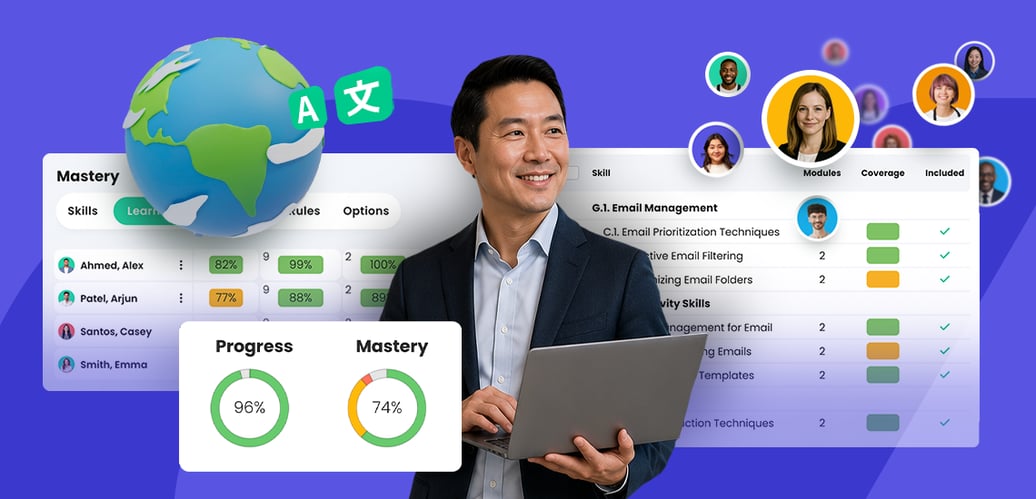
Franchise businesses are built on a simple promise: grow quickly with independent, local owners while providing a consistent brand experience, delivered anywhere in the world. Whether a customer walks into a location in London, Cape Town, or New York, they expect the same quality, service, and experience. That consistency is what defines the brand—and what protects its reputation. Source: CYPHER Learning
But delivering that consistency at scale is harder than ever.
Rapid expansion, distributed owners, and evolving customer expectations have exposed a critical truth: franchise training is no longer just an operational necessity—it’s a brand protection strategy.
The hidden risk in franchise growth
Growth is the goal of every franchise model. But with every new location, the risk of inconsistency increases.
Common challenges include:
- Different interpretations of processes.
- Variations in customer service standards.
- Inconsistent product or service delivery.
- Gaps in onboarding and ongoing training.
Even small inconsistencies can compound into major brand issues:
- Negative customer experiences.
- Poor reviews and reputational damage.
- Compliance risks.
- Lost revenue.
The more you scale, the more fragile your brand becomes—unless training scales with it.
Consistency at scale is the real challenge
At the heart of franchise success is repeatability.
Every location should deliver:
- The same customer experience.
- The same operational standards.
- The same brand voice.
But traditional training approaches struggle to keep up:
- Static manuals quickly become outdated.
- In-person training is difficult to standardize.
- Regional adaptations create drift.
Modern franchise organizations are shifting toward centralized, digital training ecosystems that ensure every learner receives the same, up-to-date experience.
With the right platform, you can:
- Standardize onboarding across all locations.
- Deliver consistent learning paths globally.
- Update content centrally and distribute instantly.
This ensures that every franchisee and employee is aligned with the brand—no matter where they are.
Compliance is no longer optional
In many franchise industries—such as food service, healthcare, and retail—compliance isn’t just important. It’s mandatory.
Failure to meet compliance standards can lead to:
- Legal penalties.
- Health and safety risks.
- Loss of licenses.
- Brand damage.
But compliance is also one of the hardest things to manage at scale.
You need to ensure that:
- Every employee completes required training, for your brand and the local region.
- Certifications are up to date.
- Renewals happen on time.
- Records are audit-ready.
Modern learning platforms make this manageable by:
- Automating compliance tracking.
- Assigning required training based on role or location.
- Triggering reminders and re-enrollments.
- Providing real-time compliance dashboards.
This transforms compliance from a reactive process into a proactive, automated system—reducing risk and protecting the brand. Source: CYPHER Learning
Reporting turns training into visibility
One of the biggest gaps in traditional franchise training is visibility.
Franchise leaders often struggle to answer basic questions:
- Who has completed training?
- Which locations are falling behind?
- Where are performance gaps emerging?
Without data, training becomes a black box.
Modern reporting changes that.
With advanced analytics, you can:
- Track completion rates across locations.
- Identify high-performing vs. at-risk franchises.
- Monitor compliance status in real time.
- Analyze learning impact on operational metrics.
This level of visibility allows you to:
- Intervene early when issues arise.
- Support underperforming locations.
- Maintain consistent standards across the network.
Training is no longer just a cost center—it becomes a strategic control system for your brand.
Automation enables scale without complexity
The larger your franchise network grows, the more complex training becomes.
Manual processes simply don’t scale:
- Enrolling users individually.
- Sending reminders manually.
- Tracking progress in spreadsheets.
This is where automation becomes essential.
With automation, you can:
- Automatically enroll new hires into onboarding programs.
- Assign training based on role, location, or organization.
- Send notifications for deadlines and renewals.
- Trigger follow-up learning based on performance.
For example:
- A new employee joins a franchise → automatically enrolled in onboarding.
- A certification is about to expire → automatic reminder sent.
- A learner fails an assessment → remedial training assigned.
This reduces administrative burden while ensuring nothing falls through the cracks. Source: CYPHER Learning
From training program to brand safeguard
When you combine consistency, compliance, reporting, and automation, training becomes much more than an enablement tool.
It becomes a brand safeguard.
A well-designed franchise training strategy ensures:
- Every location operates to the same standard.
- Every employee understands the brand.
- Every compliance requirement is met.
- Every risk is visible and manageable.
This is especially critical in today’s environment, where:
- Customer expectations are higher.
- Reviews spread instantly.
- Brand perception can change overnight.
Training is no longer behind the scenes—it’s directly tied to brand reputation.
The role of modern learning platforms
To achieve this level of control and scalability, franchise organizations need more than basic LMS functionality.
They need a platform that can:
- Deliver consistent learning globally.
- Adapt to local needs without losing control.
- Automate workflows and compliance.
- Provide real-time insights.
CYPHER Learning is designed to support exactly this.
With CYPHER, organizations can:
- Create standardized training programs and distribute them globally.
- Use automation to manage onboarding, compliance, and renewals.
- Track performance and compliance with powerful reporting tools.
- Deliver personalized learning experiences at scale.
- Enable employees to be associated with more than one franchise organization.
This allows franchise brands to grow confidently—without sacrificing consistency or control.
Building a future-ready franchise training strategy
To turn training into a brand protection strategy, organizations should focus on four key areas:
Standardize what matters most
Define the non-negotiables:
- Brand standards.
- Customer experience.
- Compliance requirements.
Ensure these are consistently delivered across all locations.
Automate wherever possible
Remove manual processes and let the system handle:
- Enrollment.
- Notifications.
- Compliance tracking.
Use data to drive decisions
Leverage reporting to:
- Identify risks early.
- Support struggling locations.
- Continuously improve training.
Enable continuous learning
Training shouldn’t stop after onboarding, but provide:
- Ongoing learning paths.
- Refresher training.
- Role-based development.
Protecting the brand at scale
Franchise success depends on one thing above all: trust. Customers trust that your brand will deliver the same experience—every time, everywhere. That trust is fragile. And without the right training strategy, it’s easy to lose.
By investing in modern, scalable training—powered by consistency, compliance, reporting, and automation—organizations can protect their brand while continuing to grow. Because in today’s franchise landscape, training isn’t just about learning.
It’s about safeguarding everything your brand stands for.
Ready to protect your brand with smarter training?
CYPHER Learning helps franchise organizations deliver consistent, compliant, and scalable training—turning learning into a strategic advantage.
Discover how CYPHER can help you protect your brand while you grow.
References
- Source: CYPHER Learning - https://www.cypherlearning.com/solutions/franchisee-training
- Source: CYPHER Learning - https://www.cypherlearning.com/blog/business/top-5-lms-platforms-for-compliance-training
- Source: CYPHER Learning - https://www.cypherlearning.com/tour/automation


