



The future of AI isn't better prompt engineering, it's better human experiences
Over the past two years, organizations have rushed to improve AI fluency. They've rolled out prompt engineering workshops, created AI usage guides, and encouraged employees to experiment with tools like ChatGPT, Microsoft Copilot, and Gemini. The assumption has been simple: if employees learn how to use AI, they'll become more productive.
It's a logical approach, but it may also be the wrong one.
The real challenge facing organizations isn't that employees don't know how to write better prompts. It's that they're being asked to become experts in yet another technology while already navigating an increasingly complex workplace.
AI was meant to simplify work. Instead, in many organizations, it has become another skill employees are expected to master.
What if we've been thinking about AI fluency the wrong way?
Source: Microsoft Work Trend Index 2026
The goal isn't AI fluency, it's job fluency
Think about the technology you use every day. Most people don't consider themselves fluent in email, video conferencing, or GPS navigation. They simply use those tools to get their work done. The technology fades into the background while the task remains the focus. AI should be no different.
Employees shouldn't need to think about prompts, context windows, model selection, or how to structure requests to get useful answers. They should be focused on serving customers, managing projects, solving problems, leading teams, or closing deals.
The role of AI isn't to teach people how to think like machines, it's to make technology understand people. That's a subtle but important shift.
Instead of asking employees to adapt to AI, organizations should expect AI to adapt to employees.
Why generic AI isn't enough
General-purpose AI tools are incredibly powerful, but they also place much of the responsibility on the user. Employees must decide what to ask, provide the right context, upload the right documents, judge whether the response is accurate, and determine whether it reflects company policies or approved processes.
In other words, they have to do much of the work before AI becomes helpful. For knowledge workers juggling dozens of priorities, that's a significant cognitive burden.
It also introduces risk. Without trusted organizational context, AI can provide incomplete guidance, outdated information, or recommendations that don't align with company policies or regulatory requirements.
That's why many organizations are discovering that access to AI alone doesn't create capability, context does.
AI should understand the learner
The most effective AI experiences don't begin with a blank prompt, they begin with understanding.
Imagine an employee working through a sales onboarding program. Instead of opening a separate AI tool and explaining their role, experience level, current challenge, and relevant company documentation, the AI already understands the situation.
- It knows which course they're taking.
- It understands their role and proficiency.
- It remembers what they've already completed and where they've struggled.
- It has access to trusted organizational knowledge.
Now the conversation changes.
Instead of asking, "How do I write a better prompt?"
The employee simply asks: "How should I respond if a customer raises this objection?"
Or: "Can you explain this policy in simpler terms?"
Or: "Can we practice this conversation before my meeting tomorrow?"
The employee isn't learning how to use AI, they're learning how to do their job more effectively.
From knowledge to capability
This distinction matters because knowledge alone rarely changes performance. Employees build capability through a continuous cycle of learning, practice, feedback, and reflection. AI should support that entire journey.
When someone encounters an unfamiliar concept, AI should help them learn by providing clear explanations grounded in trusted company knowledge.
When they're preparing for an important conversation or task, AI should help them practice in a safe environment where mistakes become opportunities to improve.
When they're ready to demonstrate capability, AI should help assess their understanding, identify knowledge gaps, and recommend the next steps for development.
Learning, practice, and assessment shouldn't be separate activities scheduled weeks apart. They should become everyday moments embedded naturally within work. This is where AI moves beyond being an information tool and becomes a capability-building partner.
Measuring what matters
Many organizations still measure AI initiatives by adoption metrics.
- How many employees have access?
- How many prompts were submitted?
- How many licenses are active?
Those numbers say very little about business impact.
A better question is whether employees are becoming more capable.
- Can they make better decisions?
- Can they perform unfamiliar tasks with greater confidence?
- Can they apply organizational knowledge consistently?
- Can they solve problems more effectively?
These outcomes matter far more than usage statistics because they reflect the true purpose of enterprise AI: improving human performance.
The next evolution of AI
The first wave of enterprise AI focused on giving employees access to powerful technology. The next wave will focus on making that technology almost invisible.
The best AI experiences won't require employees to become prompt engineers or AI specialists. They'll feel like working alongside an experienced coach who understands their role, knows the organization's knowledge, adapts to their level of expertise, and helps them improve continuously. That's a fundamentally different vision of AI fluency.
It's not about teaching people to communicate better with machines. It's about designing machines that communicate better with people. Organizations that embrace this shift won't simply have employees who use AI more often. They'll have employees who learn faster, practice more confidently, make better decisions, and perform at a higher level every day.
And ultimately, that's where the real competitive advantage lies.
Where CYPHER fits into the future of AI
At CYPHER, we believe the future of workplace learning isn't about teaching employees to become AI experts. It's about making AI so intuitive and context-aware that it becomes a natural part of how people learn, practice, and perform.
That's why CYPHER Agent was designed around people, not prompts.
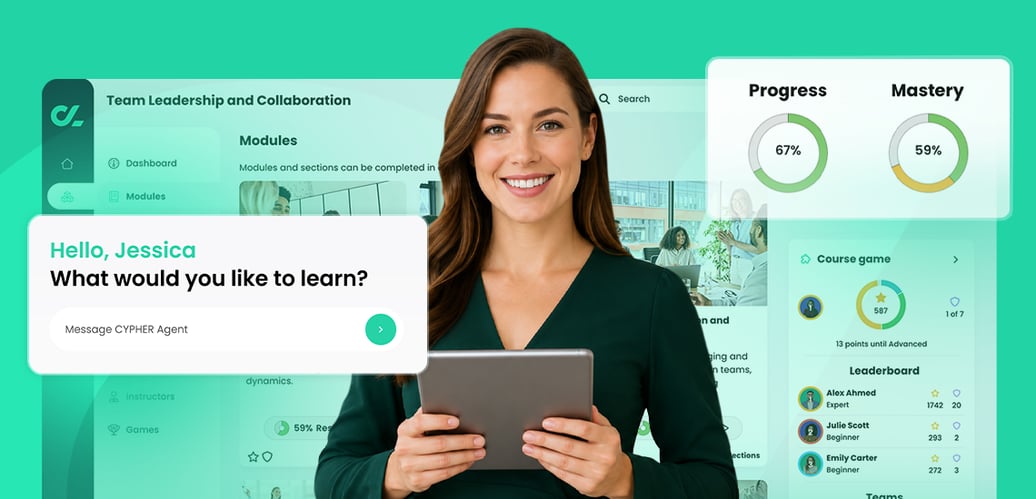
Instead of asking learners to switch to a generic AI tool, explain their situation, upload documents, and hope for the right answer, CYPHER Agent already understands the learning context. It knows the course, the learner's role and progress, the skills they're developing, and the trusted organizational knowledge they need.
Whether someone needs to learn a new concept, practice a challenging conversation, or assess their readiness before applying a new skill, CYPHER Agent provides personalized support exactly when it's needed. Source: CYPHER Learning
The result isn't just greater AI adoption. It's a workforce that learns continuously, builds confidence through practice, and develops real capability as part of everyday work.
The future of AI in the workplace isn't about replacing people or teaching them how to use another tool. It's about giving every employee an intelligent partner that helps them perform at their best.
Discover how CYPHER is helping organizations transform learning into continuous workforce capability. Schedule a demo today.
References
-
Source: Microsoft Work Trend Index 2026 - https://www.microsoft.com/en-us/worklab/work-trend-index/agents-human-agency-and-the-opportunity-for-every-organization
-
Source: CYPHER Learning - https://www.cypherlearning.com/ai-360


