




For decades, learning has inherited an assumption from the web: if people need to know something, they should search for it. Type the right keywords. Scan the results. Open a resource. Decide whether it is relevant. Read until you find the answer. Then translate that information into the situation in front of you.
Search made enormous amounts of knowledge accessible. But access is not the same as understanding.
As AI becomes part of how people work and learn, we are moving toward a different interaction with knowledge. Instead of asking, “Where can I find information about this?” learners can increasingly ask, “What do I need to know about this, right now?”
This shift is part of a broader evolution in learning: from delivering education to providing dynamic enablement. Learning teams have traditionally focused on courses, programs and credentials. Those remain important, but people need many other forms of support throughout the working day. Sometimes they need to learn something new. Sometimes they need an answer, a deeper explanation, access to trusted expertise or simply enough guidance to complete the task in front of them. Dynamic enablement brings these experiences together around a more immediate goal: giving people the knowledge and support they need to perform, in the moment they need it. Source: Josh Bersin
Search puts the work on the learner
Traditional search begins with retrieval. The learner has to know enough about the subject to choose useful keywords, recognize the right result and interpret what they find. That creates friction precisely when people need clarity most.
Imagine an employee encountering an unfamiliar process while completing a task. A conventional learning environment might require them to leave what they are doing, locate the right course or resource, navigate to the relevant lesson and work out how the information applies. Source: Litmos
An AI assisted learning experience can change the starting point from navigation to conversation. The learner can express the problem as a question. The system can then use available context to provide guidance that is more relevant to the learner and the learning environment.
This matters because people rarely experience knowledge gaps as search queries. They experience them as questions: What does this mean? Why did this happen? How should I approach this task? What am I missing?
The future of learning technology should meet people at that moment of uncertainty.
Context changes the value of an answer
A generic answer can be technically correct and still be unhelpful.
Consider two employees asking the same question. One is new to the organization. The other has years of experience. Their roles differ, their existing knowledge differs and the task they are trying to complete may differ.
Giving both people exactly the same explanation misses an opportunity.
This is where Contextual AI becomes important. Rather than treating every prompt as an isolated request, contextual intelligence can draw on relevant information about the learner, the course, organizational knowledge and the current learning task. CYPHER Agent is designed around this approach, bringing those elements together to provide more relevant learning guidance. Source: CYPHER Learning; Source: eLearning Industry
The result is a different relationship with the learning platform. People do not need to repeatedly establish basic context before an interaction becomes useful. The experience can begin closer to the actual need.
That makes AI less like a separate destination and more like an intelligent layer within learning.
CYPHER Agent: Learn turns questions into learning moments
The shift from searching to asking becomes especially meaningful when AI does more than return an answer.
A learner who asks a question may need an explanation, but they may also need to explore the underlying concept, identify a knowledge gap or understand what to learn next.
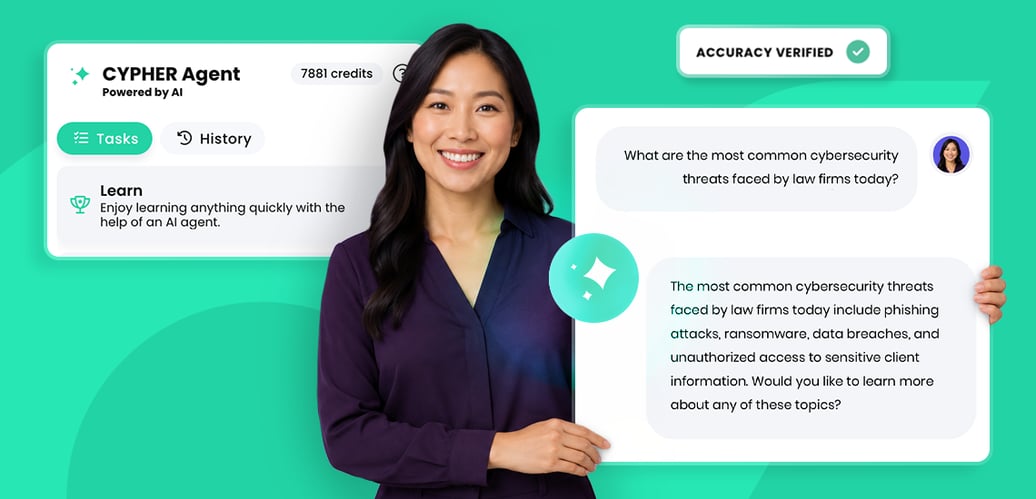
This is where CYPHER Agent: Learn can become part of a dynamic enablement experience. Instead of requiring every need to become a course or every question to become a search, learners can engage conversationally with an AI agent within their learning environment. They can ask a question, dig deeper into a topic and explore relevant knowledge in context. The interaction can meet a short term performance need while also creating an opportunity for deeper learning when it is useful.
That distinction matters. Dynamic enablement is not about replacing formal learning with instant answers. It is about giving people different ways to access knowledge depending on what the moment requires. Sometimes the right experience is a structured course or learning path. Sometimes it is practice or assessment. And sometimes it is simply being able to ask a question and get relevant guidance without breaking the flow of work. By combining conversational support with structured learning, CYPHER can help organizations move more naturally between learning something and using what has been learned to perform.
Asking raises a new question about trust
Moving from search results to generated answers introduces an important responsibility.
When learners search, they can often see where information came from and compare several resources themselves. Conversational AI compresses that process. It can synthesize information into a direct response, which makes the experience faster but also increases the importance of accuracy.
For learning teams, speed without confidence is not enough.
This is why verification mechanisms matter. AI Crosscheck is part of CYPHER Agent's approach to accuracy, providing an independent check on AI generated course content.
The principle behind it is bigger than any single feature: as AI becomes more deeply integrated into learning creation and support, organizations need ways to keep human judgment, trusted knowledge and validation in the loop.
The strongest AI learning experiences will not ask people to choose between usefulness and confidence. They will work to provide both.
The learning interface is changing
The search box taught us to think in keywords. Conversational AI encourages us to think in intentions.
That shift may sound small, but it changes what an LMS can become.
An LMS has traditionally helped organizations organize learning, deliver courses, manage progression and measure activity. Those functions still matter. AI adds another dimension: helping people engage with knowledge through questions at the moment they need it. Source: Talented Learning
For learning leaders, the opportunity is not simply to add a chatbot to an existing experience. It is to rethink how easily people can move from uncertainty to understanding.
The important questions are changing:
- Can learners get useful guidance without already knowing where to look?
- Can organizational knowledge become easier to access in the context of learning?
- Can AI help people understand rather than merely retrieve?
- Can learning remain structured where structure matters while becoming conversational where conversation works better?
- Can organizations introduce that convenience without lowering their expectations for accuracy?
Those are ultimately questions about learning design, not just technology.
From finding information to building capability
Search is not disappearing. There will always be moments when people want to browse resources, investigate alternatives or go directly to a known document.
What is ending is its position as the default gateway to digital knowledge.
When AI understands enough context to make a question useful, learners no longer have to spend as much effort finding the learning before they can begin learning.
They can start with what they actually need to know.
For organizations, that creates an opportunity to bring learning closer to work, make trusted organizational knowledge more useful and give employees a more natural way to explore what they do not yet understand. CYPHER Learning is building toward that model by combining Contextual AI, CYPHER Agent and structured learning capabilities in one platform.
The next generation of learning will not be defined by how quickly someone can find the right page.
It will be defined by how effectively they can ask the right question, understand the answer and turn that understanding into capability.
Ready to see what learning looks like when asking replaces searching? Request a demo and explore how CYPHER Agent can bring contextual, conversational AI into the flow of work.
References
- Source: Josh Bersin - https://joshbersin.com/2026/03/the-world-of-corporate-training-lurches-toward-enablement/
- Source: Litmos - https://www.litmos.com/blog/articles/using-ai-to-supercharge-your-corporate-academy/
- Source: CYPHER Learning - https://www.cypherlearning.com/ai-360
- Source: eLearning Industry - https://elearningindustry.com/ai-for-personalized-learning-how-the-modern-lms-has-changed
- Source: Talented Learning - https://talentedlearning.com/16-enterprise-lms-trends-shaping-2026-an-analysts-view


