



For the past three years, the conversation around artificial intelligence has been dominated by technology. Organizations have raced to identify the right models, evaluate vendors, establish governance frameworks, and define implementation strategies. Billions of dollars have been committed to AI initiatives, driven by the expectation that the technology will fundamentally reshape productivity and competitiveness.
Yet a different story is beginning to emerge.
In July 2026, The New York Times reported that AI companies are recruiting electricians, carpenters, and other skilled tradespeople by the thousands to build the infrastructure supporting the next generation of AI. It is an unexpected headline, but it reveals an important truth. The race to AI leadership is no longer being constrained by algorithms alone. It is increasingly constrained by people. Source: The New York Times
That same principle applies inside every enterprise. The question is no longer whether organizations can deploy AI. Most already have. The more consequential question is whether their workforce is prepared to use AI in ways that create measurable business value.
This represents a profound shift in how executives should think about AI strategy. For years, organizations have approached AI primarily as a technology transformation. Increasingly, it is becoming a workforce transformation.
The organizations that realize this first will not simply adopt AI faster, they will outperform competitors because their people will learn, adapt, and improve faster than everyone else.
AI has changed the rules of workforce development
Historically, workforce development followed a relatively predictable model. New technology was introduced, employees completed training, proficiency gradually increased, and the organization moved forward until the next major change. That model depended on one critical assumption: knowledge remained relatively stable.
Artificial intelligence has eliminated that assumption. Models evolve continuously, new capabilities appear almost weekly, internal policies are revised, regulations change, best practices mature, and entirely new ways of working emerge at a pace few organizations have experienced before. Employees are no longer learning a fixed set of skills, they are learning how to operate within an environment of constant change.
This distinction matters, when knowledge changes continuously, readiness cannot be treated as an annual training initiative. It becomes an organizational capability that must be continuously assessed, reinforced, and refined.
The competitive advantage is no longer the speed at which an organization deploys AI. It is the speed at which its workforce develops the capability to use AI effectively.
Corporate learning is undergoing a category shift
This changing reality is forcing enterprise learning to evolve. For decades, organizations invested in separate systems to solve separate problems.
- Learning management systems delivered courses.
- Knowledge bases stored information.
- Performance support tools answered questions.
- Coaching platforms developed skills.
- Microlearning reinforced knowledge.
- Skills platforms mapped competencies.
These categories made sense when learning happened before work. Today, they are beginning to converge because work itself has changed.
An employee faced with a new challenge may not need a course. They may need a trusted answer, a short explanation, a simulation, guided practice, an assessment, a recommendation, or an expert who can provide immediate support. The appropriate intervention depends entirely on the context, the role, and the level of proficiency.
Learning is no longer defined by the format of the content, it is defined by its ability to improve performance at the moment it matters.
This is more than an evolution of the LMS. It represents the emergence of a new category centered on workforce enablement. Rather than asking, "What course should someone take?" organizations are increasingly asking, "What intervention will help this person perform better right now?"
That is a fundamentally different problem to solve.
The enterprise knowledge layer is becoming strategic infrastructure
If there is one lesson organizations are learning from early AI deployments, it is that intelligence is only as reliable as the knowledge behind it. Many organizations have introduced AI assistants while their knowledge remains fragmented across shared drives, collaboration platforms, email archives, departmental repositories, and outdated documentation. Employees receive inconsistent answers because the underlying knowledge is inconsistent.
This is not simply a technology challenge, it is a governance challenge. Enterprise knowledge can no longer be viewed as a collection of documents waiting to be searched. It has become strategic infrastructure that must be continuously ingested, validated, permissioned, refreshed, and made available within the context of work.
Without this foundation, AI becomes another disconnected tool. With it, AI becomes a trusted partner capable of delivering contextual guidance that reflects the organization's current policies, processes, expertise, and priorities.
In the coming years, the organizations with the strongest knowledge foundations may well become the organizations that realize the greatest return from AI.
Measuring workforce capability instead of learning activity
This shift also challenges one of the longest-standing assumptions in corporate learning: that learning activity is an appropriate measure of success.
Completion rates, learning hours, and satisfaction scores have value, but they provide little insight into whether an organization is actually becoming more capable.
Executive teams are asking different questions.
- How quickly are new employees becoming productive?
- Which business units are confidently adopting AI?
- Where do capability gaps exist?
- How consistently are decisions being made?
- Has support volume decreased?
- Are teams solving problems faster?
These are not learning metrics, they are business metrics. The implication is significant. Corporate learning is moving beyond measuring participation toward measuring organizational capability and business outcomes.
A framework for assessing AI workforce readiness
If workforce readiness is becoming a competitive differentiator, organizations need a structured way to understand where they stand today and where investment will create the greatest impact.
At CYPHER, we believe AI workforce readiness can be viewed across four interconnected dimensions.
Capability readiness
Begins with understanding the current state of the workforce. Organizations need visibility into existing AI knowledge, confidence, proficiency, and role-specific capability before they can design meaningful development strategies.
Knowledge readiness
Examines whether employees have access to trusted, current, and permission-aware organizational knowledge. AI cannot consistently improve performance if the knowledge it relies on is fragmented or outdated.
Enablement readiness
Focuses on how capability is developed. Rather than relying solely on scheduled training, organizations should combine personalized learning, guided practice, assessments, coaching, and contextual support that adapts to individual roles and evolving business needs.
Outcome readiness
Measures whether these investments are improving business performance. The ultimate objective is not higher completion rates but faster onboarding, greater productivity, stronger adoption, improved decision-making, and reduced operational risk.
These four dimensions reinforce one another. Weakness in any one area limits the organization's ability to scale AI successfully.
Why this matters for enterprise leaders
Every major technology shift eventually changes the skills organizations require. AI is different because it changes how those skills are developed. The organizations leading this transformation are not treating workforce readiness as an HR initiative or a learning initiative. They are treating it as a strategic business capability.
That perspective changes investment priorities, it changes how success is measured, and it changes the role of learning technology. Most importantly, it changes how organizations think about competitive advantage.
The companies that lead the next decade will not necessarily have access to better AI models than everyone else. Increasingly, those models will become widely available. Their advantage will come from something far more difficult to replicate: a workforce that can continuously adapt as AI evolves.
Where CYPHER is leading the next generation of workforce enablement
This shift is precisely why CYPHER has built an AI-native platform designed around workforce enablement rather than course management.
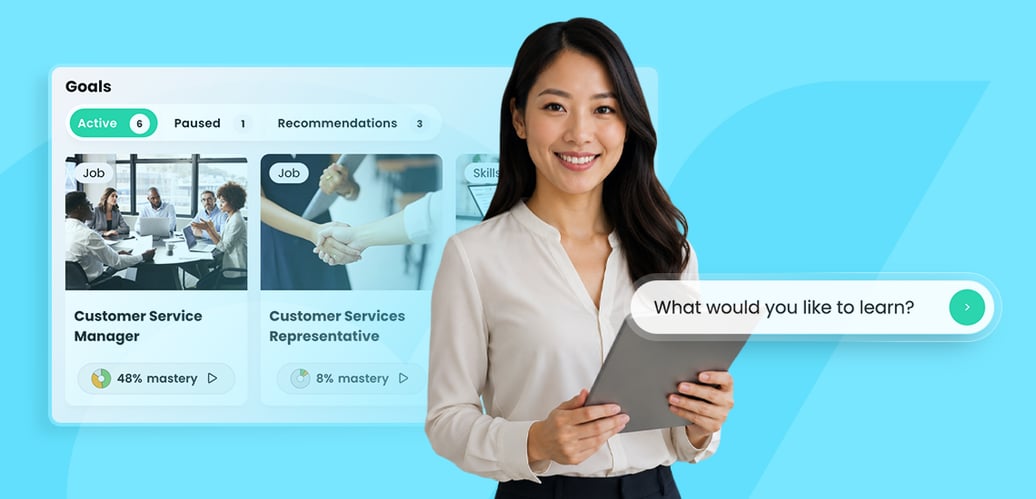
Organizations can assess workforce capability, identify readiness gaps, personalize development by role and proficiency, ground AI experiences in trusted enterprise knowledge, provide contextual guidance through CYPHER Agent, enable realistic practice and assessment, and measure the business outcomes that matter most.
At the heart of this approach is trusted organizational knowledge. CYPHER grounds AI experiences in permissioned, up-to-date enterprise content, ensuring employees receive relevant, reliable guidance in the context of their work. Combined with personalized learning, practice, assessments, and automation, organizations can continuously build capability as business needs evolve.
Corporate learning is entering a new era where learning, knowledge management, AI coaching, performance support, and business intelligence are converging into a single workforce enablement strategy. CYPHER is helping organizations lead that transformation.
The conversation around AI has spent years focused on models, infrastructure, and technology. The next chapter will be defined by people. The organizations that build the most AI-ready workforces won't just keep pace with change, they'll shape what's possible.
Build an AI-ready workforce with CYPHER Agent
Discover how CYPHER Agent helps organizations assess AI workforce readiness, close capability gaps, and deliver trusted, AI-powered guidance that accelerates learning and improves performance.
Schedule a demo with CYPHER and see AI workforce readiness in action.
References
-
Source: The New York Times - https://www.nytimes.com/2026/07/29/business/economy/data-center-electricians-training.html
-
Source: CYPHER Learning - https://www.cypherlearning.com/ai-360


