




Sooner or later, every major AI training initiative encounters the same question.
Is it actually working?
It is relatively easy to report how many employees enrolled in AI training, completed a course, or earned a certification. Those metrics matter. They tell you whether people are participating and progressing.
But they do not tell you whether employees are becoming better at using AI.
That distinction becomes increasingly important as organizations invest in AI workforce development. The business case is rarely to get 5,000 employees through an introductory course. It is to help those employees use AI effectively, responsibly, and in ways that improve how work gets done.
Measuring AI training ROI therefore requires organizations to look beyond learning activity and connect training to changes in capability, behavior, workflows, and business performance.
The question is not simply, “Did people complete the training?”
It is “What changed because people developed these skills?”
AI training ROI starts with the outcome you are trying to create
Before choosing metrics, define what success should look like.
If an organization launches an AI Academy with the goal of improving general AI literacy, success might initially mean employees understanding appropriate AI use, recognizing unreliable outputs, and knowing the organization's governance requirements.
If the objective is AI upskilling for a sales team, success might involve employees becoming proficient in approved AI supported workflows for research, meeting preparation, or communication.
If AI training is designed around a particular operational process, the desired outcome might be reducing the time required to complete that process while maintaining an appropriate level of quality.
Those are different objectives, so they require different measurements.
This is one reason a single “AI training ROI” number can be misleading. AI workforce development can affect knowledge, skills, behavior, efficiency, quality, and business performance at different points in the journey.
A stronger measurement model follows that progression.
Start with adoption, but do not stop there
Adoption is an important early indicator.
If employees have received AI training but are not using approved AI tools or applying what they learned, there is unlikely to be much downstream business impact.
Organizations might examine indicators such as how many employees are participating in AI training, which learning paths they are following, whether they complete relevant assessments, and whether they progress into more advanced learning.
Outside the learning platform, organizations may also have access to usage information from their approved AI tools.
That can help answer questions such as:
-
Are employees actually using the tools?
-
Which teams have adopted them?
-
Is usage increasing following training?
-
Are people returning to the technology or trying it once and abandoning it?
The distinction between LMS and AI tool data matters. A learning platform can show what people are learning. The AI application or relevant business system is generally a better source for evidence about actual tool and workflow usage.
Together, those signals provide a more complete picture.
Measure proficiency, not just participation
Someone can complete an AI course without being able to apply what they learned.
That makes proficiency a more meaningful indicator than completion alone.
Assessment can help organizations determine whether learners understand concepts and can demonstrate relevant knowledge or skills.
For foundational AI literacy, that might include understanding responsible use, recognizing hallucinations, knowing when verification is necessary, or applying organizational rules to a scenario.
Role specific AI upskilling could assess more contextual capabilities.
-
Can a salesperson identify the appropriate way to use AI in an account research scenario?
-
Can a marketer evaluate an AI generated output for unsupported claims?
-
Can a manager identify when an AI recommendation lacks important context?
CYPHER supports assessments, skills, certifications, badges, and other learning milestones that organizations can use to structure and recognize progression.
That gives organizations a stronger measurement question:
Not just “Who completed AI training?” but “What can they demonstrate now?”
Use certification as a capability milestone
Certification can provide another useful layer of measurement, particularly when an organization wants to establish clear standards for AI capability.
An AI Academy might create a foundational AI literacy certification for the wider workforce, followed by role specific certifications for employees developing more advanced capabilities.
For example, employees could progress from a common AI literacy foundation into learning aligned with sales, marketing, management, or another function.
Certification does not automatically prove business impact. But it can provide a visible milestone that shows employees have completed defined learning and met the assessment requirements established by the organization.
That distinction is important.
A certification should not be presented as evidence that someone is now inherently an “AI expert.” Its value depends on the learning objectives and assessment behind it.
Used thoughtfully, certifications can help organizations define what different levels of AI development mean and monitor how the workforce is progressing toward them.
Find out whether AI is entering real workflows
This is where measurement starts moving beyond learning and into behavior.
Employees may understand AI and perform well in an assessment but never incorporate it into their work.
Organizations therefore need to examine whether trained capabilities are being applied to relevant workflows.
That might mean measuring the use of an approved AI capability within a specific process, examining adoption data from enterprise AI applications, surveying employees about use cases, or gathering feedback from managers about how teams are working differently.
The metric needs to be tied to something meaningful.
“Employee used AI 50 times this month” tells you very little.
“Employee regularly uses the approved AI workflow for account preparation” tells you considerably more.
This is where role based AI training becomes particularly useful. When training is built around defined tasks and workflows, organizations have something concrete to measure afterward.
The learning objective and the workflow metric can speak the same language.
Measure time saved carefully
Time saved is one of the most attractive AI ROI metrics.
It is also one of the easiest to overstate.
Asking employees how much time AI saves them can provide useful directional information, but self reported estimates should not automatically be treated as precise financial returns.
Where possible, establish a baseline.
-
How long did a defined task typically take before the new AI supported workflow?
-
How long does it take afterward?
-
How frequently is the task performed?
-
Has the nature or quality of the output changed?
If an employee reduces a 60 minute task to 40 minutes, that does not automatically mean the organization has “saved” 20 minutes of labor cost. The employee may simply use those 20 minutes for another valuable activity.
That can still be an excellent outcome.
But measurement should reflect what actually happened.
Time released for higher value work and direct cost reduction are not necessarily the same thing.
Maintaining that distinction makes the business case for AI training more credible.
Look at task completion, not just time
Faster is not always better.
AI may create value by helping employees complete tasks they previously struggled with, increasing consistency, or reducing the amount of rework required.
That makes task completion another useful dimension.
Organizations might examine whether employees can successfully perform a defined AI supported task after training, whether they require less assistance, or whether they can complete more complex workflows than they could previously.
Consider an employee learning how to use AI for a new research process. Speed may improve. But another valuable outcome might be that they now have a repeatable approach for completing a task they previously performed inconsistently. That is capability development.
AI training measurement should be broad enough to recognize it.
Quality belongs in the ROI equation
AI can make an employee faster while making their output worse.
That is not a successful transformation.
Quality measures are therefore essential, particularly when AI is being used to produce information, analysis, communications, or other outputs that require human evaluation.
What quality means will depend on the task.
A customer communication might be evaluated for accuracy, completeness, relevance, and adherence to brand or organizational standards.
Research might be assessed for source quality and factual accuracy.
An internal summary might be judged by whether important information has been preserved.
The organization should ideally define those criteria before measuring the effect of AI training.
This allows teams to compare like with like.
If employees are completing work 25 percent faster but error rates are increasing, that matters. If work is completed more quickly while quality remains stable or improves, the picture is very different.
Efficiency without quality is an incomplete AI ROI metric.
Connect learning data to business outcomes
Eventually, executives want to understand what all this means for the organization.
That is where measurement becomes both more valuable and more difficult.
Business outcomes could include productivity improvements, reduced rework, faster customer response, increased capacity, better sales execution, shorter process times, improved service quality, or other measures relevant to the particular AI use case.
But organizations should be cautious about attribution.
If sales performance improves after AI training, the training may have contributed. So might pricing changes, market conditions, a new manager, a product launch, or ten other factors.
An LMS should not claim to prove causation it cannot establish.
A stronger approach is to build an evidence chain:
-
Learning: Did employees participate?
-
Proficiency: Did their knowledge or demonstrated capability improve?
-
Adoption: Are they using the relevant AI tools?
-
Behavior: Are they applying AI to the intended workflows?
-
Performance: Did speed, task completion, or quality change?
-
Business outcome: Did a relevant organizational metric improve?
The stronger the evidence across that chain, the stronger the case that AI workforce development is contributing to the outcome.
Create an AI training measurement scorecard
Organizations do not need hundreds of metrics to understand whether AI training is working.
They need a focused set of measures that connects learning to changes in capability, behavior, and business performance.
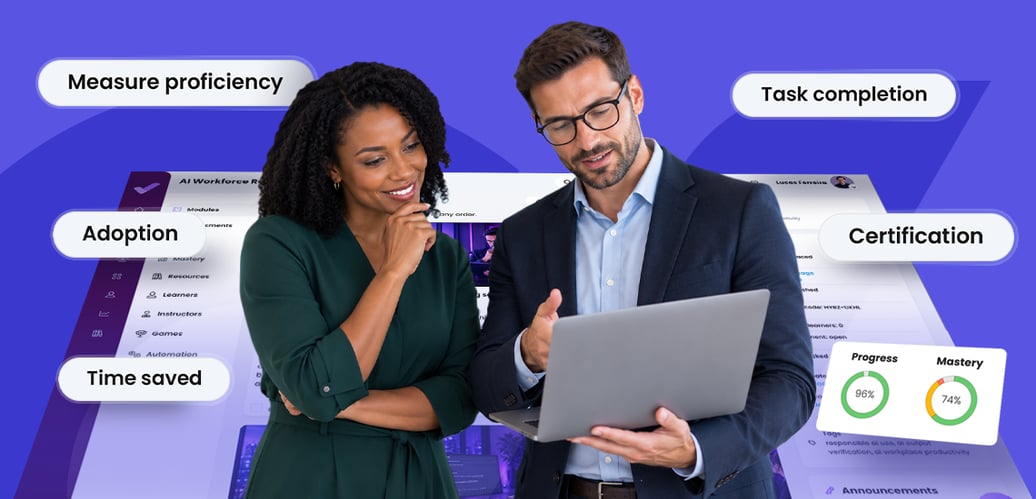
A practical AI training measurement framework could include:
-
Training adoption: Are the right employees participating in the learning? Look at enrollment, participation, completion, and progression through relevant learning paths.
-
Proficiency: Can employees demonstrate the knowledge and skills the training was designed to develop? Assessments and skills data can provide a stronger indication of capability than completion alone.
-
Certification: Who has reached the standards your organization has established for foundational or role specific AI capability? Certification can provide a clear milestone as employees progress through an AI Academy.
-
AI adoption: Are employees actually using the approved AI tools available to them? This information will typically come from the AI platform rather than the LMS.
-
Workflow usage: Are employees applying AI to the tasks and workflows the training was designed to support? Usage within relevant AI and business systems can help connect learning with workplace behavior.
-
Time saved: Has the time required to complete specific tasks changed? Where possible, compare performance against a meaningful baseline rather than relying entirely on estimates of productivity gains.
-
Task completion: Can employees perform relevant tasks more effectively after training? In some cases, the benefit of AI may be increased capacity, greater consistency, or the ability to complete work that previously required more support rather than simply doing the same task faster.
-
Quality improvements: Has the quality of work changed alongside efficiency? Depending on the use case, organizations might examine accuracy, consistency, completeness, rework, or adherence to defined standards.
-
Business outcomes: Is the initiative contributing to the organizational result it was designed to influence? That could include productivity, capacity, customer response times, sales execution, service quality, or another relevant business measure.
These measures will rarely live in one system.
The LMS can provide evidence about learning participation, assessments, skills, and certifications. AI platforms can provide adoption and usage information. Operational and business systems can reveal what happens to workflows, quality, and performance.
The strongest AI training ROI story comes from connecting those different signals rather than expecting course completion to prove business impact on its own.
This also creates a more useful conversation with executives. Instead of reporting that 90 percent of employees completed AI training, learning teams can begin showing a progression from training participation to demonstrated proficiency, from proficiency to workplace application, and from application to measurable performance outcomes.
Compare different roles differently
One universal AI ROI metric makes little sense when AI is being used differently across the organization.
A sales team and a marketing team may complete the same foundational AI literacy training, but their advanced learning should lead toward different outcomes.
-
For sales, the organization might examine proficiency alongside adoption of approved account preparation workflows and changes in preparation time or quality.
-
For marketing, it might look at relevant AI skills alongside the use of approved research or content workflows, production time, and defined quality criteria.
The learning strategy can reflect those differences.
CYPHER allows organizations to create different learning paths based on factors such as role, skill level, department, audience, or use case.
Measurement can then follow the same structure.
Everyone may share a foundational definition of AI literacy. The measures of advanced capability become more specific as the learning becomes more specific.
ROI should improve as the AI Academy learns
AI training is not a project that should be measured once at the end. Measurement should feed the next iteration. Perhaps assessment data shows that employees understand prompting but consistently struggle with verification. Maybe AI tool data reveals that a workflow covered heavily in training is rarely being used. Perhaps one department is demonstrating significantly stronger adoption than another or employee feedback reveals a new AI use case that deserves its own learning path. Those insights should change the training.
CYPHER's AI Academy model is designed around the idea that learning can continue developing as technologies, use cases, and learner capabilities change.
This turns measurement into more than reporting. It becomes part of curriculum design.
The real return is workforce capability
Course completion matters.
But it is the beginning of the measurement story, not the end.
The strongest case for AI training ROI connects what employees learn to what they can demonstrate, what they actually do, how their work changes, and which business outcomes those changes support.
That requires learning data, AI adoption data, operational metrics, quality measures, and business context.
It also requires restraint. Not every efficiency gain can be converted neatly into dollars. Not every business improvement can be attributed directly to training. Credible measurement acknowledges those limitations rather than hiding them.
The goal is to understand whether AI workforce development is producing genuine capability.
An AI Academy gives organizations a structure for continually developing and measuring that capability. With CYPHER Learning, you can create foundational and role specific AI learning, build assessments and skills into the experience, establish certifications and learning milestones, and use learning data to understand where your workforce is progressing and where further development is needed.
Then connect those learning insights with the AI usage, workflow, quality, and business data already available across your organization.


