




Most organizations would never give sales, marketing, HR, and leadership identical job training.
Yet that is often what happens with AI.
Everyone attends the same introduction to generative AI. Everyone learns the same prompting framework. Everyone receives the same examples. Then employees are expected to work out how those lessons translate into their own roles.
A shared foundation has value. Employees need a common understanding of AI, responsible use, data privacy, hallucinations, verification, and organizational policies.
But that is where standardized AI workforce training should begin, not where it should end.
The real opportunity comes when employees can answer a much more relevant question:
How can I use AI effectively in the work I actually do?
That requires role-based AI training designed around the tasks, decisions, risks, and skills that differ across functions.
Why identical AI training falls short
Imagine teaching four employees how to use generative AI.
One works in sales. One works in marketing. One works in HR. One leads a business unit.
You could teach all four how to write a better prompt. But what happens next?
-
The salesperson wants to prepare for an account meeting.
-
The marketer wants to turn research into campaign ideas.
-
The HR professional wants to understand how AI can support routine work while handling employee information appropriately.
-
The leader wants to synthesize a large amount of information before making a decision.
They may be using similar technology, but the context surrounding its use is completely different.
The information available to them differs. The consequences of an inaccurate output differ. Their workflows differ. The expertise required to evaluate a response differs.
Effective AI workforce training should account for those differences.
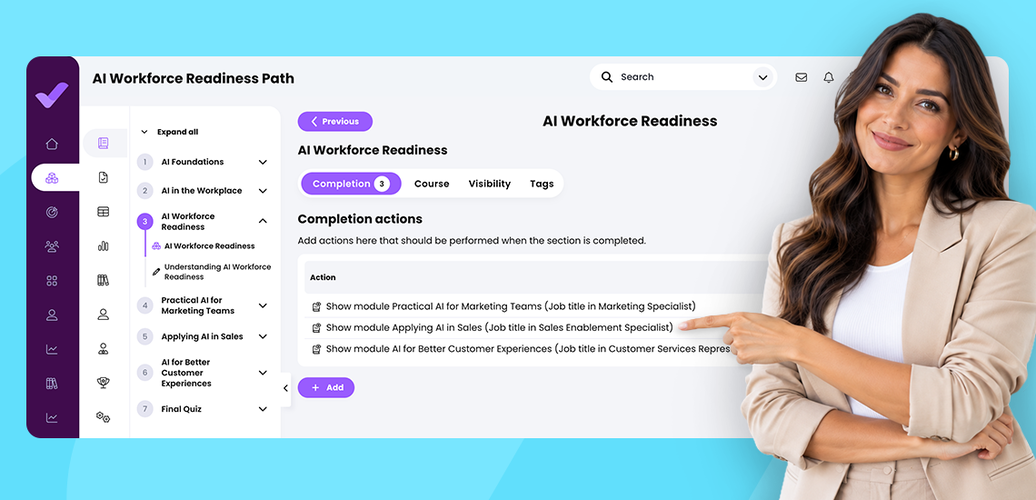
CYPHER's AI Academy approach supports this model by allowing organizations to create learning paths based on factors such as role, skill level, department, audience, or use case.
Start with a common AI foundation
Role-based training does not mean creating an entirely separate AI program for every department.
There are foundational capabilities most employees should understand.
An organization might establish core learning covering what generative AI is, its strengths and limitations, prompting fundamentals, hallucinations and verification, data privacy, security, responsible use, organizational policies, and human oversight.
Think of this as the trunk of the tree.
Role specific learning becomes the branches.
This approach gives employees a shared vocabulary and set of expectations while avoiding unnecessary repetition later. It also means governance does not have to be reinvented for every department.
Once learners understand the fundamentals, they can progress toward practical applications relevant to their work.
That progression from AI literacy into practical use cases and more advanced applications is central to building an AI Academy that develops alongside its learners.
Build sales AI training around the selling process
Sales teams do not need an abstract catalog of AI use cases. They need to understand where AI can appropriately support the activities surrounding customer conversations and relationships.
Training could explore scenarios such as using approved AI tools to organize account research, prepare questions for a meeting, summarize permitted information, brainstorm approaches to an objection, or improve a first draft of follow up communication.
But the learning should go beyond showing employees that these applications exist.
A salesperson needs to know how to judge the output.
If AI generates information about a prospect, what needs verification? If the employee wants to provide customer information as context, what does company policy allow? If AI drafts an email, what needs to be checked before it reaches the customer?
A sales pathway might therefore progress through:
-
AI foundations for sales: Responsible use, data considerations, verification, and prompting.
-
Sales applications: Research, meeting preparation, organization, communication, and other approved workflows.
-
Practice: Scenarios where learners decide how to use AI in realistic sales situations.
-
Advanced capability: More sophisticated workflows appropriate to the organization's tools and sales process.
The goal is not to automate selling. It is to help salespeople develop better judgment about where AI can support their work.
Make marketing AI training about more than content generation
Marketing is often one of the first functions to experiment heavily with generative AI.
That can make its training needs more sophisticated.
Employees may already know that AI can generate a first draft. What they need next is a better understanding of where AI adds value across research, ideation, analysis, content workflows, and campaign development.
Training could ask marketers to compare outputs produced with different levels of context, evaluate whether AI generated claims are adequately supported, identify when source verification is required, or determine whether an output aligns with the organization's brand and audience.
Marketing also presents an opportunity to develop critical evaluation skills.
A grammatically perfect response can still be generic, inaccurate, off brand, unsupported, or strategically weak.
AI fluency in marketing therefore depends as much on evaluating and improving outputs as generating them.
Role-based training can reflect that reality by building exercises around the actual standards marketers use when judging their own work.
Treat HR as a higher context AI environment
HR illustrates particularly clearly why role-based AI training matters.
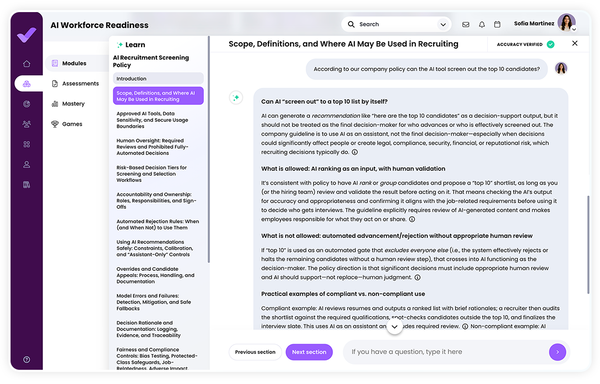
An HR professional may encounter personal information, confidential conversations, internal policies, and decisions that affect people. That makes understanding organizational governance and the limits of AI especially important.
Training could explore lower risk applications such as brainstorming ideas, structuring non sensitive information, preparing generic communications, or developing a first draft from approved material.
It should also teach employees to recognize situations where greater caution or human expertise is required.
-
Can this information be entered into this AI tool?
-
Is personal or confidential information involved?
-
Does this output require verification?
-
Could relying on the output influence a decision about an employee or candidate?
-
Is specialist or human review required?
The exact answers depend on the organization's tools, policies, legal obligations, and processes. Training should not pretend that an LMS can determine those answers automatically. Instead, role-based AI training can help HR professionals practice applying the organization's established rules to realistic situations.
That is far more useful than giving them the same generic list of prompts as every other employee.
Train leaders to question AI, not simply use it
Leadership AI training needs another emphasis.
Executives and managers may use AI to synthesize information, explore ideas, prepare for conversations, consider alternative perspectives, or work through complex information.
The risk is that a polished AI response can create an illusion of certainty.
Leadership training should therefore place considerable emphasis on judgment.
-
What assumptions is the AI making?
-
What context does it lack?
-
What evidence supports the answer?
-
Whose perspective is missing?
-
What happens if the recommendation is wrong?
-
Is AI assisting a decision, or has the person effectively delegated the decision to AI?
These are valuable questions because leaders often operate in situations where there is no objectively perfect answer.
A useful leadership pathway could combine practical AI applications with scenarios requiring learners to critique an AI response, identify missing context, compare possible approaches, and determine where human expertise must take precedence.
The objective is not AI led leadership. It is better informed human leadership in an AI enabled workplace.
Map skills before building courses
The easiest way to create role-based AI training is not to start with content.
Start with capability.
For each role, identify what someone should be able to understand, do, evaluate, and decide.
A simple framework could look like this:
- Sales
Example AI capabilities: Research effectively, prepare for conversations, evaluate prospect information, protect customer data.
- Marketing
Example AI capabilities: Develop and refine ideas, evaluate outputs, verify claims, apply brand and audience context.
- HR
Example AI capabilities: Recognize appropriate use cases, protect sensitive information, apply governance, identify when human oversight is essential.
- Leadership
Example AI capabilities: Synthesize information, interrogate AI outputs, recognize assumptions, maintain accountability for decisions.
These capabilities can then be mapped to skills.
From there, organizations can determine which skills are universal, which are role specific, and which require more advanced proficiency.
Only then should the question become: What learning will develop those skills?
That prevents the curriculum from becoming a collection of interesting AI tutorials without a clear connection to workforce capability.
Create different paths for different starting points
Role is only one dimension of personalization.
Two marketers may have completely different levels of AI experience. One might be opening an AI tool for the first time. Another might already use it daily.
Making both complete identical training can create unnecessary friction.
Organizations can instead design learning paths that account for both role and existing capability.
For example:
-
Foundation path: AI literacy, responsible use, privacy, prompting, hallucinations, and verification.
-
Role path: Practical applications, scenarios, and skills relevant to the learner's function.
-
Advanced path: More sophisticated workflows and capabilities for experienced users.
-
Ongoing path: New learning introduced as tools, policies, use cases, and organizational priorities change.
Assessment can help provide evidence of what learners understand and where further development may be useful. Courses, assessments, skills, certifications, badges, and other milestones can then give structure to progression.
The important point is that personalization should have a purpose. Employees do not need different learning simply for the sake of having different learning. They need a path that reflects what they already know and what they need to be able to do next.
Use company knowledge to make AI training relevant
Generic AI examples can explain a concept.
Organizational context is what makes that concept useful at work.
An effective role-based program should incorporate the policies, processes, terminology, scenarios, products, and knowledge employees actually encounter.
That might mean creating sales scenarios around your sales process, marketing exercises around your brand standards, HR learning around approved internal policies, or leadership scenarios based on the types of decisions managers regularly face.
This is also an area where AI can accelerate learning development.
CYPHER Agent can help teams turn trusted organizational knowledge and resources into structured learning experiences, including course content, assessments, skills, and gamified elements. Subject matter experts can then review and refine what is created before it reaches learners.
That combination matters.
AI can help make development faster. Your experts still provide the business context that makes the training credible.
Role-based training should never be finished
The AI skills a salesperson needs today may not be the skills they need next year.
The same applies to marketing, HR, leadership, and every other function.
New AI capabilities will appear. Organizations will approve different tools. Employees will discover useful workflows. Policies will evolve. Teams that currently need foundational training will become more sophisticated.
Role-based AI workforce training therefore needs an iteration cycle.
Review which learning employees are completing. Look at assessment and skills data. Talk to teams about where AI is becoming useful and where confusion remains. Work with subject matter experts to identify emerging applications and risks.
Then update the pathways.
An AI Academy should never really be considered finished because the technology, learners, and relevant use cases continue to develop.
Build one AI Academy, not one AI course for everyone
Organizations do need shared AI literacy.
But a common foundation should lead somewhere.
Sales needs to understand AI in the context of selling. Marketing needs to apply it to marketing work. HR needs training that reflects the sensitivity and judgment inherent in its responsibilities. Leaders need to know how to benefit from AI without surrendering accountability to it.
The answer is not four completely disconnected training programs.
It is one AI workforce development strategy with a shared foundation and different paths toward role specific capability.
An AI Academy provides a structure for doing that.
With CYPHER Learning, organizations can build learning for different roles, audiences, and skill levels within one platform. Create foundational AI literacy, develop role specific paths, assess knowledge and skills, recognize progress through certifications and badges, and continue evolving learning as AI and your organization's needs change.
Your people may use the same AI tools, but they do not do the same work.


