




Finding the right AI course authoring platform for your L&D team can feel like comparing apples to algorithms. You need a tool that creates professional training content fast, personalizes it for different roles, and scales across your entire organization without tripling your tech stack.
That is exactly what this guide covers. We evaluated six AI course authoring platforms built for enterprise learning and development, including CYPHER Learning, to help you choose the platform that fits your team's needs.
Below, you will find a breakdown of each platform's AI capabilities, automation features, skills tracking, and how they handle enterprise-scale deployment.
Quick guide: 6 best AI course authoring platforms for enterprise L&D
- CYPHER Learning: The best AI-native platform for building and delivering enterprise training at scale.
- Docebo: A content marketplace option for organizations that rely on curated third-party libraries.
- Absorb LMS: An admin-friendly interface for teams that prioritize reporting workflows.
- Cornerstone OnDemand: A talent suite add-on for HR departments already running Cornerstone tools.
- LearnUpon: A multi-portal setup for companies training external partners alongside employees.
- D2L Brightspace: An academic-origin platform adapted for corporate compliance programs.
How we chose the best AI course authoring platforms for enterprise L&D
Picking the right platform for your L&D team goes beyond reading a features list. We evaluated each platform through the lens of an enterprise training buyer, focusing on what matters most when you need to create, personalize, and scale courses across a distributed workforce.
Here is what shaped our evaluation:
- AI course creation speed: How quickly can you turn raw expertise or company documents into a polished, ready-to-launch course? We looked for platforms where AI handles structuring, assessments, and multimedia so your team can publish in minutes instead of weeks.
- Personalization depth: Can the platform tailor learning paths by role, skill level, and performance data? Personalized training keeps your learners engaged and closes skill gaps faster.
- Automation capabilities: Does the platform automate enrollments, reminders, compliance renewals, and progress tracking? Fewer manual tasks mean your L&D team spends more time on strategy.
- Scalability and multi-tenant support: Can you roll out branded portals for different regions, business units, or partner audiences without bolting on extra tools?
- Skills and competency tracking: Does the platform map skills to courses and measure mastery rather than just course completions? Skills-based data gives you a clearer picture of workforce readiness.
- Integration ecosystem: How well does the platform connect with your HRIS, CRM, and existing content libraries? A connected ecosystem means less data re-entry and better learner insights.
The 6 best AI course authoring platforms for enterprise L&D
1. CYPHER Learning: best overall AI course authoring platform for enterprise L&D
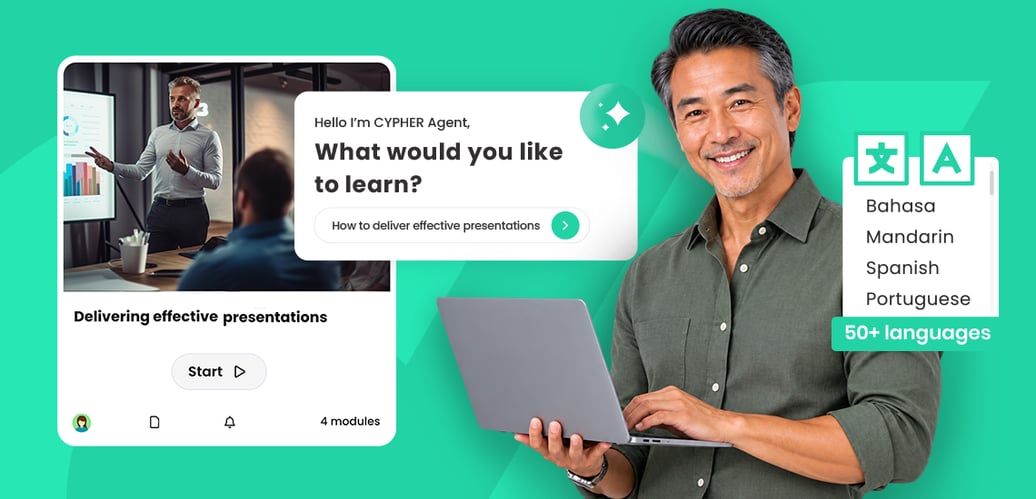
CYPHER Learning gives you an AI-native platform built to turn company knowledge into professional-grade training in minutes. With CYPHER Agent, you can generate full courses from a simple prompt or your own uploaded documents, complete with assessments, gamification, skill mappings, and multimedia.
This means your L&D team moves from months-long development cycles to same-day publishing. According to independent research by IDC, organizations using the CYPHER Learning platform have achieved a 640% three-year ROI and 60% faster course creation.
CYPHER Learning also unifies content creation, delivery, certification, compliance, reporting, and monetization in one platform. You do not need separate authoring tools, an LMS, and a third-party analytics suite. Everything lives in a single environment, giving you centralized control with localized flexibility through branded sub-portals.
For enterprise buyers evaluating AI course authoring, CYPHER Learning stands apart with its AI Crosscheck feature, which uses dual-model validation to verify content accuracy and reduce hallucinations. That means the courses your AI generates are credible and trustworthy from the start.
CYPHER Learning features
- AI-powered course generation: Turn a prompt or an uploaded document into a structured course with quizzes, voiceovers, images, and skill tags in minutes. Your instructional designers keep full editorial control over every element.
- AI Crosscheck: Dual-model validation flags inaccuracies before content reaches learners, so you publish credible content without fact-checking bottlenecks.
- Competency and skills mapping: CYPHER Agent automatically identifies and aligns competencies to courses, modules, and assessments. You can track mastery-level proficiency rather than just course completion.
- Advanced automation engine: Set rules to automate enrollments, reminders, compliance renewals, certificate issuance, and learner progression. Your admin workload drops dramatically.
- 50+ language support with universal translator: Create a course once and deploy it globally. Real-time translation lets you maintain consistency across regions without duplicating effort.
- Integrated e-commerce: Sell courses, bundles, and subscriptions directly from the platform. No third-party storefront required, so you can monetize training from day one.
CYPHER Learning pros and cons
Pros:
- AI-native course creation reduces development time from months to minutes while preserving editorial oversight.
- Unified platform for authoring, delivery, compliance, skills tracking, and e-commerce eliminates the need for multiple tools.
- Enterprise-class integrations with HRIS, CRM, and LTI, plus 50+ language support, make global rollouts straightforward.
Cons:
- The depth of automation options can take new admins a few sessions to fully configure.
- Organizations with very simple training needs may not use every built-in capability right away.
- Some niche third-party content integrations may require initial setup through LTI or API connectors.
2. Docebo: a content marketplace option for curated library needs
Docebo includes a content marketplace that connects you to third-party course libraries from multiple providers. If your organization relies heavily on pre-built courses rather than custom authoring, Docebo aggregates those catalogs in one location.
The platform also offers AI-assisted tagging and content recommendations based on learner activity. Reporting tools give admins visibility into enrollment rates and completion data across business units.
Docebo features
- Content marketplace: Browse and assign courses from third-party providers without leaving the platform.
- AI-powered tagging: Automatically categorizes and labels learning content to reduce cataloging work.
- Multi-audience portals: Create separate branded environments for employees, partners, and customers.
Docebo pros and cons
Pros:
- The content marketplace gives you access to multiple third-party course libraries in one place.
- AI-assisted tagging reduces the time admins spend organizing learning catalogs.
- Multi-audience portal configuration lets you separate internal and external learner groups.
Cons:
- Native AI course authoring is more limited compared to platforms purpose-built for AI-first content creation.
- Advanced reporting features are not available on all plan tiers.
- Integrating custom SCORM content from external authoring tools requires additional configuration steps.
3. Absorb LMS: an admin-focused interface for reporting-first teams
Absorb LMS includes an AI-powered admin assistant called Intelligent Assist, which lets you type natural-language requests to pull reports or manage learner records. For teams that spend significant time on administrative tasks, this feature reduces the number of clicks needed to find data.
The platform also includes Absorb Create, a built-in authoring tool that uses generative AI to draft course outlines and quiz questions. Absorb Skills offers a library of over 20,000 pre-built courses for upskilling initiatives.
Absorb LMS features
- Intelligent Assist: A natural-language admin tool that lets you request reports and manage records by typing plain English queries.
- Absorb Create: A built-in authoring module that uses generative AI to draft course structures and quizzes.
- Absorb Skills: A catalog of 20,000+ courses spanning multiple industries and skill levels for upskilling programs.
Absorb LMS pros and cons
Pros:
- Intelligent Assist lets admins pull reports and manage users through natural-language commands.
- The built-in authoring tool handles basic course generation without a separate software purchase.
- A large pre-built course library supports quick deployment for general upskilling programs.
Cons:
- AI authoring capabilities do not extend to multimedia generation, voiceovers, or gamification setup.
- Competency and skills mapping is not natively tied to individual course modules and assessments.
- Multi-language support does not include real-time translation for authored content.
4. Cornerstone OnDemand: a talent suite add-on for existing Cornerstone users
Cornerstone OnDemand positions its LMS as part of a broader talent management suite that includes recruiting, performance reviews, and succession planning. If your organization already runs Cornerstone for HR workflows, adding the learning module keeps your data in one ecosystem.
The platform includes Galaxy AI, which assists with course recommendations and skill gap analysis. Cornerstone also offers a content subscription service with curated third-party courses.
Cornerstone OnDemand features
- Galaxy AI: Assists with course recommendations and workforce skill gap identification.
- Talent suite integration: Connects learning data to recruiting, performance, and succession planning modules.
- Content subscriptions: Access curated third-party learning libraries as an add-on to your Cornerstone environment.
Cornerstone OnDemand pros and cons
Pros:
- Unified talent management suite connects learning data to HR workflows like performance reviews.
- Galaxy AI offers skill gap analysis across large employee populations.
- Content subscription options let you supplement in-house training with curated courses.
Cons:
- The platform does not include a native AI course authoring tool for generating courses from scratch.
- Organizations not already using Cornerstone for HR may find the onboarding process lengthy.
- The learning module functions as an add-on, and standalone LMS use cases are not the primary design focus.
5. LearnUpon: a multi-portal setup for blended internal and external training
LearnUpon offers a multi-portal architecture that lets you create separate learning environments for employees, customers, and partners from a single account. If your training program spans multiple audience types, LearnUpon consolidates management in one dashboard.
The platform recently introduced agentic AI features, including Create+ for course authoring and an AI assistant called Lia that helps learners find relevant content through conversational prompts.
LearnUpon features
- Multi-portal management: Run distinct branded learning portals for different audiences from one admin account.
- Create+ AI authoring: An AI-assisted course builder that generates interactive course content from text inputs.
- Ask Lia: A conversational AI assistant that helps learners discover relevant courses based on natural-language questions.
LearnUpon pros and cons
Pros:
- Multi-portal architecture consolidates management of internal and external training audiences.
- Create+ AI authoring generates course content from simple text inputs.
- Ask Lia gives learners a conversational interface for course discovery.
Cons:
- AI authoring does not include automated skill mapping, gamification setup, or multimedia generation.
- Competency-based learning and mastery tracking features are not part of the core platform.
- Agentic features are in beta, and full functionality is still on the product roadmap.
6. D2L Brightspace: an academic-origin platform for corporate compliance
D2L Brightspace started as a higher-education LMS and has expanded into corporate training. Organizations with structured compliance and certification requirements may find its academic roots useful for managing formal learning programs.
The platform includes AI-enhanced content suggestions and adaptive learning paths. D2L also offers a Performance+ module for tracking employee development milestones tied to business goals.
D2L Brightspace features
- Adaptive learning paths: Adjusts course sequences based on assessment results and learner progress data.
- Performance+ module: Tracks employee development milestones and connects them to organizational goals.
- Compliance management: Manages certification tracking, renewal reminders, and audit-ready reporting.
D2L Brightspace pros and cons
Pros:
- Academic-grade assessment engine handles complex compliance and certification workflows.
- Adaptive learning paths adjust content sequences based on individual learner performance.
- Performance+ ties learning milestones to organizational development goals.
Cons:
- The platform does not include a native AI course creation tool for generating courses from prompts or documents.
- The interface reflects its academic origins, and corporate L&D teams may need customization to match their workflows.
- Enterprise e-commerce and course monetization features are not built into the core platform.
Comparison table: the best AI course authoring platforms for enterprise L&D
| Platform | AI course generation | Skills mapping | Built-in e-commerce |
|---|---|---|---|
| CYPHER Learning | ✓ Full courses from prompts or documents | ✓ Auto-mapped to modules and assessments | ✓ Native storefront |
| Docebo | ✗ AI assists tagging, not full course generation | ✗ Not natively mapped to modules | ✗ Requires third-party integration |
| Absorb LMS | ✓ Basic outlines and quizzes via Absorb Create | ✗ Not tied to individual assessments | ✗ Requires third-party integration |
| Cornerstone OnDemand | ✗ No native AI course authoring | ✓ Skill gap analysis via Galaxy AI | ✗ Not available |
| LearnUpon | ✓ Basic content via Create+ (beta features) | ✗ Skill tagging only, no mastery tracking | ✗ Requires third-party integration |
| D2L Brightspace | ✗ AI-enhanced suggestions, not full generation | ✗ Limited to performance milestones | ✗ Not built into core platform |
How do AI course authoring platforms speed up enterprise onboarding?
Enterprise onboarding programs often involve dozens of role-specific modules, compliance certifications, and company-knowledge courses. AI course authoring platforms cut the production timeline by generating structured content from your existing materials.
Instead of assigning an instructional designer weeks of work per module, you can upload a policy document or a product guide and let the AI draft a complete course with assessments and gamification elements.
According to LinkedIn's 2025 Workplace Learning Report, 91% of L&D professionals agree that continuous learning is more important than ever for career success. That acceleration matters when you are onboarding large cohorts across multiple locations or time zones.
What should enterprise L&D teams look for in AI-powered training automation?
Automation in an AI-powered training platform should go beyond basic email reminders. Look for platforms that automate enrollment triggers, compliance renewal cycles, certificate issuance, and learner path progression based on assessment results.
The goal is to reduce your team's repetitive admin work so they can focus on strategy and content quality. A good automation engine connects learning events to downstream actions without requiring your team to build custom workflows from scratch.
You should also check whether the platform ties automation to skills data. When enrollments and learning paths adjust automatically based on skill gaps, you get a training program that stays current without constant oversight.
Why CYPHER Learning is the best AI course authoring platform for enterprise L&D
CYPHER Learning gives enterprise L&D teams a single platform where AI handles the heavy lifting of course creation, personalization, and delivery. You can go from a document upload to a polished, skills-tagged, gamified course in minutes, not months.
What sets CYPHER Learning apart is how deeply AI is built into every stage of the learning lifecycle. From AI-powered authoring and adaptive assessments to automated compliance tracking and insightful analytics, the platform keeps your programs running at the speed your business demands.
If you are ready to see how CYPHER Learning can accelerate your employee training programs, book a demo and experience the platform firsthand.
FAQs about best AI course authoring platforms for enterprise L&D
What is an AI course authoring platform?
An AI course authoring platform uses artificial intelligence to generate structured learning content from prompts, documents, or existing materials. CYPHER Learning, for example, creates full courses with assessments, skill tags, and gamification in minutes.
How does AI speed up corporate course development?
AI automates the most time-intensive parts of course creation, including content structuring, quiz generation, and multimedia production. With CYPHER Learning, your team can reduce development timelines from weeks to minutes while keeping editorial control.
Can AI-generated training content be trusted for accuracy?
Accuracy depends on the platform. CYPHER Learning includes AI Crosscheck, a dual-model validation feature that flags inaccuracies before courses go live. This gives your team a built-in quality gate for AI-generated material.
What makes CYPHER Learning different from other enterprise LMS platforms?
CYPHER Learning unifies AI-native course creation, delivery, skills tracking, compliance, e-commerce, and automation in one platform. Most alternatives require separate tools for authoring, delivery, and analytics.
How do I evaluate which AI course authoring platform fits my organization?
Start by mapping your requirements around course creation speed, personalization, automation, skills tracking, and integration needs. Then test platforms against those criteria with a hands-on demo.


