



You've narrowed the field to five vendors. Each one demos well, checks the AI box, and promises to transform how your organization learns. Then you run a pilot with your own compliance documents and suddenly two of them can't handle your file formats, one generates content your SMEs won't sign off on, and the remaining two price their "enterprise" features behind a separate contract. Sound familiar?
This guide gives you a structured evaluation framework for selecting an AI enablement platform that delivers measurable capability, not just a catalog of courses. You'll find the core capabilities to assess, the questions to ask vendors before you shortlist, and the warning signs that separate long-term partners from short-term novelty.
Key takeaways: how to evaluate an AI enablement platform
- Feature lists alone do not reveal how a platform performs when you deploy it across thousands of learners in distributed teams.
- The right platform turns organizational knowledge into applied capability, not just another content library that goes unused.
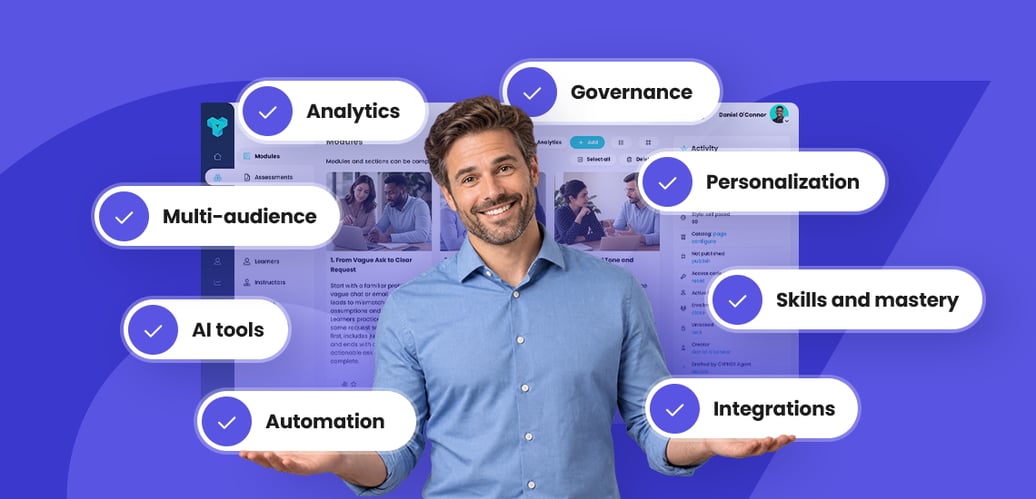
- Evaluate AI content creation, personalization, skills tracking, analytics, governance, integrations, localization, and automation as a connected system.
- CYPHER Learning unifies course creation, delivery, skills mapping, and analytics in a single AI-powered platform built for enterprise scale.
- Pilot programs and reference calls expose performance gaps that demos and sales presentations cannot surface on their own.
Why AI enablement platform selection is harder than it looks
Every vendor in the enterprise learning space now claims AI capabilities. The labels sound similar: AI-powered course creation, intelligent recommendations, adaptive learning. Line up five platforms side by side and the feature matrices blur together.
That similarity is exactly the problem. Feature lists describe what a platform can do in isolation. They don't tell you how content quality holds up after 500 courses, whether personalization algorithms improve learner outcomes over time, or how the system handles 10,000 concurrent users across three continents.
According to research from Josh Bersin, 74% of companies report they are not keeping up with demand for new skills. That gap underscores why selecting the right platform matters more than ever.
Why feature lists do not show performance at scale
A demo environment with 50 test learners will always look polished. The real test happens when your compliance team in Frankfurt needs German-language courses built from internal policies, your sales enablement team in Chicago needs role-specific coaching scenarios, and your customer training group in Singapore needs branded portals with localized content. All running at once.
Scale exposes what feature lists conceal. Content quality degrades. Admin workflows bottleneck. Reporting fragments across business units. Learner engagement drops because the "personalization" turned out to be basic rules rather than contextual intelligence. Evaluating a platform means testing for these realities, not ticking boxes on a spreadsheet.
What an enterprise AI enablement platform should help you do
Before you evaluate specific capabilities, it helps to define what you're actually buying. An enterprise AI enablement platform is not a content library with a chatbot bolted on. It's the operational system that connects your organization's knowledge to the people who need it, in the format they need, at the moment they need it.
Turning knowledge into capability
Most organizations have more knowledge than they can distribute effectively. Your subject matter experts hold critical information in their heads, in slide decks, or scattered across SharePoint and Google Drive. The platform's job is to transform that fragmented knowledge into structured, skills-aligned learning experiences people can apply on the job.
That means the platform needs to do more than host content. It needs to help you create from existing materials, map content to specific skills and competencies, deliver it in context, assess whether learners can apply what they've learned, and measure the business outcomes that follow.
Why buyers need more than isolated AI tools
Some organizations try to solve the enablement challenge by assembling point solutions: one tool for course authoring, another for skills assessment, a third for analytics, and a separate AI assistant for learner support. These tools don't share data, don't maintain a unified learner profile, and create overhead that grows with every new integration.
One platform means a single system where course creation, delivery, skills tracking, analytics, and learner support are connected. When a learner completes a coaching simulation, skills data should update automatically. When an admin creates a new compliance course, skills mapping should be built in, not bolted on afterward.
That connected architecture is what separates an enablement platform from a collection of tools.
Core capabilities to evaluate in every buying process
The following eight capability areas form the backbone of a thorough evaluation. Each one matters on its own, but pay particular attention to how they work together. A platform that excels in content creation but struggles with analytics, for example, will leave you building courses you cannot measure.
AI content creation and content quality controls
AI-powered course creation gets the most attention in vendor demos. But the real evaluation question isn't "can the AI generate a course?" It's "can the AI generate a course that meets your quality standards from your own source materials?"
Look for platforms that let you create courses from your internal documents, policies, and subject matter expert recordings rather than relying solely on broad prompts. CYPHER Learning, for instance, lets course creators build from company-provided files, turning compliance policies and process documents into structured learning experiences.
The platform also includes AI Crosscheck, a dual-model validation system that flags hallucinations and inaccuracies before content reaches learners.
Ask vendors how they handle content accuracy, what editorial controls sit between AI generation and publication, and whether course creators can intervene at each step rather than accepting a single generated output.
Personalization and in-the-moment support
True personalization goes well beyond recommending courses based on job title. It means adapting learning experiences to what each person already knows, what they need next, and how they prefer to engage.
Evaluate whether the platform delivers contextual, in-the-moment support. If a sales rep is preparing for a client meeting, can they ask the system a question and get an answer grounded in your organization's training materials? When a new hire is stuck on a process, can they get coaching without searching through a course catalog?
The difference between a recommendation engine and a genuine personalization system comes down to the depth of learner data the platform uses. Platforms that track skills progression, assessment results, and engagement patterns personalize far more effectively than those that rely only on role and enrollment history.
Skills and mastery tracking
Tracking course completions tells you who showed up. Tracking skills mastery tells you who can actually do the work. That distinction matters for every L&D leader who needs to demonstrate business impact, not just training activity.
Look for platforms that connect learning activities to a defined skills framework, use multiple assessment types to verify proficiency, and provide a consolidated view of mastery across your organization.
CYPHER Learning, for example, provides a mastery grid that shows skills proficiency across all learners in a single view. That lets L&D teams identify gaps and focus development where it has the greatest impact.
Here are a few questions worth asking: does the platform support competency-based learning? Can skills be mapped automatically during course creation, or does that require manual tagging after the fact? How does the system differentiate between someone who completed a course and someone who demonstrated proficiency?
Analytics and measurable outcomes
Your executive team doesn't want to know how many courses were completed last quarter. They want to know whether training improved time-to-proficiency, reduced compliance incidents, or lifted sales performance. The platform's analytics need to connect learning activity to business outcomes.
Evaluate the depth and flexibility of reporting. Can you build custom reports that align with your specific business KPIs? Does the platform offer pre-built reports for common use cases like onboarding effectiveness or compliance readiness? Can you segment data by business unit, region, role, or custom attributes?
Also consider how data flows out of the platform. If your organization uses a BI tool or HRIS for workforce analytics, the platform needs to integrate so training data contributes to the broader talent picture rather than sitting in a silo.
Governance, security, and control
AI introduces governance questions that conventional platform procurement didn't face. Who controls what the AI can and cannot generate? How is proprietary training content protected? What happens to your data when the AI processes it?
Evaluate the platform's administrator oversight capabilities. Can you restrict which topics the AI is allowed to address? Can you monitor how AI features are being used across your organization? Are there role-based controls that limit AI access by user group?
CYPHER Learning, for instance, provides administrator controls that let you set topic restrictions, monitor prompt usage, and limit AI access by group.
Data privacy is equally critical. Confirm that proprietary materials you use for course creation and learner interactions are not fed back to train the vendor's AI models. Your content should remain yours, and learner data should stay within your instance.
Integrations and workflow fit
An enterprise AI enablement platform doesn't exist in isolation. It needs to connect to your HRIS, CRM, content libraries, video conferencing tools, and authentication systems. The quality of those integrations determines whether the platform fits your existing workflows or creates parallel processes your team has to manage.
Go beyond asking "do you integrate with Workday?" Ask how deep the integration goes. Does learner data sync bidirectionally? Can enrollment be triggered by events in your HRIS? Does the platform support LTI, SAML, and your existing SSO infrastructure? You can explore the types of connections available through the CYPHER Learning integrations marketplace.
Consider the platform's API capabilities, too. As your tech stack evolves, you need a platform that can adapt to new integration requirements without waiting for the vendor to build custom connectors.
Localization and multi-audience delivery
Global enterprises need to deliver training in multiple languages, across multiple brands, and to multiple audience types: employees, partners, customers, and franchisees. This is where many platforms reveal their limitations.
Evaluate whether the platform supports real-time translation, branded sub-portals for different audiences, and localized content delivery that goes beyond simple language switching. Can you run employee onboarding in English, partner certification in Spanish, and customer training under a completely different brand, all from one platform instance?
CYPHER Learning supports 50+ languages with real-time translation and allows organizations to create fully branded, localized portals for each audience. This multi-audience capability reduces the need for separate platform instances and the administrative overhead that comes with managing them.
Automation and scalability
As your training operation grows, repetitive admin work becomes the bottleneck. Enrollment management, progress reminders, certificate issuance, compliance tracking, and reporting all consume time your L&D team could spend on work that actually moves the needle.
Evaluate the platform's automation capabilities. Can you build rules that automatically enroll learners based on role changes, trigger reminders when certifications are expiring, issue badges when competencies are met, and escalate non-completion to managers?
Scalability isn't just about handling more learners. It's about handling more complexity, more audience types, more content, and more business units without proportionally increasing admin effort. The right platform scales your operations, not just your user count.
Questions enterprise buyers should ask before they shortlist vendors
Once you've evaluated core capabilities, the shortlisting phase requires a different kind of diligence. These questions help you separate what the platform does from how it actually performs in your environment.
What to test in a pilot
A pilot is your chance to stress-test the platform against your real conditions, not the vendor's ideal scenario. Here are some areas to design your pilot around:
Content creation from real materials. Bring your own compliance documents, product guides, and SOPs. Evaluate the output quality, the human editing required, and the time from source material to published course.
Learner experience at realistic scale. Enroll a representative group of actual learners from different roles, locations, and comfort levels. Measure engagement and satisfaction alongside qualitative feedback.
Admin workflows under load. Have administrators perform actual daily tasks: enrolling users, pulling reports, and managing compliance deadlines. Note where the platform accelerates work and where it creates friction.
Integration behavior. Test the integrations you will actually use. Push data between the platform and your HRIS. Verify SSO and confirm that reporting data exports in the format your BI team needs.
Warning signs to watch for
Certain patterns during the evaluation process suggest problems you will face after implementation. Watch for these warning signs:
Demo-only capabilities. If the vendor cannot let you test a feature in a sandbox environment, it may not be production-ready. Ask for hands-on access, not just a walkthrough.
Vague answers about data privacy. If the vendor cannot clearly explain how your proprietary content is handled by their AI systems and what happens to your data if you leave, treat that as a significant risk.
Integration promises without documentation. "We integrate with everything" is not a technical answer. Ask for API documentation and references from customers using the specific integrations you need.
No customer references in your industry. If the vendor cannot connect you with customers who have similar scale and compliance requirements, proceed with caution.
Unclear total cost of ownership. Understand what is included in the base platform and what requires additional licensing. Evaluate cost over three to five years, including implementation, integrations, and support.
Choose for long-term capability, not short-term novelty
The AI enablement platform market will keep evolving. New features will launch, new vendors will emerge, and the language around AI in learning will continue to shift. That's precisely why your evaluation framework should prioritize durable capabilities over the novelty of any single feature.
Focus on platforms that connect content creation, personalization, skills tracking, reporting, governance, integrations, localization, and automation in a unified system. Test them against your real conditions, with your real content, and your real learners. Ask hard questions about data privacy, integration depth, and long-term scalability.
The organizations that choose well will build learning operations that scale with the business, close skills gaps faster, and demonstrate measurable impact to leadership. The ones that chase the flashiest demo will be shopping for a replacement in 18 months. Your evaluation framework is what separates those two outcomes.
Ready to see how CYPHER can support distributed training at scale?
Schedule your demo today!FAQs about evaluating an AI enablement platform
An AI enablement platform is a learning system that uses artificial intelligence to create, deliver, personalize, and measure training at enterprise scale. It goes beyond a conventional learning management system by connecting content creation, skills tracking, and reporting in one system. CYPHER Learning unifies these capabilities for corporate, academic, and training use cases in a single platform.
A conventional LMS primarily hosts and delivers pre-built courses. An AI enablement platform actively creates content from your source materials, personalizes learning to individual needs, tracks skills mastery rather than just completions, and provides contextual support at the moment of need. The shift is from managing courses to building organizational capability.
Start with content creation quality and accuracy controls, then evaluate personalization depth, skills and mastery tracking, and reporting that connect to business outcomes. CYPHER Learning addresses these areas through its AI course creation tools, Crosscheck content validation, mastery grid, and administrator controls that let you manage how AI is used across your organization.
Track metrics that connect learning to business performance: time-to-proficiency for new hires, reduction in course creation time and cost, skills gap closure rates, compliance completion rates, and learner engagement trends. The right platform gives you reporting tools that tie these outcomes to specific training programs and business units.
A pilot lets you test the platform against your real content, real learners, and real workflows. Demos show ideal conditions. Pilots reveal how the platform handles your specific complexity. CYPHER Learning offers guided demos and hands-on access so you can evaluate the platform with your own materials before committing.


