




Organizations can spend months debating how to build an AI training strategy while employees are already experimenting with AI every day.
That creates an uncomfortable gap.
People are learning through trial and error. Different teams are developing their own practices. Some employees are becoming sophisticated AI users while others remain uncertain about where to begin. Meanwhile, policies, tools, and use cases continue to change.
An AI Academy provides a way to bring structure to that experimentation. But it does not need to launch as an enormous organization wide transformation.
In fact, trying to build everything before anyone starts learning can slow progress considerably.
A more practical approach is to use the first 90 days to establish the foundation, create an initial curriculum, test it with a defined audience, learn from the results, and then expand.
The objective of the first 90 days is not to finish your AI Academy. It is to build a model that can keep developing after day 90.
Here is a practical roadmap.
Weeks 1 and 2: define the strategy before building training
The first two weeks should be about decisions, not course production.
Start by defining what the organization wants its AI Academy to accomplish.
That goal needs to be more specific than “make our workforce AI ready.”
Perhaps the immediate priority is establishing AI literacy across the organization. Another organization might already have strong adoption but need employees to use approved AI tools more effectively. A particular department may be ready for advanced AI upskilling while the rest of the workforce still needs foundational education.
Define the audience, desired capabilities, and business context first.
At this stage, identify the people who need to contribute to the academy. That could include learning leaders, AI leaders, IT, security, legal or compliance teams where appropriate, and subject matter experts from the functions included in the initial program.
The aim is not to create a large steering committee. It is to make sure the learning reflects the organization's actual AI environment.
By the end of week two, you should be able to clearly articulate who the academy is for, what capabilities it needs to develop, and which organizational priorities it supports.
Assess the skills you already have
Avoid assuming that everyone is an AI beginner.
Within the same organization, one employee may barely have opened an AI tool while another has already built it into several daily workflows.
Your starting point should reflect that variation.
Use assessments, surveys, interviews, existing learning data, or a combination of methods to establish a baseline. Look beyond confidence alone. Someone who describes themselves as an advanced AI user may be highly capable at prompting but less aware of verification, privacy, or governance considerations.
Consider capability across areas such as AI fundamentals, prompting, evaluation of AI generated information, responsible use, data awareness, practical application, and role specific skills.
Then map the desired skills.
A useful model is to separate them into three layers:
-
Foundational capabilities are relevant to most learners, such as AI literacy, responsible use, verification, and human oversight.
-
Role specific capabilities connect AI to particular functions, workflows, and responsibilities.
-
Advanced capabilities are intended for learners who need to move beyond everyday AI use into more sophisticated applications.
This skills map becomes the foundation for the curriculum.
Weeks 3 and 4: build the minimum viable curriculum
Once you understand the audience and skills, start creating learning.
Resist the temptation to build an enormous course catalog.
Your first curriculum only needs enough depth to establish the foundation and test the learning model.
For many organizations, that means beginning with AI literacy.
Learners might cover what generative AI is, what it does well, where its limitations lie, how to prompt effectively, why hallucinations happen, how to evaluate outputs, what organizational policies apply, and where human oversight is required.
Then add practical application.
This is where the curriculum should begin reflecting the work your pilot audience actually performs.
A sales pilot might include scenarios around approved research, account preparation, or communication workflows. Marketing could focus on ideation, analysis, research, and evaluating AI generated content. Managers might explore information synthesis and the appropriate use of AI when preparing for decisions or conversations.
The AI Academy should become progressively more practical as learners move beyond the foundations. CYPHER's approach similarly supports progression from AI literacy into practical use cases and role specific learning.
Build pathways instead of one enormous AI course
Weeks three and four are also the time to establish the basic architecture of the academy.
Think in terms of pathways rather than a linear collection of courses.
A learner might begin with foundational AI literacy before progressing into learning appropriate to their role and existing capability. More experienced users could eventually move into advanced material without repeatedly completing concepts they already understand.
CYPHER supports different learning paths based on factors including role, skill level, department, audience, and use case.
You can also decide how learners will demonstrate progress.
Courses, assessments, skills, certifications, badges, and other milestones can provide structure around the experience.
For the first 30 days, keep that structure understandable. A foundation path, an initial role specific path, and a clear milestone may be enough.
You are building the framework that can support a much larger curriculum later.
Use AI to accelerate development without removing human review
Speed matters when the subject itself is changing quickly.
By the time a lengthy traditional development process is complete, some AI examples, tools, or practices may already have moved on.
AI assisted course creation can reduce some of that production burden.
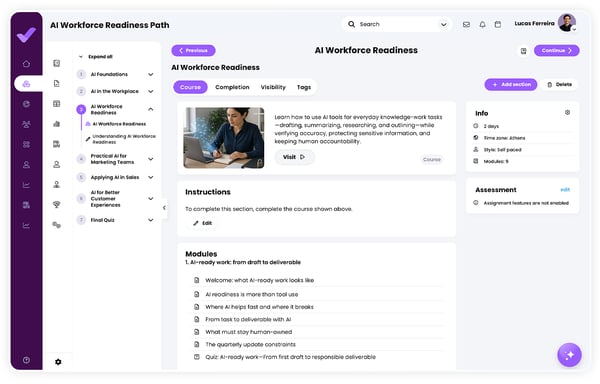
CYPHER Agent can help teams turn trusted organizational knowledge and resources into structured learning experiences, including course content, assessments, skills, and gamified elements.
The important word is help.
Subject matter experts still need to determine what is relevant, accurate, appropriate, and aligned with organizational policies. AI can accelerate the mechanics of developing learning without taking ownership of the learning strategy.
By the end of the first month, aim to have a usable curriculum rather than a theoretically perfect one.
Then put it in front of learners.
Month 2: launch a focused pilot
The second month is where assumptions meet reality.
Choose a pilot group large enough to generate useful feedback but contained enough that you can observe what happens.
The best pilot audience is not necessarily the team most enthusiastic about AI.
Choose a group that represents a meaningful use case for the academy. Ideally, the group has recognizable workflows where AI could be applied, supportive leadership, and enough variation in existing capability to test whether the learning works for different learners.
Establish your baseline before the pilot begins.
-
If you want to understand whether knowledge or proficiency improves, assess it before training.
-
If the intended outcome involves a particular workflow, understand how that workflow currently operates.
-
If you plan to measure AI adoption, establish current usage where appropriate data is available.
This creates something to compare against later.
Make the pilot about application, not completion
Completion data will tell you whether learners moved through the program.
Your pilot needs to tell you more.
Use assessments to understand whether learners can demonstrate the concepts and skills covered by the training. Gather learner feedback about which material was relevant, which was too basic, and where they still need support.
Most importantly, look for evidence that learning is beginning to enter the work.
The appropriate measures depend on the pilot.
You might examine whether employees are using approved AI tools, whether specific trained workflows are being adopted, whether learners can complete relevant tasks, or whether confidence and proficiency are changing.
Some of this information can come from the learning platform. Other evidence needs to come from AI applications, operational systems, surveys, manager feedback, or direct observation.
Do not force every outcome into the LMS.
The LMS can show what people learned and how they performed in the learning environment. Other systems help reveal what changed when they returned to work.
Use the pilot to find what you got wrong
A successful pilot is not one that validates every assumption made during the first month.
It is one that teaches you enough to make the next version better.
Perhaps employees already understood the introductory material and needed to reach practical applications sooner.
Maybe a role specific pathway turned out to be too generic.
Assessment results might reveal that employees understand prompting but struggle with verification.
A workflow that looked compelling during curriculum design may prove irrelevant in practice.
Those are useful findings.
Treat the pilot as product development for your AI Academy. Watch how people use it, identify friction, and improve the experience before expanding it.
This also establishes an important cultural expectation: the academy itself is going to evolve.
Month 3: measure capability, not just activity
By month three, you should have enough information to evaluate the first version of the program.
Start with learning data.
Look at participation, completion, assessment performance, skills development, and certification progress where relevant.
Then move outward.
Examine adoption of approved AI tools where data is available. Look at the workflows covered by the training. Gather feedback from learners and managers. If the pilot targeted efficiency or quality, compare the appropriate measures with the baseline established before launch.
Avoid rushing to claim ROI.
Ninety days may be enough to identify encouraging signals, but many business outcomes take longer to emerge and can be influenced by factors beyond training.
Instead, build an evidence chain.
Training participation should lead toward demonstrated proficiency. Proficiency should support workplace application. Application should eventually contribute to changes in performance and relevant business outcomes.
That is a much stronger story than reporting that 95 percent of the pilot group completed an AI course.
Decide what to keep, change, and remove
Before expanding the academy, make deliberate curriculum decisions.
-
Keep the learning that proved relevant and effective.
-
Improve areas where assessment results or learner feedback reveal gaps.
-
Remove material that is redundant, outdated, or unnecessary.
-
Add new learning around use cases that emerged during the pilot.
Then revisit the skills map from the first two weeks. You may discover that the organization needs capabilities you had not originally identified. Some skills may need greater emphasis. Others may matter only to a particular audience.
This is why an AI Academy should never be considered finished. New tools, use cases, policies, and learner needs will continue to emerge.
Iteration is not something that happens after the academy is built. It is how the academy stays useful.
Expand by audience, not simply by headcount
Organization wide adoption does not mean assigning the same curriculum to everyone.
Use what you learned from the pilot to build the next set of pathways.
Perhaps the foundational AI literacy program is ready to expand broadly, while practical training branches into sales, marketing, operations, customer service, or leadership.
You may also need different paths based on proficiency. Beginners can develop foundational capability while experienced users move directly toward more relevant applications.
Expansion can happen in stages.
The objective by day 90 is not necessarily to have every employee actively enrolled. It is to have a repeatable model for bringing new audiences into the academy without rebuilding the program from scratch.
That is what makes scaling sustainable.
Think beyond employees as the academy matures
An AI Academy can also expand beyond the workforce.
Customers may need help understanding AI capabilities within your products. Partners may need AI skills to sell, implement, or support your solutions. Associations and professional organizations may want to help entire communities respond to changes created by AI.
Bright MLS offers a useful example of this broader model.
Bright MLS serves more than 100,000 real estate professionals, and the Bright AI Academy, powered by CYPHER Learning, is designed to help that community build AI literacy, develop practical skills, and become more confident applying AI in their businesses.
It demonstrates an important point about scale.
An AI Academy does not have to stop at organizational boundaries. Once the learning model is established, it can support different audiences whose AI capability matters to the organization.
What should you have by day 90?
At the end of the first 90 days, your most important deliverable is not a huge library of AI courses.
You should have a defined AI capability framework, an initial skills map, a foundational curriculum, at least one practical pathway, a tested pilot, baseline and post training data, learner feedback, an initial measurement framework, and a plan for the next audiences and skills you want to develop.
You should also know considerably more than you did on day one.
You will have seen where employees struggle, which use cases resonate, which learning needs refinement, and where more advanced capability is beginning to emerge.
That knowledge is what allows the academy to move from pilot to sustainable program.
Day 90 is the beginning, not the deadline
The temptation with a 90 day roadmap is to treat day 90 as the finish line.
For an AI Academy, it should be the opposite.
The first 90 days establish the operating model.
You have defined the skills that matter. You have created an initial curriculum. You have tested it with real learners. You have begun measuring capability. Most importantly, you now have a process for learning from the results and improving what comes next.
From there, the academy can expand into new roles, new skill levels, new use cases, and eventually new audiences.
With CYPHER Learning, organizations can bring that journey together in one AI native learning platform, creating learning for different roles and skill levels, building assessments and skills into the experience, establishing certifications and milestones, and using CYPHER Agent to help accelerate the development of learning from trusted organizational knowledge.
You do not need 90 days to build every AI skill your organization will ever need. You need 90 days to build an AI Academy capable of developing with them.


