
Building your AI Academy with CYPHER
Turn AI interest into practical skills
AI is moving fast, and chances are your people are already using it. They may be experimenting with ChatGPT, trying new AI tools, sharing prompts with colleagues, or figuring out ways to automate parts of their work.
That is a good start. But experimenting with AI and knowing how to use it effectively are two very different things. For organizations, the next challenge is helping people move beyond casual experimentation. Employees, customers, partners, members, agents, and other audiences need to understand where AI can actually help them, how to use it responsibly, and how to apply it to the work they do every day.
That is where an AI Academy can make a real difference.
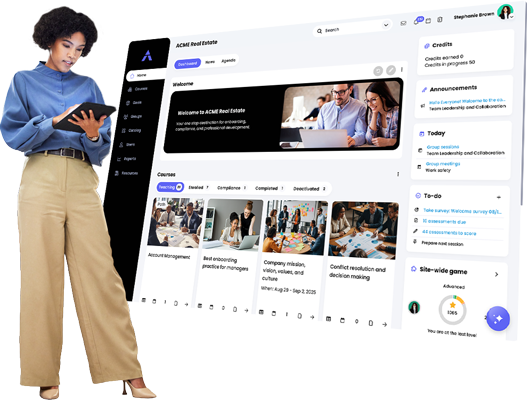
With CYPHER Learning, you can build an AI Academy that gives people a clear place to learn, practice, develop new skills, and become more confident using AI. As an AI Academy platform, CYPHER can help organizations turn scattered AI experimentation into structured, scalable learning. Instead of leaving everyone to figure it out on their own, you can create a structured learning experience around the AI skills that matter most to your organization. If you're exploring how to build an AI Academy, it starts with understanding your audience, the skills they need, and the practical ways AI can improve their work.
AI is changing work.
Training needs to keep up.
Most organizations no longer need to be convinced that AI is important. The conversation has already moved on. Now the questions are much more practical:
What should our people actually use AI for?
Which tools make sense for different roles?
How can AI help someone save time, make better decisions, communicate more effectively, or get more done?
What should people avoid doing with AI?
Where does human judgment still need to take the lead?
And how do we make sure people are not simply playing around with AI, but actually becoming better at using it?
Those are training questions.
An AI training platform gives organizations a way to answer them systematically and create learning that can grow alongside the technology.
Rather than sending employees to a webinar here, sharing an article there, and hoping everyone somehow pieces it together, you can give people clear learning paths based on what they need to know and what they need to do.
Someone brand new to AI might start with AI literacy training for employees, covering the fundamentals of generative AI, responsible use, security, and basic applications.
Someone who already understands the basics might move into role-specific use cases, advanced prompting, workflow development, or practical exercises.
Over time, the goal is simple: help people become more capable and confident using AI in situations that actually matter.
An AI Academy should be practical
There is plenty of information available about artificial intelligence. What is harder to find is training that helps someone sit down at work tomorrow morning and do something better. That is where an AI Academy becomes especially useful.
A salesperson might learn how to use AI to prepare for an account meeting, research a prospect, organize notes, or create a stronger first draft of a follow-up.
A real estate professional might learn how to save time on routine tasks, better organize information, or use AI to support marketing and client communication. AI training for real estate agents can be especially valuable because the technology has the potential to affect so many parts of their daily business, while giving agents more time to focus on clients and relationships.
A manager might use AI to summarize information, brainstorm ideas, prepare for a meeting, or improve a piece of communication before sending it to the team.
A customer might need training on the AI features inside a product they already use.
The use cases will look different from one organization to another, and that is the point. Your AI Academy should be built around the work your audience is actually doing. People do not need another generic explanation of how exciting AI is. They need help understanding how it applies to them.
See CYPHER in action
Not everyone in your organization needs the same AI training.
A beginner who has barely used generative AI should not necessarily receive the same experience as someone who has already incorporated it into their daily workflow.
The same goes for different roles.
A sales professional may need one set of skills. A marketer may need another. Managers, customers, partners, agents, and other audiences may all have different priorities.
CYPHER gives organizations the ability to create and deliver learning across those different audiences from one platform.
For companies developing enterprise AI training, that flexibility becomes especially important. Large organizations may need to support different departments, locations, job functions, customers, partners, and levels of AI experience at the same time.
That means your AI Academy does not have to become one massive course that tries to teach everything to everyone.
You can create different learning paths based on role, skill level, department, audience, or use case.
An AI upskilling platform can also help you move people through that journey over time. As learners become more comfortable with AI, they can progress into more advanced material rather than repeating information they already know.
That makes training more useful because people can spend less time sitting through information they already know and more time developing skills they can actually apply.
One of the obvious problems with creating AI training is that the subject itself keeps changing.
Tools improve. New features appear. New use cases become possible. Best practices change. Organizations develop new policies around what employees can and cannot do.
A traditional course development process can become slow very quickly. By the time a large training program has been created, reviewed, revised, and launched, parts of it may already need to be updated.
CYPHER can help reduce that burden. CYPHER Agent can help teams turn existing organizational knowledge and trusted resources into structured learning experiences, including course content, assessments, skills, and gamified elements. Teams can combine AI-assisted course creation with their own expertise and review process.
Your subject matter experts are still the ones who understand your business, your audience, and what people actually need to know. AI simply helps them move faster. That is particularly useful when you are building AI workforce training around a topic that may look noticeably different six months from now.
A modern AI training platform should make it easier to update training, add new use cases, and respond as your organization's AI strategy develops.
A strong AI Academy can start with the basics and become more advanced as your learners do.
Build a foundation
Start by making sure people understand what they are working with.
- What is generative AI?
- What is it good at?
- What is it not good at?
- What kinds of information should people be careful about entering into AI tools?
- What does responsible use look like inside your organization?
AI literacy training for employees can give people a common starting point and remove some of the uncertainty surrounding AI. That shared foundation matters. Before people can use AI confidently, they need to understand both what it can do and where they still need to apply their own judgment.
Move into practical use cases
Once people understand the fundamentals, training can become much more hands-on. Learners can work through prompts, workflows, real-world scenarios, role-specific examples, and different ways of incorporating AI into their existing work.
This is usually where AI starts becoming much more interesting. Instead of learning about AI as a concept, people start seeing where it can save them 20 minutes, improve a first draft, help them think through a problem, or make a repetitive task easier.
For organizations investing in AI workforce training, this move from understanding to practical application is critical. The goal is not simply to increase awareness of AI. It is to help people become better at their jobs because they know how and when to use it.
Create role-specific learning paths
AI is going to look different depending on who is using it.
- Your sales team may want help with research and communication.
- Your marketing team may be interested in content, analysis, and campaign workflows.
- Managers may want help processing information or preparing for conversations.
- Customers may need to understand how to use AI features inside your product.
- Real estate organizations may need AI training for agents that focuses on workflows, productivity, marketing, research, client service, and other practical applications specific to the industry.
There is no reason all of those people should receive identical training. Build the learning around what will actually help them.
Recognize progress
You can also give people a clear sense of progression. Courses, assessments, skills, certifications, badges, and other milestones can help learners see what they have completed and where they should go next.
For organizations, that creates something much more useful than simply saying, “We gave everyone AI training.” You can build an actual program around what people should understand, practice, and demonstrate.
For larger organizations, an enterprise AI training program can also give leadership greater visibility into how AI skills are developing across different teams and audiences.
Keep updating it
An AI Academy should never really be “finished.” New tools will arrive. People will discover new use cases. Your organization will learn what is working.
Learners who started with basic AI literacy will eventually be ready for more advanced training. You can continue building the academy as those needs change.
Bright MLS offers a good example of what this can look like.
Bright serves more than 100,000 real estate professionals and has been investing heavily in the role AI can play in the future of real estate. As part of that direction, Bright created its first Chief Artificial Intelligence Officer role and has talked publicly about becoming an AI-native MLS.
The Bright AI Academy, powered by CYPHER Learning, takes that strategy another step forward. The academy is designed to help Bright's community build AI literacy, develop practical skills, and become more confident applying AI in their businesses.
It is a powerful example of what AI training for real estate professionals can become when it is approached as an ongoing learning initiative rather than a one-time course.
That matters because giving people access to AI tools is only part of the equation. People also need to know what to do with them.
For Bright, that means helping real estate professionals understand how AI can become useful in the context of their actual work.
For another organization, the audience and use cases might be completely different. The model still applies. Give people the technology, then give them the knowledge and skills to make something useful out of it.
An AI Academy should not feel like another random piece of software your audience has been told to log into. It should feel connected to your organization.
CYPHER supports branded and white-label learning experiences, giving organizations the ability to create experiences for different audiences while keeping their own identity front and center.
That could mean training employees across your company. It could mean creating an academy for customers. It might serve partners, association members, agents, franchisees, contractors, or a much larger professional community.
The audience can be different. The goal is the same. Make it easy for people to find the training they need, understand why it matters, and apply what they learn.
For organizations looking for an AI Academy platform, this is an important part of the equation. The platform should support your learning strategy without making your academy feel separate from the organization that created it.
There is no single blueprint for how to build an AI Academy.
- You might start with an AI fundamentals certification for everyone in your company, then introduce more advanced tracks for specific departments.
- You might build an academy that helps customers learn how to use AI inside your products.
- You could create a certification program for partners.
- An association could use an AI Academy to help members understand how AI is changing their profession.
- A large organization might create separate programs for employees, managers, customers, and partners.
Or, like Bright MLS, you might use an academy to help an entire professional community build the skills needed to navigate a major shift in its industry.
It does not have to start out huge.
If you're thinking about how to build an AI Academy, start with the audience, skills, and use cases that matter most. See what people respond to. Measure what is working. Then keep building.
The right AI upskilling platform gives you room to expand as your strategy and your learners become more sophisticated.
AI adoption is already happening, whether organizations have formalized it or not. People are testing tools. They are finding shortcuts. They are asking colleagues for prompts. They are figuring out what works through trial and error.
You can leave that process entirely to chance. Or you can give people a better way to learn.
With CYPHER Learning, you can build an AI Academy around your own knowledge, audience, brand, and business goals. Whether you're developing enterprise AI training for a global workforce, AI literacy training for employees, AI training for customers and partners, or a specialized program for an industry like real estate, CYPHER gives you a platform for turning AI education into an ongoing learning experience.
Help beginners get comfortable with AI. Give experienced users more advanced skills. Create learning for different roles and audiences. Update training as AI changes.
And most importantly, help people move from experimenting with AI to actually knowing how to use it.
Ready to build your AI Academy? See how CYPHER can help you create and scale an AI training platform built around the way your people actually work.
Schedule a demo